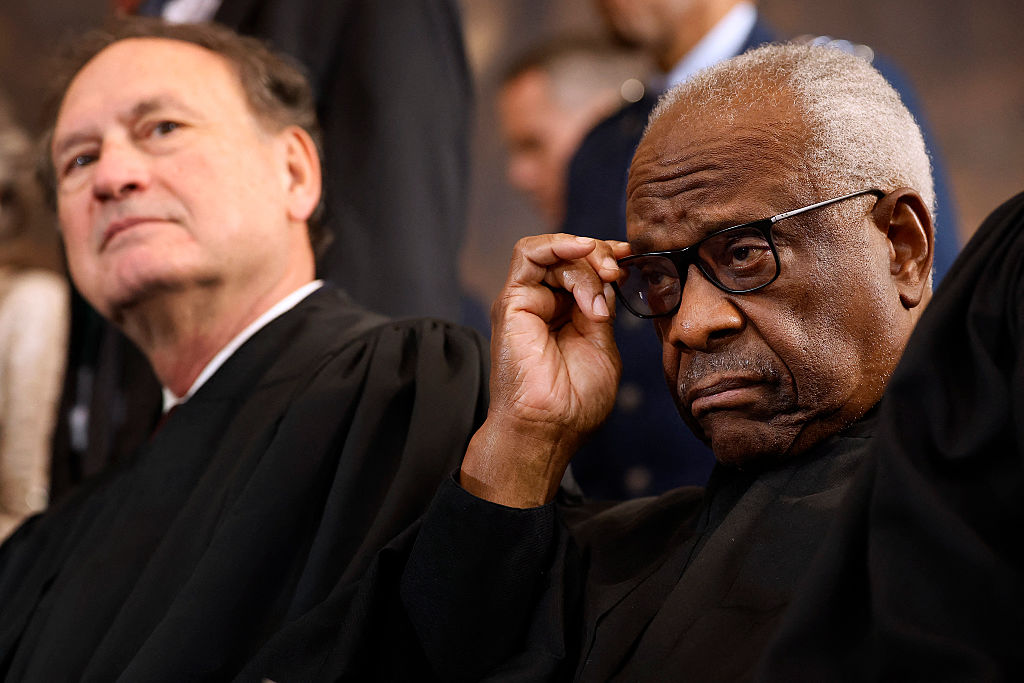



Supreme Court Justices Samuel Alito and Clarence Thomas issued a sharp dissent after the court declined to hear a case they argued could require police officers to apply different legal standards based on a person’s race.

According to Fox News, the case, United States v. Donte J. Carter, centered on whether police unlawfully seized Donte J. Carter before they had reasonable suspicion to detain him. The Supreme Court declined to review the decision, leaving a ruling from the District of Columbia Court of Appeals in place.

Writing for himself and Thomas, Alito argued that the lower court’s reasoning conflicts with the principle that government officials should not treat people differently because of race.

“It is dangerous to allow an individual to be treated differently based on statistics, studies, or expert testimony that purports to show that members of the racial or ethnic group to which he belongs are more likely to act in a certain way than are members of other groups,” Alito wrote. “Here, the special treatment helped the individual; in other situations, it will not.”

The D.C. Court of Appeals concluded that Carter’s race was relevant in determining whether a reasonable person in his position would have felt free to end an encounter with police.

The court cited research suggesting Black Americans are often more distrustful of law enforcement and may be less likely to believe their constitutional rights will be respected during interactions with officers. Based on that reasoning, it ruled that Carter had effectively been seized before police had the legal justification to do so.

As a result, Carter’s convictions on firearm and theft-related charges were vacated.

Advertisement

According to court records, officers approached Carter and asked whether he was carrying a weapon. He responded that he was not. Police then instructed him to pull up his pants, at which point they noticed an L-shaped bulge that was later identified as a .40-caliber handgun. Prosecutors said the firearm had been stolen from an FBI agent’s vehicle.

Alito argued that the lower court’s decision creates constitutional problems by requiring officers to consider race when evaluating encounters with the public.

“Under the test, officers will need to quickly assess a person’s race,” he wrote. “We have said that our ‘Constitution is color-blind.’ It ‘almost never’ allows government actors to treat persons differently based on their race.”

His opinion cited several Supreme Court precedents, including Students for Fair Admissions v. Harvard, Louisiana v. Callais, and Shaw v. Reno, arguing that constitutional protections should be applied equally regardless of race.

Because the Supreme Court declined to hear the appeal, the D.C. Court of Appeals’ ruling remains in effect.