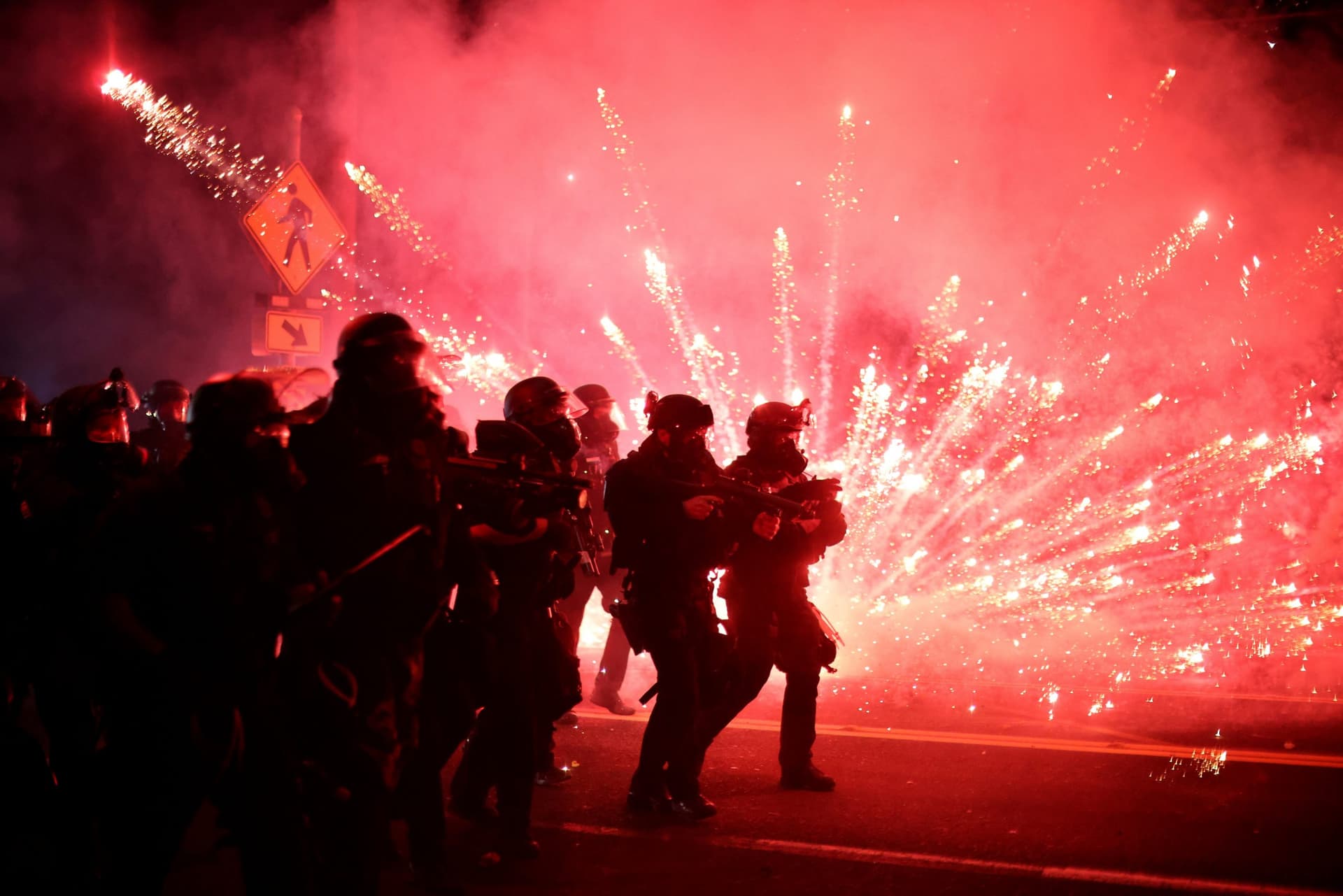
Of all the police departments that have been tossed about by the waves of the past year’s unrest, Portland, Oregon’s might have had it the worst. Now, it could be coming under federal control, thanks to the terms of a 7-year-old agreement with the Department of Justice.
According to a report in The Oregonian from April, the problem stems from a settlement the Portland Police Bureau reached with the DOJ in 2014 regarding its use of force against mentally ill individuals. At the time, Portland agreed to changes in training, use-of-force practices, Taser policies and investigations into potential misconduct.
The problem arose during the riots and protests in the city last year and dealt with how the PPB reported instances of police use of force to the Department of Justice.
KGW-TV anchor Dan Haggerty reported Tuesday that “the Justice Department logged more than 6,000 separate instances of use-of-force with PPB” during the relentless sturm und drang in the Pacific Northwest city.
“Each one of those is supposed to be logged in a very specific way and, according to DOJ, they weren’t, or at least that’s how it appears. The DOJ sent a warning letter to Portland police demanding a response and the city has until Friday to explain themselves and present a plan,” Haggerty reported.
However, a civilian officer who oversees the Police Bureau’s Office of Inspector General, Mary Claire Buckley, said the bureau never had to “write up our plan” before and it would take some time, according to a report in The Oregonian from March.
Furthermore, many of the lapses in logging can be explained by the exigencies of last summer’s riots, which were felt acutely in Portland.
For instance, under the DOJ’s reporting scheme, officers have to fill in a report for data collection purposes if they use force and file it at the end of their shift, noting what happened and why they did it. Supervisors are also supposed to complete their own separate report after the use of force incident. Neither happened with great frequency.
“We were overwhelmed by the unprecedented protest activity,” Buckley said during a public forum in March, according to The Oregonian. “No other city in this country had 171 straight days of protest activity.”
Whereas a normal month would see 40 use-of-force reports, June 2020 alone saw more than 3,000, Buckley said.
“It was not that the bureau didn’t have a system. It’s not that we deliberately didn’t do the work,” Buckley said at the forum. “It was just that there was so much of it that we couldn’t keep up.”
However, that could mean the federal government could come in and take over the Portland Police Bureau — something Jason Renaud with the Mental Health Association of Portland told Haggerty might be justified.
“We haven’t heard from the city of Portland. That’s what the DOJ has asked for,” Renaud said.
“They have asked the city to respond, if the city is not willing to do that, and they haven’t been willing so far, then the issue goes to mediation, which has not been successful in the past. And if it does, isn’t successful in mediation, then the Police Bureau will go into the hands of a federal judge.”
And yet, during the seven years the settlement’s been in place, Portland hadn’t been brought back before U.S. District Judge Michael H. Simon, the judge overseeing the settlement. In April, that changed with a formal notice of non-compliance. Portland has until Friday to respond, as previously noted; if the city remains at loggerheads with the DOJ, yes, mediation comes first. After that comes a judge — and the police department could well pass into the hands of the federal government if it’s not pleased with the progress Portland is making.
The issue remains that the Department of Justice’s reporting guidelines for logging use of force are strict and, at least at the public forum in March, DOJ representatives didn’t appear sympathetic to the city’s plight.
“Having failed the system for investigation of force at the front end, you starve the accountability system on the back end,” said Jonas Geissler, one of the DOJ’s senior trial attorneys, said at the forum according to The Oregonian.
“Absent such data, I don’t know where we go yet from here,” Geissler said. “We’ll have to see.”
Assistant U.S. Attorney Jared Hager, meanwhile, said he was unnerved that the problems in data collection were happening years after the settlement was reached.
“Over the summer, it was revealed to us and for the city, the community and to the world really, that there is a systemic failure to implement some of the terms of the settlement agreement,” Hager said, according to The Oregonian.
The problem was, however, that the city was overwhelmed, not a systemic failure to meet its obligations. Intervention at the federal level, meanwhile, could mean the Portland Police Bureau would be under the control of President Joe Biden’s administration, where the potential for politicization would be massive.
After all, when the president has been talking up police reform and those in his corner are fond of defund-the-police sloganeering, are we to believe Portland’s police bureau won’t be treated as a whipping boy for anti-police sentiment, no matter what the facts maybe? It may be a dream come true for the new administration, but it’d be a nightmare for Portland’s Law Enforcement community. Overworked, overstretched, undermanned, unsupported — and now, a potential public relations tool for an overpoliticized federal government.
The feds and Portland can and should reach an agreement that doesn’t put the PPB on a collision course with potential federalization. The city’s officers — and its residents — deserve at least that much.
This article appeared originally on The Western Journal.