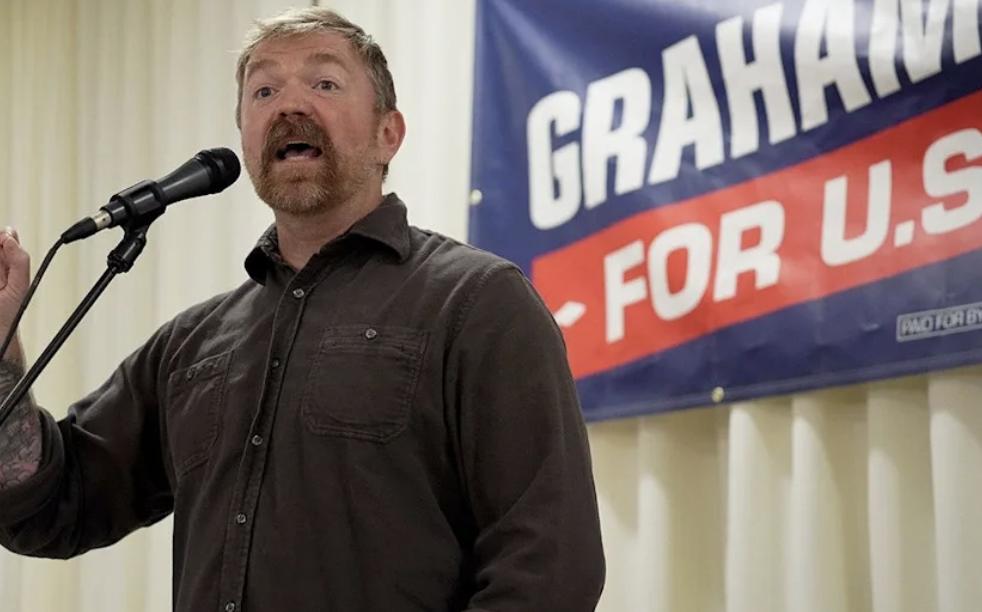



Graham Platner has endured one of the most difficult stretches of his U.S. Senate campaign, but on Tuesday he still secured the Democratic nomination in Maine.
Platner, a combat veteran and oyster farmer backed by progressive figures including Sens. Bernie Sanders of Vermont and Elizabeth Warren of Massachusetts, along with Rep. Ro Khanna of California, defeated two lesser-known opponents in the Democratic primary, according to the Associated Press.
Speaking to supporters at the Blue Hill YMCA after the race was called, Platner turned his attention quickly to Republican Sen. Susan Collins.
“Susan Collins said she would only serve two terms. She’s now running for her sixth,” Platner told the crowd. He cast his campaign as a challenge to political insiders in both parties, adding, “The truth is, Susan Collins doesn’t serve us. She serves Donald Trump. She serves the Epstein class.”
Platner will now face Collins, who ran unopposed for the Republican nomination, in a race that could help determine which party controls the Senate after the midterm elections. Maine is expected to be one of the most closely watched contests in the country.
Platner has campaigned on an economically populist message, criticizing corporate influence and arguing that Washington has failed working-class voters. He also defeated Democratic Gov. Janet Mills in the primary, although Mills had suspended her campaign earlier this spring. Her name remained on the ballot after she dropped out following weak polling and fundraising numbers. Mills had been supported by Senate Democratic Leader Chuck Schumer and the party’s Senate campaign arm.
“We’re going to win in November and we’re going to take power back for the people in this country,” Platner said at his final rally before the primary.
Still, his victory comes after weeks of controversy. Platner has faced scrutiny over old Reddit comments, a tattoo on his chest that resembled a Nazi symbol and has since been covered, reports that he exchanged sexually explicit messages with women while married, and allegations from former girlfriends involving violent behavior, heavy drinking, and rape fantasies. Platner has denied the latest allegations of violence.
A day before the primary, a former senior staffer on Platner’s campaign wrote in The Washington Post that Platner “is not someone who would be good for Maine or for the country.”
The controversies led some national Democrats to question whether Platner could remain viable in a general election. But Platner told supporters that Maine voters had stood by him through the attacks.
“When hurtful things I said on the internet a decade ago came out into the public as I shared my personal journey through PTSD and darkness of recovery and accountability and growth, Maine had my back,” he said Friday at a rally near his hometown in Down East Maine.
Platner has spoken openly about struggling with PTSD after three tours in Iraq with the Marines and one tour in Afghanistan with the Army National Guard. He apologized last fall after several of his Reddit posts resurfaced shortly after he entered the race.
He has also said he got the skull-and-crossbones tattoo in 2007 while drinking with other Marines in Croatia, and that he covered it after learning last year that it resembled a Nazi symbol. New allegations from an ex-girlfriend, however, have raised questions about when he became aware of the tattoo’s meaning.
Khanna, who appeared with Platner at a Friday rally, said he had spoken with the candidate about the allegations.
“I’m more concerned about making it clear that we’re opposed to misogyny,” Khanna told Fox News Digital. “Those relationships were toxic and volatile. There’s no excuse for that.”
Khanna said Platner told him he had been in a “very dark period” after returning from combat, but added that this did not excuse the behavior. He said Platner later found stability after coming back to Maine and working as an oyster farmer.
In his Tuesday night speech, Platner leaned into that argument, telling supporters that political change also requires believing people can change.
“And the reason I believe that is because I have lived it,” he said. “And the reason that I have lived it is because of my wife.”
Voters interviewed before the rally were split. Jeff, a conservative from Waterboro, said Platner carried too much baggage to be a strong candidate. Ellen, a registered Republican from Acton, said Platner was not perfect but believed he could still do the job.
Collins, meanwhile, told reporters Friday that the latest allegations against Platner were “troubling” and said he had “a lot of questions to answer.”
Republicans are already preparing to make Platner’s past a central issue in the general election. National Republican Senatorial Committee Chair Tim Scott said Platner’s win marked “the beginning of the end” for his campaign. The Republican National Committee has also highlighted the allegations against him.
So far, no major Democratic backers have withdrawn their endorsements. Khanna said Democrats need to stay focused on defeating Collins.
Platner has drawn large crowds and raised significant money, giving Democrats hope that Maine could become a pickup opportunity. But Collins has survived difficult races before. In 2020, polls showed her in serious trouble, yet she defeated Democrat Sara Gideon by nine points.
Collins, a moderate Republican, has occasionally broken with Donald Trump, including voting to convict him in his second impeachment trial and opposing Pete Hegseth’s confirmation as defense secretary. But Democrats continue to point to her 2018 vote to confirm Justice Brett Kavanaugh, which helped cement the Supreme Court majority that later overturned Roe v. Wade.