
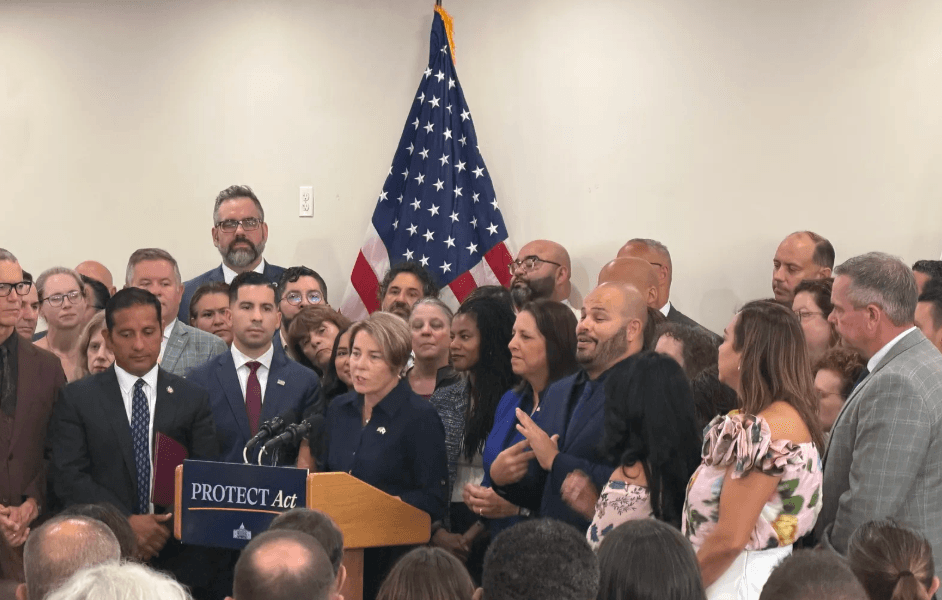
Massachusetts Democratic Gov. Maura Healey signed a new law on Aug. 5 aimed at limiting where U.S. Immigration and Customs Enforcement can operate across the state.
The legislation identifies schools, daycares, hospitals, health centers, nursing homes, and courthouses as locations where ICE activity is restricted. Healey has described the measure as the strongest law of its kind in the country, arguing that aggressive immigration enforcement has created fear in communities and discouraged people from using essential public services.
During the signing event in Chelsea, Healey said some children in the city have been missing school because their families are afraid of possible encounters with ICE. She also claimed that some residents have avoided medical appointments or stayed away from courthouses out of concern that federal immigration agents could be present.
“The law I’m signing today is a public safety law,” Healey told reporters.
She acknowledged that the country needs broader immigration reform and stronger controls at the border, but she also sharply criticized the tactics being used by ICE.
“We can also agree that ICE is so wrong in what it’s doing and ICE needs to be stopped, here in Massachusetts and around this country, just stopped in its tracks,” Healey said.
The new law comes as the Trump administration continues expanding immigration enforcement nationwide. ICE detentions reached their highest level of President Donald Trump’s second term in July, making immigration policy an even more contentious issue between the federal government and Democratic-led states.
The Department of Homeland Security pushed back strongly against Massachusetts officials.
In a statement provided to CBS News, a DHS representative accused state lawmakers of making communities less safe by limiting cooperation between local authorities and federal immigration officers.
The department argued that when state and local officials restrict law enforcement agencies from working with DHS, federal officers are forced to conduct more visible enforcement operations in communities. According to the statement, that happens because ICE agents must locate and arrest individuals after they have already been released from local custody.
DHS also pointed to cities that cooperate with ICE, claiming that seven of the 10 safest cities in the United States work with federal immigration authorities.
The dispute reflects a much larger national battle over sanctuary policies.
According to the Center for Immigration Studies, 15 states were considered sanctuary states as of June. The organization defines sanctuary jurisdictions as states, cities, or counties with laws, policies, regulations, or practices that interfere with or limit federal immigration enforcement.
Supporters of sanctuary policies argue that separating immigration enforcement from schools, hospitals, courts, and local police encourages immigrants to report crimes, seek medical care, attend school, and cooperate with authorities without fear of deportation.
Critics see the policies very differently. They argue that restrictions on cooperation with ICE make it more difficult for federal agents to detain illegal immigrants, including individuals with criminal records, and can result in offenders being released back into communities.
Massachusetts is now moving even further into that debate.
Healey is presenting the law as a public safety measure designed to keep federal immigration enforcement away from places where residents receive basic services. The Trump administration, meanwhile, is arguing that Massachusetts is creating additional obstacles for immigration officers and making their jobs more difficult.