
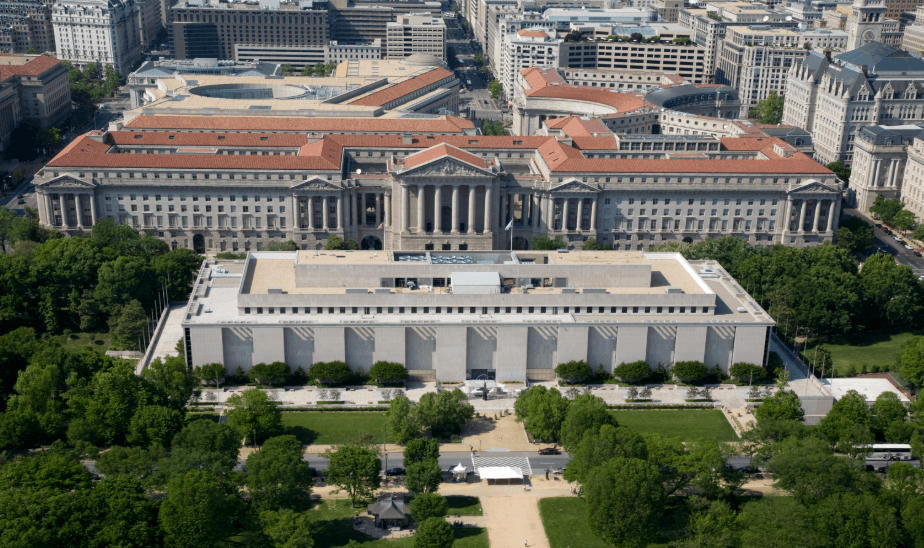
Hillsdale College professor Dr. Matthew Spaulding says the Smithsonian’s National Museum of American History has undergone what he describes as a complete ideological takeover, arguing that visitors can now walk through the museum without getting a clear sense of the nation’s history.
Speaking on “Washington Watch,” Spaulding said the museum has shifted away from presenting a broad chronological account of the American story and instead embraced a framework shaped by postmodern and critical theory.
“There’s really nothing there about America,” he said.
Spaulding argued that the change is not simply a matter of adding overlooked perspectives or correcting gaps in older exhibits. In his view, the museum has fundamentally changed the way it interprets history, treating the past less as a shared national inheritance and more as a political struggle over power, oppression, and identity.
His criticism closely mirrors the conclusions of a 162-page White House report released July 4. The report said the museum’s leadership had adopted an ideological approach that no longer presents American history primarily as a shared national story.
The review was conducted under President Donald Trump’s March 27, 2025, executive order titled “Restoring Truth and Sanity to American History,” which called for a broader examination of narratives presented at national museums and historic sites.
Spaulding said the most troubling part is not any single exhibit, but what has been pushed aside in the process.
“You can’t go there and learn about America,” he said, arguing that major historical events, figures, and themes have been either removed, minimized, or presented without enough context to give visitors a coherent understanding of the country’s development.
He pointed to exhibits dealing with gender identity, sexuality, race, and oppression as examples of material that he believes has taken on disproportionate importance. Meanwhile, he argued, traditional subjects associated with American political history and the nation’s founding receive less attention.
Spaulding also criticized the museum’s treatment of Benjamin Franklin, saying an exhibit raises questions about whether Franklin may have conducted electrical experiments on enslaved people despite, he said, a lack of evidence supporting the suggestion. He contrasted that with Franklin’s later involvement in the abolitionist movement, which he said receives far less attention.
His broader concern is that visitors are left with isolated themes rather than a meaningful historical narrative.
“You can get caught in the weeds of the particulars,” Spaulding said. “The particulars are shocking. But, when you put the particulars together and see what it’s replaced, it doesn’t tell American history.”
Critics of the Smithsonian have raised similar complaints for years. In 2022, The Washington Stand criticized the museum’s “Girlhood: It’s Complicated” exhibit, particularly its inclusion of transgender activist Jazz Jennings.
The Smithsonian also faced controversy in 2020 after the National Museum of African American History and Culture published a graphic discussing aspects of what it called “white culture,” including ideas such as self-reliance, the nuclear family, hard work, delayed gratification, and objective thinking. The graphic was later removed after widespread criticism.
Spaulding said these episodes should have prompted closer scrutiny much earlier.
He also pointed to changes in the Museum of American History’s mission statement. According to the White House report, earlier language emphasizing “American history” was replaced with wording focused on exploring “the complexity of our past” and empowering people to build “a more just and compassionate future.”
Spaulding sees that shift as evidence of a deeper philosophical change.
He said the approach is rooted in academic theories that reject permanent truths and view politics, culture, and history primarily through struggles for power. Under that framework, he argued, history becomes something to be rearranged according to present-day political goals.
FRC President Tony Perkins, who interviewed Spaulding, raised concerns about the Smithsonian’s influence on schools and young visitors. The institution receives significant federal funding and remains a major destination for student field trips, tourists, researchers, and scholars.
That influence, Spaulding argued, makes the debate about museum exhibits more consequential than a typical disagreement over academic interpretation.
The Trump administration has framed the issue in similar terms. In his executive order, Trump argued that historical revisionism increasingly portrays the United States as inherently racist, sexist, oppressive, or otherwise deeply flawed, while failing to give enough attention to the country’s advances in liberty, individual rights, and political freedom.
Supporters of the administration’s effort say the goal is to restore balance and ensure that national museums present both America’s failures and its achievements. Critics, however, may view the intervention as an attempt by the federal government to influence how historians and museum professionals interpret the past.
Spaulding said the debate carries particular weight as the United States marks its 250th anniversary.
For him, the central question is whether the Smithsonian will continue presenting American history primarily through the lens of modern ideological conflicts or return to a broader account of the people, events, ideas, failures, and achievements that shaped the country.