
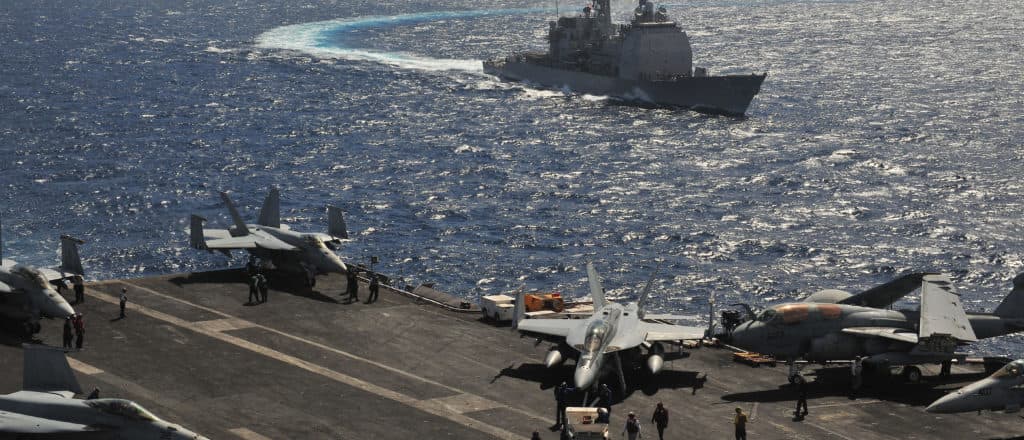

The U.S. Navy is showing off a new missile capable of reaching enemy aircraft nearly 300 miles away, but the service is revealing little about what the weapon will cost, how quickly it can be built or when naval aviators will actually get it.
The AIM-424 Long Range Air-to-Air Missile (LRAAM), nicknamed “Malice,” is being developed to strengthen fleet defense against increasingly long-range aerial threats, according to theNavy. But while the Navy has disclosed the Raytheon-built missile’s range, dimensions and intended role, key questions about its price, production capacity, procurement plans and operational timeline remain unanswered.
One military analyst told the Daily Caller News Foundation that he doubts these new “malice” missiles will be worth the price tag.
“I don’t think they are. This is the trajectory of all kinds of military tech,” Dan Grazier, the director of the National Security Reform Program at the Stimson Center, told the DCNF. “All of these things end up becoming orders of magnitude more expensive than what came before, especially with something like kind of an exquisite munition. There’s going to be a relatively limited market for these things. It’s possible that some of the other F-35 partner nations are going to order these, but that’s not a guarantee.”
The AI-powered fighter jet initiative, otherwise known as Collaborative Combat Aircraft (CCA), may be a more effective route for the U.S. Navy to defend its fleet, Grazier suggested.
“I’m not entirely sure that this is exactly the direction that the Navy really needs to be going with this kind of technology because at the same time we’re also producing the CCAs, the collaborative aircraft, the loyal wingman kind of systems,” Grazier told the DCNF. “If that concept works, then we could potentially be sending these uncrewed aircraft out a lot farther because those things are going to have more range than a missile fired from a manned aircraft.”
“What’s a better cost valuation? Is it to build the Loyal Wingman or to build the long-range missiles? This is the kind of trade-off that defense policymakers should be making, but far too often they don’t,” Grazier said. “Why buy one capability when we can buy both at twice the cost? That seems to be the general trend within the national security establishment.”
Grazier also pointed out that the concept of an extended range missile is legacy technology that has existed for decades. The Navy fielded a similar concept in 1974, when the F-14 Tomcat deployed with AIM-54 Phoenix missiles capable of engaging multiple aircraft at ranges beyond 90 miles, according to the Naval History and Heritage Command.
Malice is not the Navy’s only effort to extend the range of its air-to-air weapons.
The service also operates the AIM-174B Gunslinger, an air-launched version of the Standard Missile-6 currently deployed aboard F/A-18E/F Super Hornets and intended to engage high-value aerial targets at long ranges, according to theNavy.
The AIM-174B was the Navy’s first dedicated long-range air-to-air missile since the ancient AIM-54 Phoenix left service in 2004, according to a2025 Naval Aviation playbook.
“The whole idea of the CCAs is they’re supposed to be attributable, right? So we’re supposed to be willing to lose those, and so it just makes sense that if we can load up one of these CCAs with like existing missiles, and that concept works, and it provides the kind of capability that the services are looking for, then let’s make that investment and let’s perfect that rather than spending twice as much money … developing a kind of legacy system because that’s exactly what this concept is like.”
The Pentagon is also pouring billions into the AIM-260 Joint Advanced Tactical Missile, another next-generation air-to-air weapon.
The Air Force’s fiscal year 2027 budget request includes about $609 million in regular JATM procurement funding, while the service projects another $7.3 billion specifically for JATM procurement between fiscal years 2028 and 2031, according to Air Force budget documents.
The Navy is pursuing JATM alongside the Air Force, with its own fiscal year 2027 request including roughly $558 million in regular procurement funding, according to Navy budget documents.
“So the Navy does not have a very good track record, like budgeting track record over the last 25 years. So there’s been three outright failed shipbuilding programs between the Zumwalt , the Littoral Combat Ship and the Constellation class . I would argue that the USS Ford is also a failed acquisition program … that one just hasn’t been fully acknowledged yet,” Grazier told the DCNF. “This is a result of the pursuit of unreasonable technology, and so I don’t know. This missile might be yet another example of that. You know this is clearly a legacy capability. Again, a long-range, beyond visual range missile, fired from a manned aircraft.”
The Navy originally planned to buy 32 Zumwalt-class destroyers before cutting the class to just three as costs climbed, leaving each ship costing roughly $10.6 billion, more than seven times the original estimated unit cost, according to a 2025 Government Accountability Office report.
The Zumwalt’s railgun also ran into an extraordinary ammunition problem, as the price rose to roughly $800,000 per round while the planned fleet shrank to three ships, Defense News reported on Nov 6, 2016.
The U.S. Navy told the DCNF that the new missile will be developed for most of the new next-generation airframes.
“LRAAM will be compatible with Department of the Navy combat aircraft. Built for 4th-, 5th-, and 6th-generation platforms, LRAAM is designed for the air wing of today and the future,” a U.S. Navy official told the DCNF. “The program will continue normal development and testing activities. The Navy does not plan to provide routine updates beyond approved public releases because of operational security and program sensitivity.”
Malice weighs about 1,500 pounds and measures 13.5 feet long and 13.5 inches in diameter, according to theNavy. The Navy has not publicly disclosed when the weapon is expected to become operational.
“Strengthening fleet defense and maintaining superiority are essential to address rapidly emerging long-range air-to-air threats,” Naval News reported, citing Phil Jasper, the president of Raytheon. “Our Advanced Technology team’s approach is at the core of doing just that with the development of the AIM-424. With increased range, lethality, and combat effectiveness for naval forces, the AIM-424 delivers a generational leap in air dominance combat capability that can out range any threat.”
The new Malice missiles are designed to attack bombers with long-range missiles, which could be one of the biggest threats to U.S. naval assets.
“In a peer-to-peer war, such as a war with China, the primary threat to U.S. carrier battle groups is long range anti-ship subsonic/ supersonic cruise missiles and land based hypersonic antiship ballistic missiles,” Peter Layton, a visiting fellow at the Griffith Asia Institute, told the DCNF.
The service has already demonstrated that the missile can be carried internally by a stealth fighter. A Navy photograph released Saturday shows an AIM-424 mounted inside the internal weapons bay of an F-35C Lightning II alongside an AIM-120 Advanced Medium-Range Air-to-Air Missile mounted on the bay door, according to theDefense Visual Information Distribution Service.
“I think the Aim-424 is to improve fleet air defence against the cruise missile threats; it extends the engagement zone significantly,” Layton told the DCNF. “The missile will also push bombers further away; they will now avoid a USN carrier group by probably 400-500 miles (F-18/ F-35s placed up threat plus Aim-424 range).”
Very long-range air-to-air missiles could also threaten high-value support aircraft such as aerial refueling tankers and airborne command-and-control aircraft,Bloomberg reported, citing Layton. Such weapons drew greater attention in 2025 after Pakistan said it used Chinese-made missiles with a reported range of roughly 300 kilometers to shoot down Indian fighters,Bloomberg reported, citing Pakistan’s claims.
Engaging an aircraft from nearly 300 miles away would be “very difficult,” Layton told the DCNF. However, he explained that there are new technologies emerging that will allow target tracking over extended distances.
“The emerging approach is multi-sensor fusion, integrating radar, electronic emitter tracking, space-based sensors etc,” Layton told the DCNF. “By early next decade it is expected this will produce tracks accurate enough to support long range missile engagement. Third party engagements will become normal.”
The Navy says Malice is intended to preserve a “first look, first shot, first kill” advantage by giving U.S. aviators greater reach and tactical flexibility, according to theservice. The weapon was publicly unveiled Saturday at the Tailhook Symposium in Reno, Nevada,Bloomberg reported.
“ significantly improves fleet air defence and thus enhances fleet survivability,” Layton told the DCNF. “It will allow the CV group to remain operating during a war at about 750 miles from the Chinese mainland. Without it, the odds of survival would markedly less. This would be useful to run supplies into Taiwan in time of a protracted war in the face of a major Chinese air and missile threat.”
All content created by the Daily Caller News Foundation, an independent and nonpartisan newswire service, is available without charge to any legitimate news publisher that can provide a large audience. All republished articles must include our logo, our reporter’s byline and their DCNF affiliation. For any questions about our guidelines or partnering with us, please contact [email protected].