


Daily Caller News Foundation

The Federal Reserve held rates steady at its June meeting. That wasn’t the story.

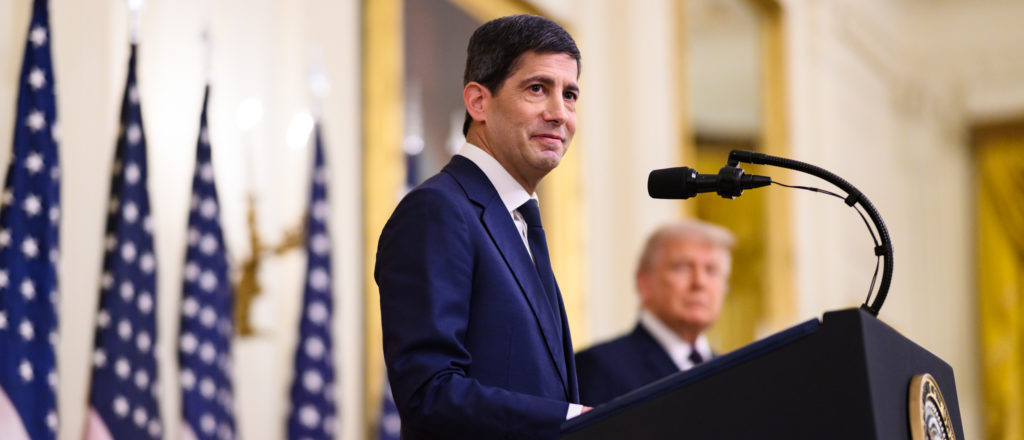
What mattered: Kevin Warsh sees a credibility crisis. The fix is to deliver on past promises, not signal the future.

I’ve known Warsh since 2002, when we worked in the White House. What struck me then, and again this week, is his instinctive skepticism toward Washington’s reflex to intervene

For five years, inflation ran above target. The institution charged with price stability watched prices climb while assuring the public it was “transitory.” It wasn’t.

At his first press conference as chairman, Warsh did something rare: he said what he meant. The statement is shorter; the language plainer. Forward guidance—the Fed’s habit of pre-announcing its intentions—is gone, with Warsh calling it “not well-suited to the current policy conjuncture.”

Forward guidance made sense in 2009, when rates were near zero. It outlived the emergency. Markets learned to watch central bankers more than the economy. Warsh is breaking that habit, consistent with his long-held view that discretionary, meeting-to-meeting policy amplifies the instability it’s meant to prevent.

Hampered by incomplete, imperfect information, and facing long and variable lags, central banks are ill-suited to discretionary fine-tuning amid exogenous shocks that can upend the best-laid plans.

Advertisement

The task forces Warsh announced are designed to refocus the institution, question past practices and get monetary policy right. Two stand out. The data task force asks whether the Fed relies on outdated information — survey methods built for a different economy, payrolls repeatedly revised, while private firms run on real-time data. The inflation framework task force asks whether the Fed has drifted from the discipline price stability requires.

Warsh was unambiguous. The 2% target isn’t up for renegotiation. “I see no reason,” he said, “until we have reestablished our commitment and ability to deliver on the 2% inflation objective to revisit that.” Good instinct. A target that bends under pressure anchors nothing. Price stability is a commitment, not a preference to trade away.

That approach shows up in his handling of the Summary of Economic Projections (SEP). Four times a year, FOMC members mark where they think rates are headed: anonymous “dots.” Calling the exercise “not helpful in the conduct of policy,” Warsh didn’t add his own. The omission said more than most dots do: a chairman declining to elevate forecasts over facts.

Warsh’s description of his colleagues’ projections as drawn “with pencils … those kinds with the big erasers” was an honest admission that forecasting is genuinely hard. Reporters pressed him for forward guidance, and he held his line without a single contradiction.

But shorter isn’t the same as disciplined. The debut had inconsistencies.

The statement still reaffirmed “maintaining ample reserves in the banking system.” “Ample reserves” is a phrase that defines almost nothing and commits the Fed to little.

The SEP has a similar problem. Years out, any FOMC forecast is mechanically pulled toward the Fed’s own targets. There is no scenario in which it diverges. That makes it closer to institutional faith than independent analysis. The projected path—inflation falling with almost no rise in unemployment, and little change in rates—describes a costless landing. Possible, but the Fed doesn’t earn credibility by assuming away trade-offs.

Advertisement

None of that undercuts the point. Say less, mean more; judge by outcomes. It’s the right instinct Warsh held long before he had the gavel. The task forces aim to put that into practice. Whether they do is the real test of this chairmanship.

The stakes are larger than a communications strategy. A central bank that misses its target can recover. Changing targets because they are inconvenient erodes credibility.

Warsh’s pledge that the FOMC is “unambiguous and unanimous” in delivering price stability matters because credibility, once lost, is far harder to rebuild than inflation is to measure.

There will be pressure to retreat — to restore forward guidance when markets wobble, to soften the 2% commitment when politics gets loud. Washington has a long memory for reform agendas that quietly stall.

Credibility isn’t restored by speeches or revised frameworks. It’s restored by results. “Change isn’t easy, change is filled with risk,” Warsh cautioned. “But our number one goal is to get monetary policy right.”

Warsh has defined success. Now he has to deliver it.

James Carter is a principal with Navigators Global. He served as a deputy assistant Treasury secretary (2002-06) and a deputy undersecretary of labor (2006-07).

The views and opinions expressed in this commentary are those of the author and do not reflect the official position of the Daily Caller News Foundation.

All content created by the Daily Caller News Foundation, an independent and nonpartisan newswire service, is available without charge to any legitimate news publisher that can provide a large audience. All republished articles must include our logo, our reporter’s byline and their DCNF affiliation. For any questions about our guidelines or partnering with us, please contact licensing@dailycallernewsfoundation.org.