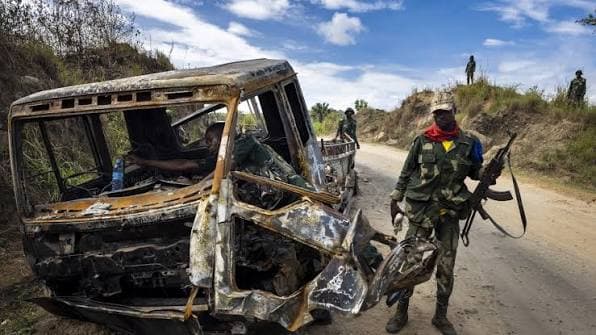
Now here’s a story that has barely broken through the headlines, and that’s remarkable considering the scale of what’s happening.
While much of the world’s attention has been fixed elsewhere, Christians in the eastern Democratic Republic of the Congo continue to face deadly attacks from an Islamic extremist group that rights organizations say is deliberately targeting believers. Last month alone, more than 20 Christians were killed during a series of assaults that left communities devastated and survivors pleading for prayers and protection.
According to Persecution.org, the attacks took place in mid-July when the Allied Democratic Forces, better known as the ADF, launched coordinated assaults on three communities in the region. The ADF, an Islamist militant organization with documented ties to the Islamic State, has been accused for years of carrying out brutal campaigns against civilians across eastern Congo.
One of the hardest-hit communities was the largely Christian commune of Mangina.
The town wasn’t attacked once.
It was attacked twice.
Mangina Mayor Nicolas Kambale said the terrorists entered the community armed with knives and firearms and specifically targeted Christians while setting homes on fire.
The first assault claimed six lives. Among those killed were a church elder and a worship leader. Six other people were wounded, and another resident was reported missing.
Then came a second attack.
Ten more people were killed.
According to survivors cited by Persecution.org, the attackers made no secret of their intentions. Victims said the Islamist extremists are seeking to eliminate the Christian presence in the region altogether.
And Mangina wasn’t the only place under attack.
Open Doors reported that militants also struck an area west of the city of Beni, killing seven civilians along with three members of the Congolese Armed Forces. The organization ranks the Democratic Republic of the Congo as the 29th most dangerous country in the world for Christians, pointing to escalating violence in the country’s eastern provinces.
The fear gripping local churches is difficult to overstate.
“Activities have slowed down,” Pastor Nkulu of Mangina said through Open Doors UK.
“Fear is increasing. Brothers and sisters, please intercede for the safety of the rural commune of Mangina and for the strengthening of the faith of Christians.”
That plea captures the reality facing many believers in the region.
According to Open Doors, eastern Congo has become a major center of Christian persecution because of the ADF’s continued campaign of violence. The organization says churches have been destroyed, Christians kidnapped, entire communities terrorized, and countless families displaced.
The violence extends beyond physical attacks.
Open Doors says Christian converts often face rejection from their own families and communities, pressure to abandon their faith, exclusion from inheritance, and intimidation if they refuse to participate in traditional religious practices.
Church leaders who publicly criticize corruption or advocate for constitutional rights also face significant risks.
According to the organization, Catholic and Protestant clergy who speak out can become targets of threats, surveillance, harassment, and public vilification, creating what it describes as a climate where calls for justice are increasingly silenced.
Human rights organizations have also documented the scale of the violence.
Amnesty International Secretary General Agnès Callamard said civilians throughout eastern Congo have endured killings, abductions, torture, and widespread abuse at the hands of ADF fighters.
She said militants have raided villages, attacked farms and medical facilities, looted property, and burned homes, worsening an already severe humanitarian crisis.
“The ADF’s violence is contributing to an escalating humanitarian crisis,” Callamard said, noting that the attacks have displaced families and disrupted access to food, healthcare, and education.
She added that the documented abuses constitute war crimes and, as part of what Amnesty describes as widespread and systematic attacks against civilians, may also amount to crimes against humanity.