
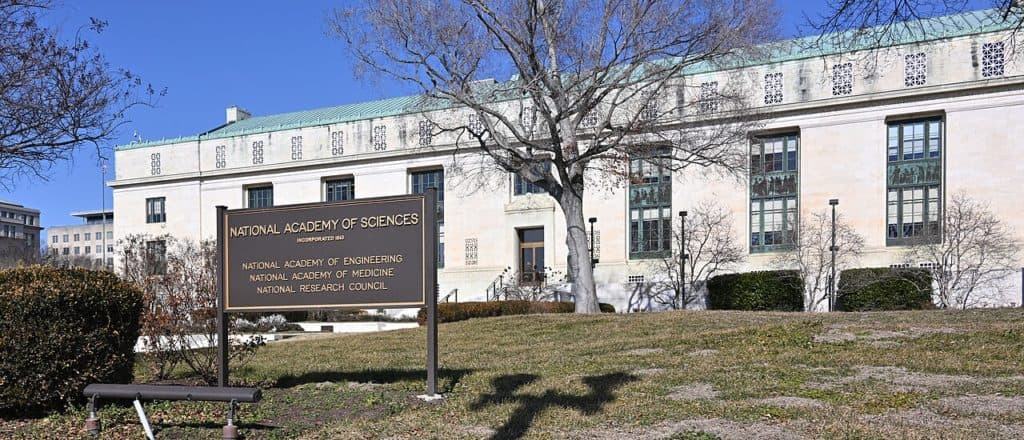

The National Academies of Sciences, Engineering, and Medicine produced a biased climate report designed to bolster lawsuits against fossil fuel companies, a coalition of state attorneys general alleges in a Thursday letter obtained by the Daily Caller News Foundation.
The attorneys general allege NASEM’s July report on attributing extreme weather events to climate change was shaped by funders, researchers and legal advocates connected to climate litigation — including the landmark Suncor Energy v. County Commissioners of Boulder County case now before the Supreme Court. The coalition is also aiming for NASEM’s handling of a separate review of its climate-related work, arguing the organization has failed to adequately address potential conflicts of interest.
“However, this review appears to be a sham, as demonstrated by NASEM’s secrecy around all aspects of the review process,” the Republican attorneys general wrote in their 12-page letter. “A truly independent review would appoint an external panel; use reviewers who are not activists, litigation participants, or NASEM employees; publish the review process and findings; identify the review’s scope; and ensure the review’s scope addresses the material criticisms of the Chapter.”
“In July, NASEM released a biased climate-attribution report, entitled ‘Attribution of Extreme Weather and Climate Events and Their Impacts 2026,’ to aid climate plaintiffs, including in the pending” Suncor case, the coalition alleged.
The dispute centers in part on the growing role of “attribution science,” which researchers use to assess how climate change influences the likelihood or severity of individual extreme-weather events. That research has increasingly intersected with litigation seeking to hold fossil fuel companies financially responsible for alleged climate-related damages.
NASEM’s report itself acknowledged potential legal applications for the science, according to the letter.
“Reinforcing its intended use in litigation, the Report states that attribution science ‘may be relevant to policy and legal decisions pertaining to climate change and liability for losses sustained as a result of extreme weather and climate events,’ may be ‘useful in estimating marginal damages attributable to climate change,’ and may inform ‘responsibility or liability determinations,’ including ‘whether defendants may be held liable’ in climate litigation,” the attorneys general wrote.
The attorneys general allege NASEM’s report entered that legal battle at a particularly consequential moment. The letter comes as the Supreme Court prepares to hear oral arguments in Suncor this October.
Boulder County and the City of Boulder sued Suncor Energy and ExxonMobil in 2018, seeking damages under Colorado law for alleged harms caused by climate change. The companies argue states cannot use state tort law to regulate alleged harms arising from interstate and international greenhouse-gas emissions and that such claims are governed by federal law.
“The timing of the Report’s release allowed plaintiffs’ amici in Suncor to cite the Report, but prevented critiques from defendants’ amici, whose filing deadline had passed,” the coalition wrote.
The letter specifically points to an amicus brief supporting the plaintiffs that repeatedly cited the NASEM report after its publication.
“Notably, one amicus organization supporting plaintiffs in Suncor bragged about the Report’s timing, cited the Report over and over on ten of its pages, and received $100 million to ‘accelerate climate action’ from the Bezos Earth Fund—which also funded NASEM’s Report,” the attorneys general wrote.
They stressed that agencies “may wish to look further into the nature of this convenient coincidence.”
“The National Academies took taxpayer money and used it to manufacture a scientific-sounding basis for climate lawsuits courts have already rejected, then timed a follow-up report to help plaintiffs in the Suncor case while locking out any rebuttal. Calling their own secret internal review ‘independent’ is a punchline,” Jason Isaac, CEO of the American Energy Institute, told the DCNF.
“Federal agencies shouldn’t need another minute to cut off funding to an organization laundering climate activism through the National Academies’ name,” Isaac continued.
In the letter, the coalition also singled out the organizations that financed NASEM’s report.
“Each of the Report’s three funders is connected to climate litigation,” the letter alleges.
The attorneys general point first to the Bezos Earth Fund, which helped fund the NASEM report and previously announced a $100 million grant to the Natural Resources Defense Council and $15 million to the Union of Concerned Scientists. Both organizations submitted amicus briefs supporting the plaintiffs in Suncor, according to the letter.
The coalition also highlights financier Robert Litterman and the Heising-Simons Foundation, alleging both have financial or organizational ties to groups involved in climate litigation.
“Another Report funder, Robert Litterman, is a board member and major funder for one of the nonprofit organizations that the government plaintiffs identify as providing ‘most of the legal work’ in Suncor,” the attorneys general wrote.
The letter alleges similar connections involving people who contributed input to the report, including Columbia University’s Michael Burger.
“The Report’s Acknowledgments section thanks Michael Burger, without mentioning that Burger is ‘Of Counsel’ for the Sher Edling law firm,” the coalition wrote.
Sher Edling has represented state and local governments in numerous climate lawsuits against fossil fuel companies. Burger also co-wrote an amicus brief in Suncor and worked on litigation involving Honolulu, according to the attorneys general.
“In other words, the Report gave the plaintiffs’ supporters exactly what they needed, exactly when they needed it, to further their litigation goals, without affording the other side an opportunity to weigh in,” the attorneys general alleged. “Agencies may wish to investigate this coincidence given the heavy overlap between the Report’s funding and development and the Suncor litigation.”
Bezos Earth Fund, the Heising-Simons Foundation, Litterman and Sher Edling each did not immediately respond to the DCNF’s requests for comment.
“The National Academies has a history of bias that will not be forgotten just because it’s feigning an ‘independent’ review of the controversial climate science chapter. Climate lawfare is a critical tool for trial lawyers and woke activists to weaponize the courts to push policy through lawfare,” O.H. Skinner, Executive Director of Alliance For Consumers, told the DCNF.
Skinner added that the activists “have built a huge dark-money-fueled apparatus to boost and support this lawfare and they don’t want to see this manual changed.”
“The Attorneys General are right to question NASEM’s federal funding and seek a charter review. As the Supreme Court prepares to hear arguments in the Suncor case, neutrality needs to be restored, and the radical left-wing apparatus behind these cases questioned at every turn,” he continued.
“Critics have demonstrated that the Chapter materially misquotes the IPCC, directly contradicts the manual’s statistics chapter, was apparently substantially ghost-written by climate plaintiffs’ attorney Michael Burger, and had funders, authors, and reviewers that included climate funders, activists, and litigation participants,” the attorneys general wrote in the letter.
The controversy has also drawn congressional scrutiny. The House Science, Space and Technology Committee previously raised concerns about NASEM’s conflict-of-interest policies.
“The Congressional committee further noted that NASEM’s January 2025 policy changes require NASEM committee members to merely disclose non-financial conflicts, such as professional and legal affiliations, with no protocol for mitigation,” the attorneys general wrote.
NASEM subsequently launched a review, but the attorneys general argue its structure and lack of publicly available information do little to address their underlying concerns.
The coalition is now asking federal agencies to consider whether those alleged problems justify cutting NASEM off from federal funding.
“Taxpayer money should not be funding NASEM’s biased actions, which warrant suspension or debarment,” the attorneys general wrote. “If NASEM continues to lend its imprimatur to litigation-driven advocacy, then Congress should find another source for objective analysis and consider revoking the 1863 charter that designates the Academies as an adviser to the federal government.”
All content created by the Daily Caller News Foundation, an independent and nonpartisan newswire service, is available without charge to any legitimate news publisher that can provide a large audience. All republished articles must include our logo, our reporter’s byline and their DCNF affiliation. For any questions about our guidelines or partnering with us, please contact [email protected].