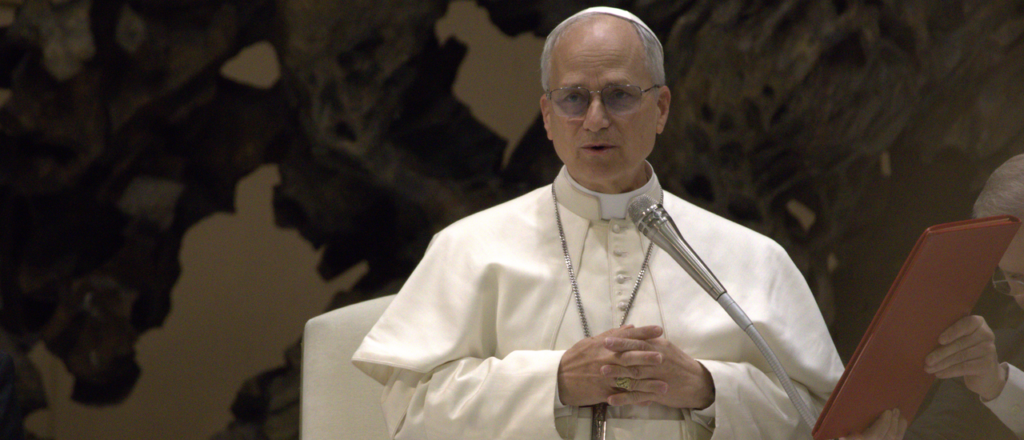
First US-Born Pope Champions America’s Founding During Award By National Constitution Center
With the United States on the cusp of celebrating 250 years independence, the first American pope was honored Friday by the National Constitution Center as its 2026 Liberty Medal recipient.
With the United States on the cusp of celebrating 250 years independence, the first American pope was honored Friday by the National Constitution Center as its 2026 Liberty Medal recipient.
Awarded annually to “men and women of courage and conviction who strive to secure the blessings of liberty for people around the globe,” the 38th Liberty Medal honors Pope Leo XIV “for his lifelong work promoting religious liberty and freedom of conscience and expression around the world—ideals enshrined by America’s founders in the First Amendment to the U.S. Constitution.”
The pope had been given the medal during a private April 30 presentation ceremony at the Vatican by an interfaith group led by National Constitution Center Interim President and CEO Vince Stango.
“I would just like to recall the words signed by the Founding Fathers of the nation 250 years ago in Philadelphia, in the Declaration of Independence, when they said that, ‘We hold these truths to be self-evident’ … that all men have received fundamental rights from our Creator,” the Holy Father said. “And they include life, liberty and the pursuit of happiness.”
“May those values continue to inspire us in the United States and throughout the world, and together, hopefully, we can all work that those freedoms will indeed be a part of the lives of all people everywhere,” he added.
Previous recipients of the medal include former Presidents Bill Clinton, George H.W. Bush, and George W. Bush, in addition to Ukrainian President Volodymyr Zelenskyy, Supreme Court Justices Ruth Bader Ginsburg and Anthony Kennedy, former Secretary of State Hillary Clinton, Arizona Senator John McCain, Alabama Rep. John Lewis, and imprisoned Catholic pro-democracy activist and media mogul
Sponsored
Sponsored
First US-Born Pope Champions America’s Founding During Award By National Constitution Center — IJR
The Friday ceremony, originally scheduled to take place in the shadow of Philadelphia’s historic Independence Hall where both the Declaration of Independence and the U.S. Constitution were signed, was moved inside the National Constitution Center due to extreme heat. Other participants in the ceremony included Democratic Pennsylvania Governor Josh Shapiro, Philadelphia Mayor Cherelle Parker, and Catholic Archbishop of Philadelphia Nelson Pérez, and other interfaith leaders.
Addressing the attendees from the Vatican, Leo began his 10-minute acceptance speech both identifying as an American and with the ideas and principles from the Declaration of Independence that launched the fledgling nation’s course through history.
“As a son of this great country, founded by courageous men and women who dreamed of liberty and of a better life for themselves and for their children, I join you in asking God’s blessings upon America’s future, that the lofty ideals enshrined at the beginning of the Declaration of Independence may continue to guide the flourishing of the nation in unity, justice and peace,” he said.
“As every American knows, however, the path to building a society that would embody those high ideals of liberty and justice for all was not always easy and, in many respects, is still a work in progress,” the pope continued. “Indeed, the effort to realize this vision is one that must be taken up anew in each generation and in the face of ever new challenges. Today, as we look to the future, this historic anniversary presents us with the opportunity to reflect once again on the nation’s founding principles in the hope that America will remain ever true to the dream that has earned it the title of land of the free and home of the brave.”
Recalling the efforts over the past 250 years to achieve the Founders’ vision for the U.S. making “‘America’ a byword for freedom,” Leo went on to praise the nation’s efforts to extend the possibility of freedom beyond its borders, including welcoming immigrants. The pope, the global shepherd of an estimated 1.4 billion Catholics, is notably spending July 4 at the Italian island of Lampedusa — a major entry point for migrants crossing the Mediterranean — to honor shipwreck victims and advocate immigration policies recognizing human dignity.
He also recognized that building a society which embodies the “high ideals of liberty and justice for all” was difficult — even requiring bravery — and “a work in progress” which must be “taken up anew in each generation and in the face of ever new challenges.”
Turning to the first right enshrined by the Founders, Leo observed that “no one who is deprived of life can enjoy liberty or pursue happiness. A country’s vitality is deeply tied to the value it affords to human life in every form and condition, acknowledging the dignity endowed upon every human person by virtue of their very existence.” He went on to reaffirm the need for laws which “recognize and safeguard this gift from the moment of conception to natural death.” In doing so, reverence for each human person would set apart any nation seeking greatness.
“In this regard, the moral greatness of a nation is manifested, above all, in its capacity to support, protect and cherish the lives of all, especially the most vulnerable and those whose worth is questioned,” he noted.
Turning to liberty, the pope observed that authentic freedom is, rather than a base desire to do anything, “founded upon the human person’s capacity to know the truth and adhere to what is good, even at great cost — a sacrifice well known to many who have labored to shape this country.” Such desires, in turn, inspire one’s search for — and the orientation of life towards — purpose, the meaning of life, and even God.
Finally, Leo praised how the American tradition of religious liberty facilitates “interfaith dialogue and interreligious cooperation in promoting the public good and enriching the debates on the great moral and ethical issues that have faced the nation and shaped the course of its history.”
He then expressed a hope for such common ground to bring about peace and reconciliation around the world.
The U.S., characterized by the nobility of heart and generosity of its people, thereby offers a model of being “united not by goals bound to momentary endeavors, but by ideals that do not fade with the passing of time.” The founding principles, the pope observed, give strength and guidance to pursue a better future.
Following perceived opposition to his approach to denying Iran its ambitions for a nuclear weapon, President Donald Trump lambasted the pope as “WEAK on Crime, and terrible for Foreign Policy ” during an April 12 tirade on Truth Social.
Leo responded the following day, appearing to dismiss media narratives of a rift between the two Americans.
“The things that I say are certainly not meant as attacks on anyone, and the message of the Gospel is very clear: ‘Blessed are the peacemakers,'” Leo said. “I have no fear of the Trump administration, or speaking out loudly of the message of the Gospel, which is what I believe I am here to do, what the Church is here to do. We are not politicians, we don’t deal with foreign policy with the same perspective he might understand it, but I do believe in the message of the Gospel, as a peacemaker.”
The pope has since continued a dialogue with the Trump administration, warmly welcoming Secretary of State Marco Rubio to the Vatican for a May 7 meeting.
All content created by the Daily Caller News Foundation, an independent and nonpartisan newswire service, is available without charge to any legitimate news publisher that can provide a large audience. All republished articles must include our logo, our reporter’s byline and their DCNF affiliation. For any questions about our guidelines or partnering with us, please contact [email protected].