
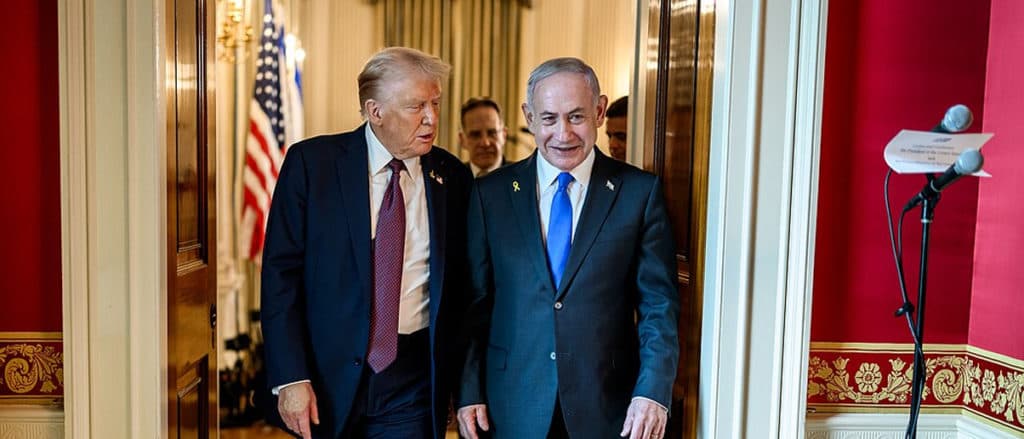
Israeli Prime Minister Benjamin Netanyahu admitted that he never asked President Donald Trump for permission before launching the first round of strikes on Iran in 2025, according to The Times of Israel.
Netanyahu said that he never asked Trump or the U.S. government about his planned strikes on Iran during the outbreak of the first round of bombing on Iran known as the 12-Day War, The Times of Israel reported, citing a translation of a speech he gave in Hebrew at the Muni Expo conference in Tel Aviv on Wednesday. The new development emerges as the Iran War stays temporarily paused under a fragile 60-day ceasefire, with no formal peace deal officially signed between the U.S. and Iran.
“I am not going to let that happen. And that is why we are acting. I did not ask for permission. I simply informed him of our plan,” The Times of Israel reported, citing Netanyahu’s speech on Wednesday. “I was pleased that he ultimately joined in toward the end of this very important action.”
Netanyahu’s comments cast fresh light on what Marco Rubio initially suggested to the press in March when this year’s U.S.-Israeli campaign began.
“We knew that there was going to be an Israeli action. We knew that that would precipitate an attack against American forces,” Rubio told reporters on March 2. “If we didn’t preemptively go after them before they launched those attacks, we would suffer higher casualties. This had to happen, no matter what.”
Rubio clarified the comment a day later, telling reporters the president “made a decision to go first because he concluded we were not gonna get hit first.”
“President Trump has a strong relationship with Prime Minister Netanyahu, and Israel has always been a great ally to the United States. There has been no greater friend to Israel and a fighter for peace than President Trump,” a White House official told the Daily Caller News Foundation. “The Israel Defense Forces were incredible partners in obliterating Iran’s nuclear facilities with Operation Midnight Hammer and decimating Iran’s military capabilities with Operation Epic Fury. Americans and our allies around the world are safer for the United States and Israel’s bold actions to deny the Iranian regime the ability to develop a nuclear weapon.”
“We are going into Iran, because I am not going to sit around waiting for our enemies – enemies who openly declare, at the top of their lungs, that they want to destroy us, and you too, by the way,” The Times of Israel reported, citing Netanyahu’s speech.
The Pentagon, the Israeli Embassy in Washington and the Office of the Israeli Prime Minister did not respond to a request for comment. The State Department referred to the White House.
Top Israeli government officials and academics have grown more critical of America as the U.S. government works to secure a final peace deal with Iran.
Israeli defense researcher Beni Sabti said the U.S. might need to suffer through an attack to renew U.S. support for Israel and remind Americans who their allies are in an X post on Saturday.
“Maybe USA needs another Pearl Harbor or 9/11 to remember who is the enemy and who is the friend,” Sabti wrote on X, before retracting the statement.
Sabti retracted the statement shortly after the DCNF published an article reporting on the X post.
“Trump’s agreement does not bind us. Israel is not subject to the United States, and we are an independent and sovereign nation,” Itamar Ben Gvir, Israel’s minister of national security, said on June 15, the Times of Israel reported.
The criticism from Israeli officials over the peace talks has prompted sharp responses from Vice President J.D. Vance.
“Donald J. Trump is the only head of state in the entire world who is sympathetic to the nation of Israel at this moment in time, and he happens to be the head of state of the world’s superpower,” Vance said on June 18 during a White House press briefing. “If I was in the cabinet of the Israeli government, I might not be attacking the only powerful ally that I have anywhere left in the entire world.”
Trump has also spoken about recent Israeli military action in Lebanon.
“You can do a little softer touch, Bibi,” Trump said on June 17 at the G7 summit. “I’m saying, when two drones are shot into the desert and dropped harmlessly, you don’t have to knock down buildings in Beirut.”
“They could behave better,” Trump said at the G7 summit. “But they could do a much better job with Hezbollah. On that, I don’t think they’re doing well, and I feel very bad for Lebanon.”
Israel recently renewed its military campaign against Hezbollah in Lebanon, just a few hours after a ceasefire had taken effect on June 20, Reuters reported, citing Lebanese Civil Defense.
Iran claimed the Israeli strikes violated the memorandum of understanding (MOU) between the United States and Iran, which calls for an immediate halt to hostilities between Iran, Lebanon, the United States and U.S. allies.
“The United States of America and the Islamic Republic of Iran and their allies in the current war, by signing this MOU, declare the immediate and permanent termination of military operations on all fronts, including in Lebanon,” the beginning of the MOU reads. “The final deal will confirm the permanent termination of the war on all fronts, including in Lebanon and other provisions of this paragraph.”
Netanyahu has signaled that Israel does not view a U.S.-Iran agreement as ending its campaign, saying, “With an agreement, without an agreement, Iran will not have nuclear weapons. Not today, and not tomorrow,” according to a June 15 X post from the Israeli prime minister’s office.
“Israel wants to attack Hezbollah, and they also are happy to screw up the ceasefire,” Defense Priorities Policy Director Benjamin Friedman previously told the DCNF. “They pushed us into the war, and they want us to continue it, even if it tanks the global economy.”
All content created by the Daily Caller News Foundation, an independent and nonpartisan newswire service, is available without charge to any legitimate news publisher that can provide a large audience. All republished articles must include our logo, our reporter’s byline and their DCNF affiliation. For any questions about our guidelines or partnering with us, please contact [email protected].