
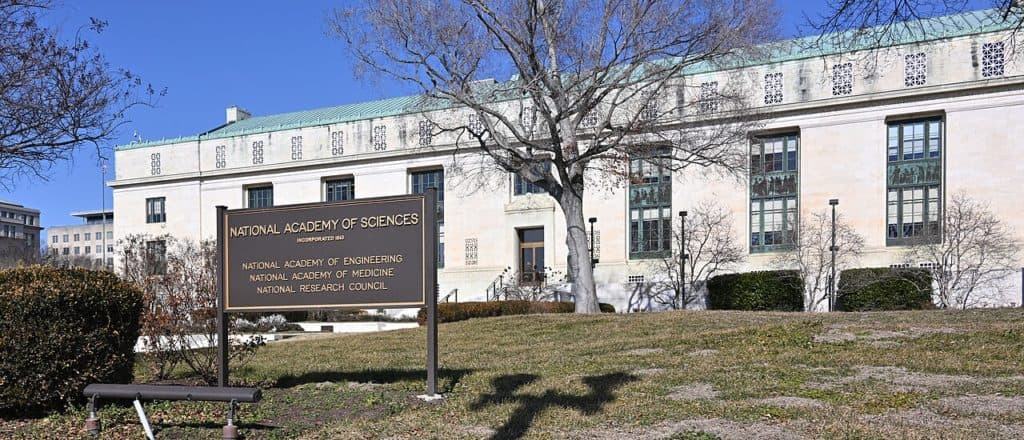

After six long months of pressure from state attorneys general, Congress, and even President Donald Trump, the National Academies of Science has finally withdrawn a controversial climate science chapter used to educate the federal judiciary. They removed it while conducting an independent review and it should stay that way because conflicts of interests are obvious.
The chapter was included for the first time in the Fourth Edition of the Reference Manual for Scientific Evidence, co-published alongside the Federal Judicial Center, and was authored and influenced by attorneys who are publicly supporting the plaintiffs in climate litigation against American energy companies. This is a clear conflict of interest and an overt attempt by climate activists to bias judges towards pro-plaintiff interpretations of scientific methods.
Unfortunately, the NAS remains intent on continuing to use flawed processes, and just last month published a climate attribution report where the litigation section was heavily influenced by the same attorney whose fingerprints were all over the judicial training manual.
That attorney is Michael Burger: a legal research scholar at the Columbia Law School, Of Counsel at Sher Edling LLP and counsel of record for the plaintiffs in Honolulu’s active climate lawsuit.
Burger presented during public meeting of NAS’s attribution science committee on the “Use of Attribution Science in Legal Contexts,” during which he disclosed that he is “actively involved” in Sher Edling’s cases against American energy companies. Sher Edling operates largely on contingency fees, meaning the firm and Burger stand to receive multi-million-dollar payouts from favorable rulings in the very cases that NAS attribution findings could influence.
That should have been enough to strike Burger’s comments from the record considering that NAS’s conflict-of-interest policy states that the organization develops and communicates its advice “free from undue influence from sponsors, donors, or other interested parties.”
Instead, Burger is listed in the report’s acknowledgements among individuals that “assisted” the authors and staff “in their task to create this report.”
Blatant disregard for an objective process is becoming a pattern at NAS. Burger was also an official reviewer and reported ghostwriter of the climate science chapter in the FJC and NAS scientific reference manual.
Attribution science has been questionable from the beginning. Developed to support litigation, it purports to show how climate change makes extreme weather more likely or more severe, but activists and plaintiffs’ attorneys have been conspiring for years to stretch the science to link global, historical emissions to individual companies.
This stretch is necessary for plaintiffs – and they have admitted as much – because if climate lawsuits go to trial, plaintiffs will ask judges to pin legal liability for emissions and weather events on individual energy companies.
Given climate plaintiffs’ obvious interest in legitimizing fringe versions of attribution science, it’s remarkable that NAS permitted activists and plaintiffs’ lawyers to play a role in developing the attribution science report.
So, if NAS isn’t going to police itself, then it’s time for Congress to step in.
The removal of the climate science chapter of the reference manual isn’t enough. The public deserves to know the details behind the process at FJC and NAS that allowed Burger and other litigation supporters to write and review the material despite their public positions favoring, or direct financial interest in, climate lawsuits.
Likewise, there needs to be clarification from NAS as to why Burger was allowed to contribute to the attribution science report even when he told the committee of his affiliation with Sher Edling.
The U.S. House Committee on Science, Space & Technology has a head start on this, and has opened an investigation into NAS’s adherence to conflict of interest policies.
And a parallel investigation from the House Judiciary Committee is probing Burger’s involvement with yet another judicial education scheme: the Environmental Law Institute’s Judiciary Project, which seeks to train judges on climate science. Burger, and other faculty members at Columbia’s Sabin Center, have been cited in or had direct influence over CJP’s modules which are presented to judges across the country.
But Congress cannot take its eye off the ball. Activists’ efforts to usurp public institutions are eroding decades of trust.
Taxpayer-funded government institutions like the NAS are designed to provide information, not open the door to conflicts of interests and plaintiffs’ lawyer paydays. If we want to ensure Americans have trust in our institutions and American companies are not being politically targeted through potential litigation, we need to ensure that NAS returns to unbiased science. Should NAS reverse their decision, there should be serious calls to permanently strip their funding.
All content created by the Daily Caller News Foundation, an independent and nonpartisan newswire service, is available without charge to any legitimate news publisher that can provide a large audience. All republished articles must include our logo, our reporter’s byline and their DCNF affiliation. For any questions about our guidelines or partnering with us, please contact [email protected].