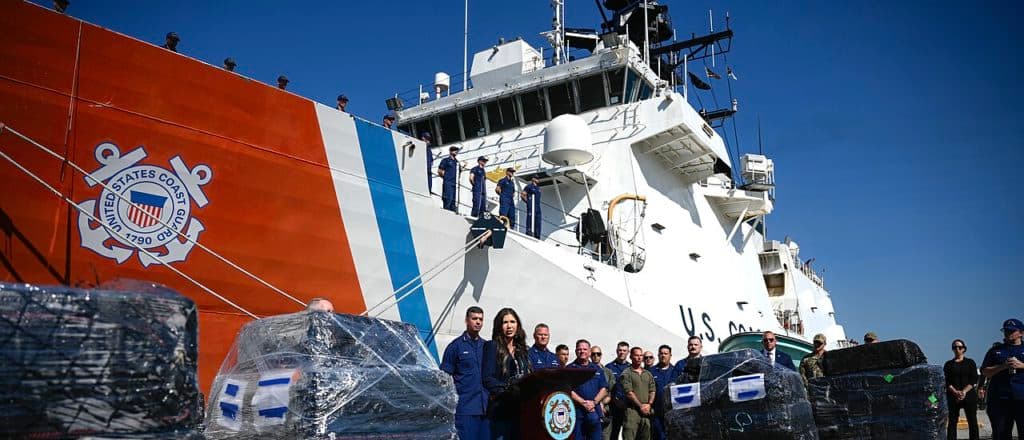

We just marked the 236th birthday of the United States Coast Guard. On August 4, 1790, Alexander Hamilton’s vision became law when Congress authorized those first ten revenue cutters. From that modest beginning, the service has grown into one of America’s five armed forces — guardians of our ports, interceptors of drug traffickers and human smugglers, icebreakers in the Arctic, first responders at sea and ready warfighters when the nation calls.
I spent over three decades in uniform, from enlisted EOD tech to B-1 squadron commander, wing commander and Joint Staff officer who was in the Pentagon’s National Military Command Center on 9/11. I know what real readiness looks like. I also know what institutional neglect looks like. And right now, the Coast Guard is still operating under a historical disadvantage that no other military service endures.
Every other branch of the armed forces has a dedicated civilian Service Secretary, Senate-confirmed, accountable to the president, focused solely on organizing, manning, training and equipping their force. The Army has one. The Navy has one. The Air Force has one. The Coast Guard does not. Its civilian leadership defaults to the Secretary of Homeland Security, who already carries an enormous portfolio covering everything from border security to disaster response to cybersecurity. That arrangement leaves the Coast Guard without a full-time political advocate at the highest levels of government.
This is not a theoretical problem. For decades it has translated into chronic under-resourcing, aging cutters and aircraft, recruiting shortfalls that only recently began to reverse, and a constant struggle for prioritization inside a massive department. The Coast Guard punches far above its weight, interdicting tons of narcotics, enforcing sanctions, conducting search and rescue, and preparing for great-power competition in the high north, yet it has lacked the institutional muscle to fight for the budget, the platforms and the authorities it needs.
Civilian control of the military is a cornerstone of our constitutional system. Creating a Secretary of the Coast Guard, reporting to the Secretary of Homeland Security and supported by an Under Secretary, would strengthen that principle, not weaken it. The position would mirror the authorities of the other Service Secretaries under Title 10, adapted to the Coast Guard’s unique multi-mission role under Titles 14 and 50. It would give the service a dedicated civilian leader to set strategic direction, oversee acquisitions, represent the force before Congress, and ensure seamless coordination with the Department of Defense in both peace and war.
This is not a radical idea. Former Homeland Security Secretary Kristi Noem has made establishing a Service Secretary a centerpiece of Force Design 2028, the bold plan to reverse the Coast Guard’s readiness spiral and grow the force. Secretary of War Pete Hegseth has endorsed it as essential for better integration across the national security enterprise. In July, Republican Sens. Rick Scott of Florida, Dan Sullivan of Alaska and Tommy Tuberville of Alabama introduced the Coast Guard Leadership Modernization Act to create the position in statute. Congressmen like Republican Rep. Mike Ezell, who represents the coast of the Gulf of America where I live in Mississippi, advocate for the idea and are leading House supporters. President Donald Trump should be able to nominate a Secretary promptly so the Senate can confirm and the work can begin.
Some will claim this adds bureaucracy. That argument ignores reality. The Coast Guard already operates under civilian authority; it simply lacks the focused civilian leadership every other service enjoys. A dedicated Secretary would cut through the dilution of attention that comes with competing departmental priorities. It would ensure the men and women who patrol our coasts, board vessels in the Caribbean, and break ice in the Arctic have a champion who wakes up every morning thinking only about their readiness and their mission.
As a combat veteran who has seen what happens when institutions are allowed to drift, I say this is a matter of national security and basic fairness. The Coast Guard has never asked for special treatment — only the tools and leadership structure necessary to do the jobs we demand of it. On its 236th birthday, Congress and the president have a clear opportunity to correct a long-standing institutional imbalance.
Pass the legislation. Nominate the Secretary. Give the Coast Guard the civilian leadership it has earned and still urgently needs. Our nation’s maritime security depends on it.
Col. Rob Maness, USAF-ret., is a decorated combat veteran and dynamic leader with over 40 years of experience steering complex organizations through high-stakes challenges. During his military service, Maness received eighteen major awards and decorations, including the Legion of Merit twice and a Bronze Star for combat leadership. Through Iron Liberty Group (2013-present), Maness consults, hosts “The Rob Maness Show” on the WorldViewTube Network, and drives digital initiatives, showcasing entrepreneurial adaptability. His leadership — forged in combat, proven in turnarounds and fueled by a knack for inspiring teams — marks him as a force for action and impact in any arena and is showcased in his book: “What You Can Do About It — Taking Real Action Against Corruption, Radicalism, and Moral Decay to Save America.”
The views and opinions expressed in this commentary are those of the author and do not reflect the official position of the Daily Caller News Foundation.
All content created by the Daily Caller News Foundation, an independent and nonpartisan newswire service, is available without charge to any legitimate news publisher that can provide a large audience. All republished articles must include our logo, our reporter’s byline and their DCNF affiliation. For any questions about our guidelines or partnering with us, please contact [email protected].