
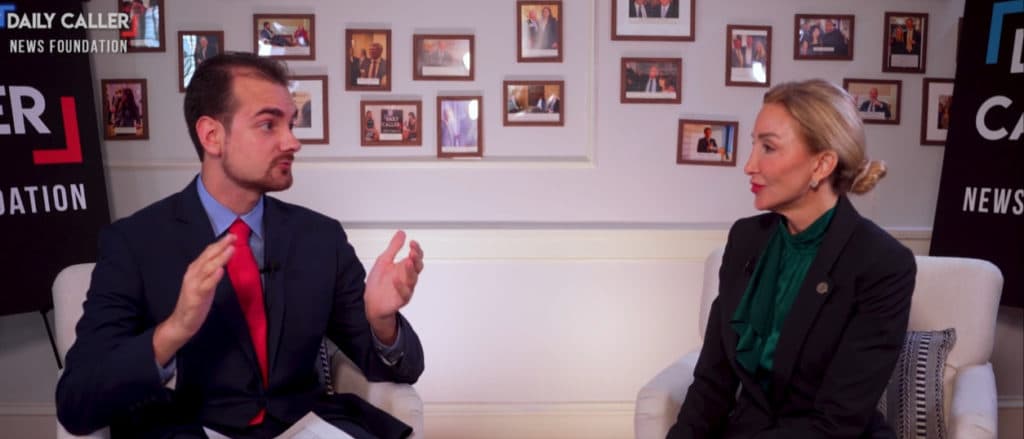

The architect of a key government initiative aimed at improving children’s health across several indicators told the Daily Caller News Foundation why the issue is especially important now and how it fits into the broader Make America Healthy Again movement.
Secretary Robert F. Kennedy Jr.’s Department of Health and Human Services (HHS) in May put out a U.S. Surgeon General’s Advisory “on the Harms of Screen Use .” In an interview with the DCNF, Principal Deputy Assistant Secretary for Health Stephanie Haridopolos called the document “a great success,” adding that it was “an opportunity of a lifetime and the capstone of my career to even be the architect of this advisory.”
Haridopolos is currently performing some of the U.S. Surgeon General’s duties while the office of the country’s primary public health spokesperson sits vacant, pending Senate action on President Donald Trump’s nominee, Dr. Nicole Saphier. The 53-year-old physician, who is married to Republican Florida Rep. Mike Haridopolos, told the DCNF her office could not have waited any longer to issue the warning.
“We searched all of the body of evidence, compiled it all in one place,” she said. “Pretty much ubiquitously, we are seeing consensus approval on this document where people are like, ‘Yes, this is a problem. Please let us know what we can do about it.'”
Haridopolos noted that HHS chose to focus on the physical harms resulting from increased screen use by children, such as obesity and nearsightedness, as well as mental health and behavioral issues.
Addressing the risk of vision problems, she cited estimatesshowing that, by 2050, nearly 40% of the world’s children and adolescents would be nearsighted, if current trends continue.
This is because young people “unfortunately are having close screens and not getting outside, getting the sunlight in their eyes,” Haridopolos told the DCNF. “Really, you need to get one or two hours of sunlight on your eyes and look on the horizon. Look past at least 20 feet away and not have the strain on your eyes.”
WATCH:
She also stressed that myopia — nearsightedness — will be a “big problem” for “future public health initiatives” because the condition often carries possible comorbidities such as macular degeneration, which affects the small part of the retina at the back of the eye which controls sharp, straight-ahead vision.
Haridopolos also said the proliferation of screen devices used by American youth resulted in “poor academic outcomes,” noting the introduction of the technology to classrooms “actually backfired.”
“They thought that tech ed was going to be a good thing,” she told the DCNF. “And we’re seeing that now we have problems with neurocognitive delays, language delays, speech issues … executive function. So, I think that we need to roll back, especially with the very young. Giving them these interactive screens that keep their attention, unfortunately get their brains wired in the wrong way and then get them addicted to the hits with the short-form videos.”
The HHS official added that the May advisory also came with a toolkit for stakeholders, including parents, educators, policymakers, and researchers, as well as tech companies and providers.
“We describe the harms, but then we also say, ‘This is what you could do about it,'” she said. “What could you do to fix the problem with best-practice evidence guidelines right now?”
Haridopolos noted that HHS is “really proud of the document” and hopes it will be used “as a citation for future policies.” She also said her department will hold a Sept. 1 symposium with experts and panelists to discuss it, teasing that HHS will “be making some announcements that day, which will be great.”
The principal deputy assistant secretary also addressed parents who may be hesitant to take away iPads and other screen-centered devices from a generation apparently obsessed with them.
“The parents, I think, when they know the harms, I think they want what’s best for their children, to be honest,” said Haridopolos, a mother of three children. “So maybe they just don’t know that they’re increasing the problems of academia. Maybe they don’t know that it’s going to cause problems with their eyesight. If they did, maybe they would think twice.”
She also emphasized that, the younger a child, the more important it is for his or her parents to monitor screen use. The doctor told the DCNF that infants and toddlers under 18 months should have no access to screen devices while children under six years of age should have a maximum of one hour of screen time a day “outside of what you need for education.” She noted this daily non-educational maximum only increases to two hours for children between the ages of six and 18.
“There’s a difference between looking something up for purpose versus not having a purpose and doomscrolling for no intent,” Haridopolos stressed.
The HHS official added that children’s exposure to hand-held devices with screens is “slightly different” from television because TV is typically watched at a distance as opposed to up close. Additionally, she underscored that children today primarily use hand-held devices to watch short-form videos that cause dopamine hits, decreasing their attention span and memory capacity.
“And there’s so many harms outside of just the development of the brain that kids are being exposed to online,” Haridopolos continued. “They have higher risk of drugs, cyberbullying. Unfortunately, sexploitation, the viral challenges, the teen takeovers, the just bad behavior associated with it. And the mental health, their depression and anxiety and possibly suicide.”
“We’re not saying technology shouldn’t be embraced. We should do it in a responsible way with digital citizenship,” she added. “We should do it in a way where we’re learning, we’re using it to our advantage, but it’s not consuming us and crowding out normal activities in life.”
When asked what the MAHA movement led by her boss, Kennedy, meant to her, Haridopolos told the DCNF that it is all about “thinking preventative.”
“As a family medicine physician, mother of three, I always thought about ‘How do I prevent disease? ‘And so that was empowering patients with knowledge to live a healthy lifestyle and not just a knee-jerk reaction to prescription medication,” she said. “Of course, it’s necessary sometimes, but I’d much rather give you the tools for success by educating you on the best practices of a healthy lifestyle and then you making those decisions.”
“If someone came into my office and had a really high triglyceride level, I would say first, instead of just giving them a prescription for gemfibrozil, which would lower their triglycerides, I’d say, ‘What are you eating in the day?’ Let’s talk about that,” the doctor stated.
She then pointed to Kennedy’s HHS’s decision in January to flip the food pyramid “upside down” to emphasize the consumption of more protein over carbohydrates and deemphasize ultra-processed foods.
Haridopolos told the DCNF that this, along with the screen use advisory and Kennedy’s June decision to restore the Presidential Fitness Test for children, all “will equal, hopefully in the future, us having less chronic disease, a healthier nation that has increased lifespan, but more importantly, health span, disease free.”
This, she says “will then help our economy with spending less on chronic diseases and sick care, and focusing more on actually investing in upstream healthcare.”
All content created by the Daily Caller News Foundation, an independent and nonpartisan newswire service, is available without charge to any legitimate news publisher that can provide a large audience. All republished articles must include our logo, our reporter’s byline and their DCNF affiliation. For any questions about our guidelines or partnering with us, please contact [email protected].