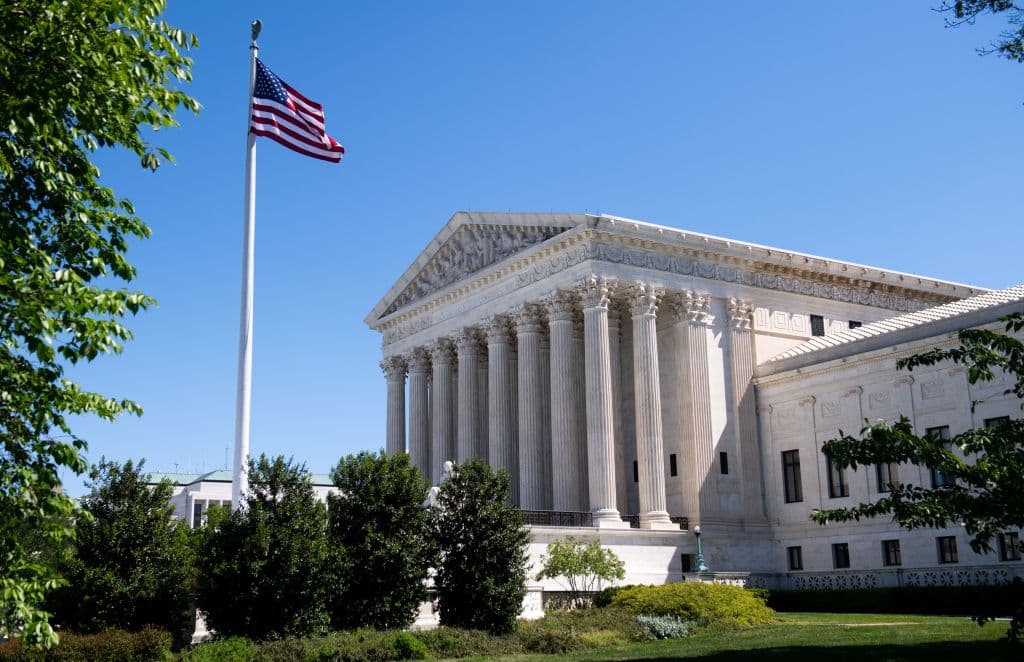
The Supreme Court on Tuesday heard oral arguments in a case that could limit the ability of convicted domestic abusers to own a gun.
The Supreme Court was hearing an appeal of a ruling from the U.S. Court of Appeals for the 5th Circuit that applied the test devised by the Supreme Court in New York Rifle & Pistol Assn. v. Bruen that required Gun control laws to be based on historical tradition.
In March, the appeals court threw out a sentence against Zackey Rahimi, who had been banned from owning a gun under a 1994 federal law.
“Rahimi, while hardly a model citizen, is nonetheless among ‘the people’ entitled to the Second Amendment’s guarantees, all other things equal,” 5th Circuit Judge Cory Wilson wrote in the court’s decision, according to the Washington Examiner.
The Biden administration appealed that ruling, saying there was “strong historical evidence supporting the general principle that the government may disarm dangerous individuals.”
According to Courthouse News Service, federal and/or state limits on domestic abusers owning Guns stretch back for almost 30 years.
In its coverage of the arguments on Tuesday, The New York Times indicated that justices appeared ready to uphold the law.
“Someone who poses a risk of Domestic violence is dangerous,” Justice Amy Coney Barrett said.
Justice Neil Gorsuch also appeared inclined to support restricting the ability of abusers to own a gun, noting in the case before the court, “We actually have a finding of a credible threat. The dangerousness argument seems most apparent there.”
Solicitor General Elizabeth B. Prelogar said there is a historical precedent underpinning the law, according to The Washington Post.
“Throughout our nation’s history, legislatures have disarmed those who have committed serious criminal conduct or whose access to Guns poses a danger — for example, loyalists, rebels, minors, individuals with mental illness, felons, and drug addicts,” she said, adding that these exists “no historical evidence that those laws were thought to violate the right to keep and bear arms.”
Chief Justice John G. Roberts Jr. had a brief discussion with federal public defender J. Matthew Wright, who was representing Rahimi, on the issue of whether Rahimi is dangerous.
“You don’t have any doubt that your client’s a dangerous person, do you?” Roberts asked.
“Your Honor, I would want to know what ‘dangerous person’ means at the moment,” Wright replied.
“Well, it means someone who’s shooting, you know, at people. That’s a good start,” Roberts said.
Liberal Justice Elena Kagan told Wright that allowing domestic abusers to have Guns would undermine public safety, according to Reuters.
“It just seems to me that your argument applies to a wide variety of disarming actions — bans, what have you — that we take for granted now because it’s so obvious that people who have Guns pose a great danger to others, and you don’t give Guns to people who have the kind of history of Domestic violence that your client has or to the mentally ill,” Kagan said.
This article appeared originally on The Western Journal.