
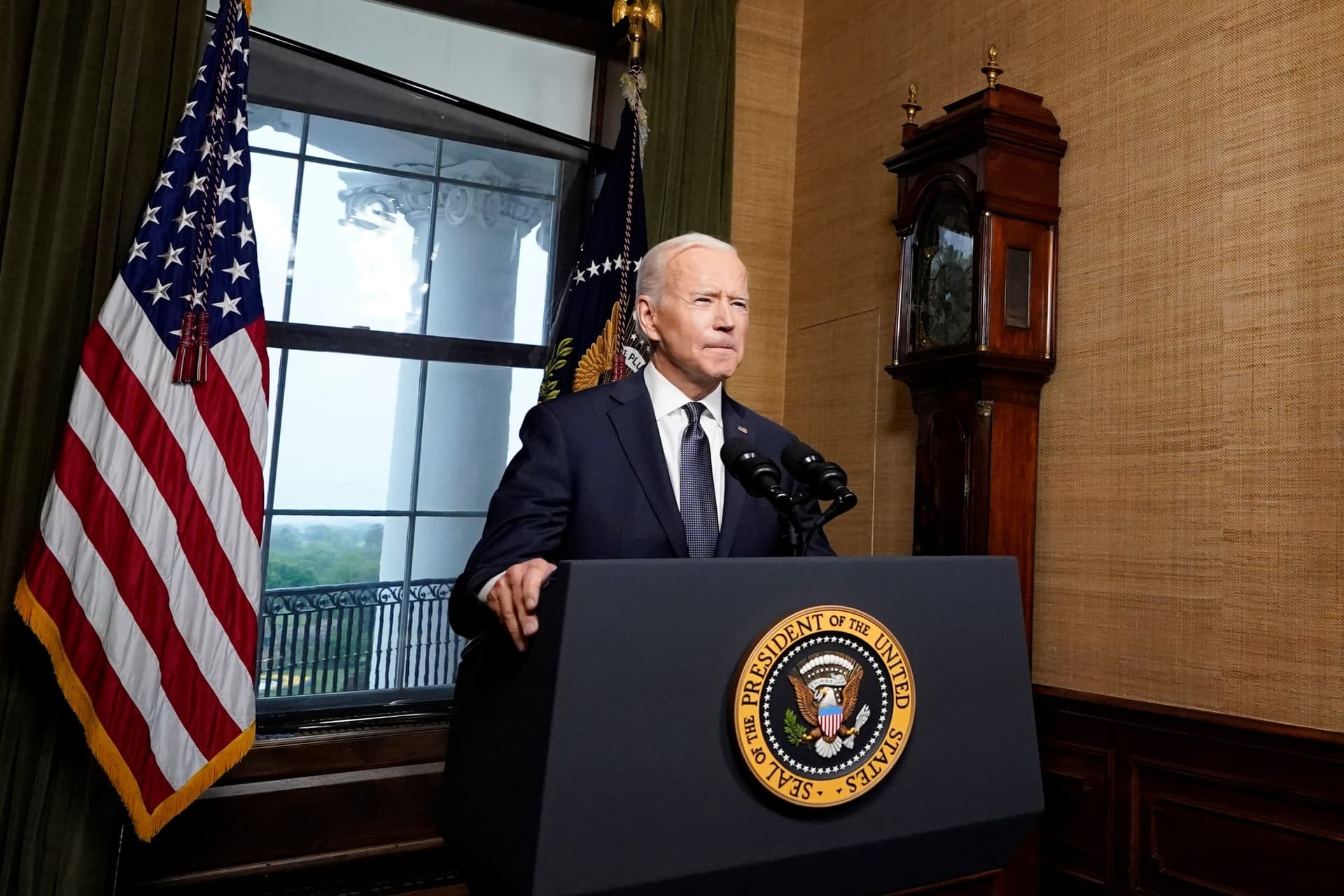
President Joe Biden earned “two Pinocchios” over the language he used to describe the United States’ mission in Afghanistan.
The Washington Post’s fact-checker Glenn Kessler noted that Biden told ABC News’ George Stephanopolous that the U.S. invaded Afghanistan for two reasons, “One, to get Bin Laden, and two, to wipe out as best we could, and we did, the al-Qaeda.”
“Then what happened? Began to morph into the notion that, instead of having a counterterrorism capability to have small forces there in — or in the region to be able to take on al-Qaeda if it tried to reconstitute, we decided to engage in nation building. In nation building. That never made any sense to me,” Biden added.
Kessler noted that Biden “is summarizing two decades of U.S. policy in a few sentences, and it’s unclear exactly what time period he is referring to when he says the policy ‘began to morph.’” However, he said the “the phrase that really jumped out at us is Biden’s assertion that nation-building ‘never made any sense to me.'”
The fact-checker went on to share that he was the Post’s diplomatic correspondent for a decade following the 9/11 terror attacks.
He said, “Our recollection was that the Bush administration initially wanted to have only a light footprint in Afghanistan after the Taliban was toppled and that members of Congress, including Biden, pushed officials to invest more in reconstruction and democracy-building. So is Biden reinventing history?”
Kessler said he reviewed media clips throughout the years and found several examples where Biden “seemed to extol the virtues of nation building.” In 2001, Biden told CBS News that the U.S. should “absolutely” be involved in nation building.
He noted that the “historical record is still pretty murky about the Bush administration’s policy after the invasion, as top officials never appeared to settle on a strategy.”
“In theory, the administration’s policy was that because failed states harbored terrorists, the United States needed to strengthen state capacity (and put them in the fight) to keep terrorists at bay. But it was not clearly articulated and not, at first, backed by substantial aid,” he added.
After detailing the “push and pull of the administration’s policies,” Kessler recalled that Biden “kept complaining Bush was not taking reconstruction seriously enough.”
He noted that Biden voiced opposition to keep a large military presence in Afghanistan.
“This brings us back to Biden’s comment. After the toppling of the Taliban, he certainly advocated reconstruction aid and funds to help promote democracy, often referring to that as ‘nation-building.’ But Jonah Blank, Biden’s chief aide on Afghanistan at the time, argues that Biden always viewed that aid through a narrow prism,” he wrote.
“His position was always: ‘Yes, we’ve got to help them rebuild — it’s both a moral and strategic need. But that’s not our primary mission, and shouldn’t become our primary mission,'” Blank said.
Kessler wrote, “Biden’s language is sloppy here. Is he referring to nation-building as Bush once did, meaning it was being done by the military? Or is he referring to simply reconstruction and development aid — evoking the phrase when he would knock Bush for not embracing a big aid package?”
“But the problem is that he routinely used the phrase ‘nation-building’ to mean something else — and it was something he advocated. So it’s disconcerting to hear him claim that nation-building ‘never made any sense to me.’ At the very least, there is a period of overlap, between 2006 and 2008, when Biden continued to criticize Bush for not spending enough on reconstruction even as a counterinsurgency strategy was embraced,” he continued.
Finally, Kessler said, “It’s almost as if Biden and Bush traded positions, with Bush embracing the nation-building he once scorned and Biden rejecting a concept he once touted. It’s certainly a muddle. But the distinction in Biden’s positions over the years are not clear, so he earns Two Pinocchios.”