
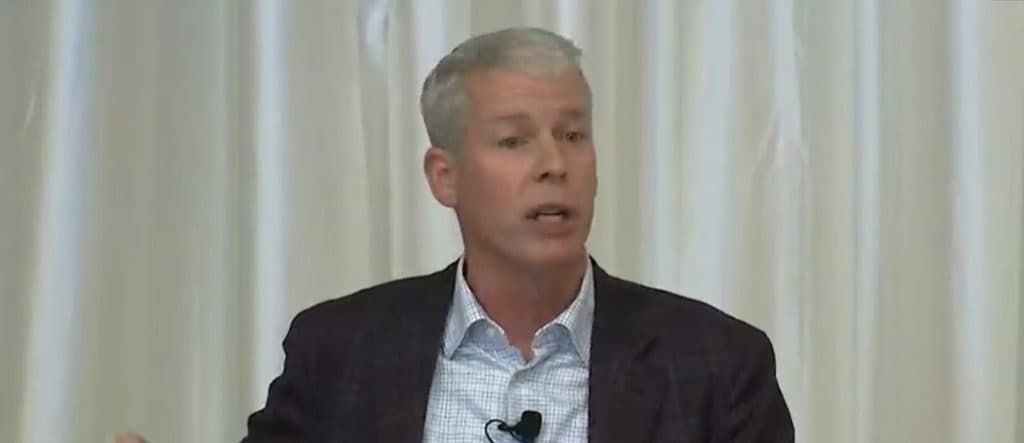
Energy Secretary Chris Wright announced an ambitious plan to have three small modular reactors (SMRs) built and producing power at the Idaho National Laboratory (INL) by July 4, 2026. This initiative was revealed during a Senate Energy and Natural Resources Committee hearing on June 18, aligning with President Donald Trump’s executive ordersto boost domestic nuclear energy development.
During an exchange with Senator John Barrasso (R-WY), Wright said, “we would like to get three new small modular reactors critical, meaning producing power by July 4 of next year at the Idaho National Lab in our containment facility.” Wright added that his objective was to “speed up ideas that are ready to go. Let’s get them on the ground and test them and prove them.”
The Secretary, who has become the most quotable cabinet spokesman for President Donald Trump’s “American Energy Dominance” agenda, accurately pointed to the Nuclear Regulatory Commission as the likely chief impediment to any rapid expansion of the U.S. nuclear power industry.
“Americans invented the nuclear power industry,” he told Barrasso, pointing out that the industry initially experienced rapid growth during the 1960s and early 1970s, when the Atomic Energy Commission served as the federal regulatory agency over it. “We came out and built 100 plus plants rapidly,” Wright added. “Then we created an NRC and stopped, and we haven’t done much for 30 or 40 years. You and I and many others really want to get that nuclear ball rolling again.
Wright’s remarks came just a few days after President Trump dismissed NRC commissioner Christopher Hanson, who was named to Chair the commission by former President Joe Biden in 2021. The proximity of that firing and Wright’s rolling out of his new initiative could be coincidental, but real coincidences such as this are fairly rare in the nation’s capital. Given that the U.S. currently has zero SMRs in operation and the NRC has only managed to approve two SMR-related projects, both for developer NuScale Power, it seems more likely that the administration identified Hanson as an impediment to progress, resulting in the President’s action.
Whether that will help clear a path for a successful completion of such an aggressive plan remains to be seen, but the ultimate outcome is important to America’s energy future, especially when it comes to restabilizing the nation’s regional power grids. Too many of those grids have become increasingly unstable as they have been loaded down with too much unpredictable, unreliable wind and solar power generation. A renaissance in nuclear generation, combined with a rapid expansion of natural gas generation that already seems to be underway, would provide the stable baseload capacity needed to keep the lights on when wind and solar inevitably fail.
On the day of Sec. Wright’s testimony, the DOE published an announcement on detailing plans for a new pathway for testing nuclear reactors. In the announcement, DOE says it has issued a formal request for proposals “seeking qualified U.S. reactor companies interested in constructing and operating their test reactors outside of the national laboratories using the DOE authorization process. Today’s action represents an important step toward streamlining nuclear reactor testing and ensuring at least three reactors achieve criticality by July 4, 2026.”
The announcement is not limited to SMRs, but a quote by Sec. Wright does say “we are expediting the development of next-generation nuclear technologies and giving American innovators a new path forward to advance their designs, propelling our economic prosperity and bolstering our national security.” Initial applications are due by July 25, 2025, but additional applications will be considered on a rolling basis.
In interviews with me and others long before becoming Trump’s Energy Secretary nominee, Wright consistently laid out his case why nuclear generation is the only truly scalable zero-carbon alternative to fossil fuels, citing the laws of physics and reliability as the principle reasons why. Even with backup batteries, wind and solar are simply not capable of providing the same reliability and stability on an integrated grid that natural gas and coal generation can provide.
This week’s developments indicate that Sec. Wright has delivered the same messages to President Trump, and the President has taken them to heart.
David Blackmon is an energy writer and consultant based in Texas. He spent 40 years in the oil and gas business, where he specialized in public policy and communications.
The views and opinions expressed in this commentary are those of the author and do not reflect the official position of the Daily Caller News Foundation.
All content created by the Daily Caller News Foundation, an independent and nonpartisan newswire service, is available without charge to any legitimate news publisher that can provide a large audience. All republished articles must include our logo, our reporter’s byline and their DCNF affiliation. For any questions about our guidelines or partnering with us, please contact [email protected].