
A Democratic member of Congress has emerged as a vocal defender of the status quo at the National Institutes of Health (NIH) and is the son of scientists connected to the embattled government agency.
Rep. Jake Auchincloss of Massachusetts expressed opposition to the Trump administration’s cuts at the NIH at a House Energy and Commerce Committee markup on Feb. 25, arguing “curiosity-driven peer reviewed basic research is not meant to pass the politicians’ test.”
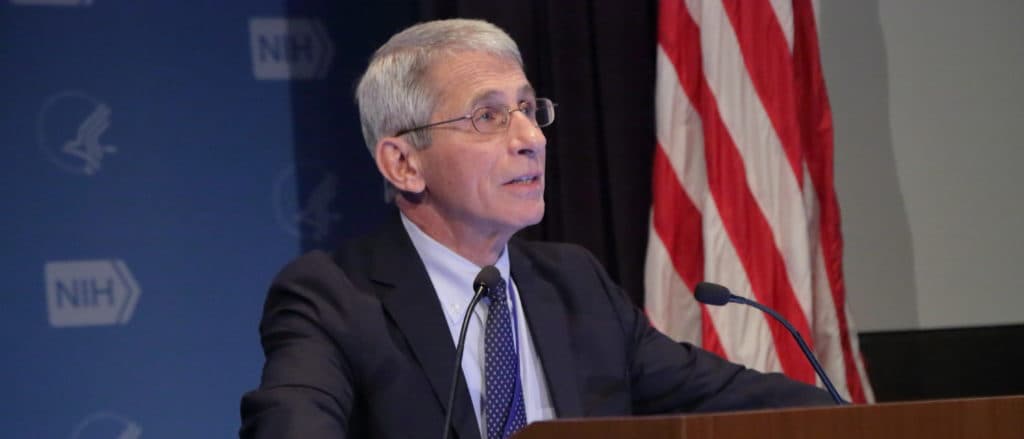
But Auchincloss may have a conflict of interest: his parents. Auchincloss’s father, Hugh Auchincloss, was an aide to National Institute of Allergy and Infectious Diseases (NIAID) Director Anthony Fauci for 16 years. No run-of-the-mill bureaucrat, the senior Auchincloss steered intramural research at NIAID from 2014 to 2015 and stepped in as the acting director of NIAID from 2022 to 2023.
Despite typically operating behind-the-scenes, Auchincloss’s name came under public scrutiny in emails revealed under the Freedom of Information Act by BuzzFeed News in 2021. Officials in Fauci’s inner circle, including the elder Auchincloss, had privately discussed research supported by NIAID with the Wuhan Institute of Virology in February 2020 — months before the research became known to much of the public.
Specifically, the emails showed Hugh Auchincloss had aided Fauci as he privately sought information about why its coronavirus research with the Wuhan lab hadn’t been checked through more rigorous protocols, even while Fauci publicly downplayed the possibility of a lab-generated virus.
It was not until April 2020, approximately 2.5 months later, that discussion about a possible connection between the coronavirus research in Wuhan and the emerging pandemic entered into mainstream discourse.
Meanwhile, the congressman’s mother, Laurie H. Glimcher, the former president and CEO of the Dana Farber Cancer Institute, cowrote five papers with irregularities and errors, including evidence of image manipulation, as reported by The New York Times and attributed to a scientific sleuth who made headlines with his discoveries last year. All of these papers had been supported by NIH funding.
A paper in the prestigious journal Science coauthored by Glimcher was retracted in April 2024, 18 years after publication. The retraction notice acknowledges “discrepancies” in several of the journal’s figures. “The authors are no longer confident that these figures support the conclusions,” it reads.
Glimcher did not respond to a request for comment.
The House Energy And Commerce Committee markup involved its authorization and oversight plan for the 119th Congress. But Auchincloss was among the Democratic members who used the markup to chastise actions by entrepreneur Elon Musk’s Department of Government Efficiency (DOGE) that have rankled some in the scientific community.
NIH announced a 15 percent cap on administrative overhead on its grants on Feb. 7, a move that has been challenged in three lawsuits. An estimated 1,165 probationary NIH employees (4.6 percent of its 25,000-person workforce) were laid off the weekend of Feb. 14. The study sections that evaluate new extramural grants were paused but have been partially restored.
Lab Leak Panic
In February 2020, Fauci contacted the elder Auchincloss within hours of discovering the connection between his institute and the Wuhan Institute of Virology.
“IMPORTANT,” Fauci wrote in the subject line of an email to the elder Auchincloss at 12:29 a.m. on February 1, 2020 — just hours after hearing from a virologist that the genome of the emerging novel coronavirus bore signatures of engineering. The email was released in the tranche obtained by BuzzFeed News.
“Hugh: It is essential that we speak this AM. Keep your cell phone on,” Fauci said in the email. “You will have tasks today that must be done.”
Fauci also instructed Auchincloss to read the file he attached to the email, which he internally named “Baric, Shi et al – Nature medicine – SARS gain of function.pdf.”
Given its abbreviated name, the attached file was likely a 2015 Nature Medicine paper coauthored by Wuhan Institute of Virology Senior Scientist Zhengli Shi and University of North Carolina virologist Ralph Baric describing an NIH-underwritten collaboration on experiments generating novel SARS-related coronaviruses.
Asked in a congressional transcribed interview about what “tasks” he was expected to do, Auchincloss said that he could not recall every detail. He said that he was asked to determine whether the research described in the paper had gone through the committee that is supposed to scrutinize the riskiest research, the Potential Pandemic Pathogens Committee (P3CO).
It hadn’t. Evidence would later emerge that other officials at NIAID’s Division of Microbiology and Infectious Diseases had allowed for grantees to determine their own gain-of-function research rules.
“The only tasks I recall were reading the paper and trying to understand it and what kind of review we had done of it,” he said. “What I think I meant was that Ralph Baric in the paper talked about gain-of-function research, and so I assumed it was gain-of-function research of concern. As it turns out, it had been through a review in the Division of Microbiology and Infectious Diseases and they determined that it was not research that was of concern.”
Though the internal file name at the NIAID describing the experiment included the phrase “gain of function” — a term NIAID used to describe experiments that enhance the deadliness or infectivity of a virus — Fauci subsequently insisted that the experiments were not gain-of-function, including in sworn testimony. Fauci was later given a full and unconditional pardon by then-President Biden.
The concerns circulating within NIAID leadership about the institute’s connection to coronavirus research in Wuhan remained internal. Fauci was involved behind-the-scenes with a new paper in Nature Medicine, published in March 2020, that helped dampen speculation about a possible link between NIAID-underwritten research projects and the emerging pandemic.
Hugh Auchincloss could not be reached for comment. He retired from NIH in September 2024 and the email on his biographical webpage at the NIH no longer works.
Dana Farber Retractions
Glimcher, though a one-time rumored candidate to replace Francis Collins as the director of the NIH, stepped away from her position at the top of Dana Farber in September 2024.
Some press reports pointed to Glimcher’s controversial decision to split Dana Farber from a longtime partnership with Brigham and Women’s Hospital as a possible impetus for the change in leadership.
But the step-down also coincided with scientific sleuth Sholto David uncovering evidence of improperly manipulated images in at least 75 papers authored by Glimcher and other scientists at Dana Farber — leading to at least 6 retractions and 31 corrections.
The papers Glimcher coauthored stretched from 2003 to 2012 and had been published in prestigious journals like Science and Neuron.
Two of these papers were slapped with corrections and one was retracted. Glimcher was the senior author on one of these papers, in Nature Immunology.
The paper “includes some impressive contributions to art, but perhaps not to science,” David wrote in a blog post.
David, who lives in Wales and has a PhD in cellular and molecular biology, told the Daily Caller News Foundation that he comments prolifically on PubPeer, a website that scientists use as a makeshift comments section for papers published in scientific journals, which typically provide no formal forum for feedback.
David said that the scientific community has made little effort to improve research integrity following the Dana Farber controversy and other high-profile retractions.
“Scientists often lay claim to their colleagues’ successes but never take responsibility for their fraud and failures,” said David. “There’s been little introspection to understand what’s gone wrong.”
All content created by the Daily Caller News Foundation, an independent and nonpartisan newswire service, is available without charge to any legitimate news publisher that can provide a large audience. All republished articles must include our logo, our reporter’s byline and their DCNF affiliation. For any questions about our guidelines or partnering with us, please contact [email protected].