
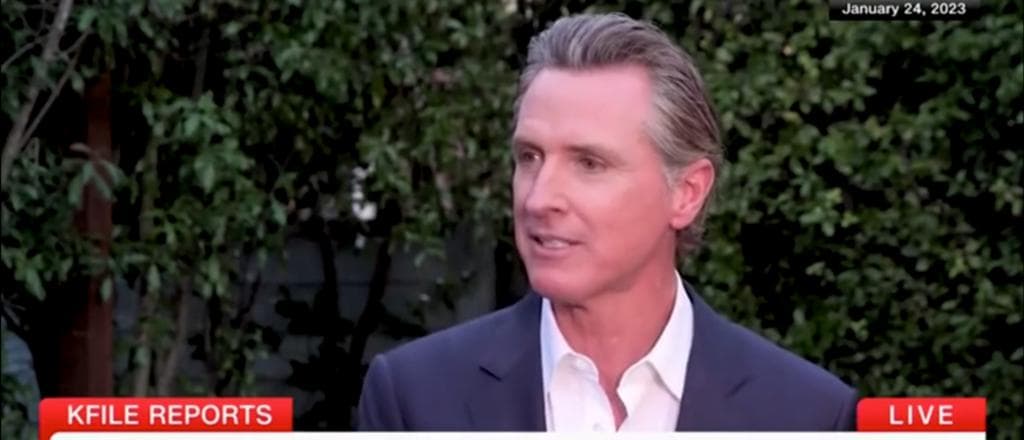

Democratic California Gov. Gavin Newsom’s efforts to limit the effect of President Donald Trump’s tariffs by working with international trade partners could hit constitutional roadblocks.
Newsom announced April 4 he would ask trade partners to exempt California-made products from any retaliatory tariffs and seek to develop new “strategic trade relationships,” doubling down on his approach Wednesday after Trump issued a 90-day pause on reciprocal tariffs while leaving in place the 10% baseline and increasing tariffs on China.
“Trump caved,” Newsom wrote Wednesday on X. “He will change his mind again. To our international partners: California is a stable, reliable partner. We want your Business.”
States are “obligated to remain outside” the foreign trade space to preserve the federal government’s discretion, Donald Kochan, executive director of the Law and Economics Center at George Mason University’s Antonin Scalia Law School, told the Daily Caller News Foundation.
He pointed to the Supreme Court’s 2000 ruling in Crosby v. National Foreign Trade Council, where it rejected a Massachusetts law restricting entities in the state from doing Business with Burma under the Constitution’s Supremacy Clause.
“Even sort of insinuating that California has the ability to negotiate side deals is itself diminishing the capacity of the federal government to speak with one voice and to negotiate trade deals, and consequently, should be avoided,” Kochan said. “All of this is true, regardless of your position on the tariffs.”
In his initial announcement, Newsom told international partners that “the Golden State will remain a steady, reliable partner for generations to come, no matter the turbulence coming out of Washington.”
“California is not Washington, D.C,” he wrote.
Stanford law professor Alan Sykes told the DCNF he doubts California’s requests to exempt the state’s exports from retaliation “will have much impact.”
“Asking for favors does not raise constitutional questions,” he said. “Formal agreements may depending on their provisions.”
While the Constitution prohibits states from entering treaties, Duke University international law professor Tim Meyer told the DCNF there “is a long practice of states entering into informal arrangements with foreign countries, including on trade matters.”
“Normally, though, these arrangements do not have much substance,” he said. “For example, California does not control tariffs, so there is little reason for other countries to agree to exempt California products from retaliatory tariffs. In theory, California could offer benefits in terms of its regulatory measures in exchange for exemptions for California products from tariffs, but that would require that any regulatory benefits be lawful under California law and that the international arrangement be non-binding.”
Josh Blackman, constitutional law professor at the South Texas College of Law Houston, noted that California has entered into “agreements” with foreign countries that “stop short of treaties” in the past. In 2019, California signed an agreement with Canada to work together on developing regulations that “accelerate the adoption of zero-emission vehicles like electric cars.”
“The Courts did not block this agreement, but there is a risk,” Blackman said.
All content created by the Daily Caller News Foundation, an independent and nonpartisan newswire service, is available without charge to any legitimate news publisher that can provide a large audience. All republished articles must include our logo, our reporter’s byline and their DCNF affiliation. For any questions about our guidelines or partnering with us, please contact [email protected].