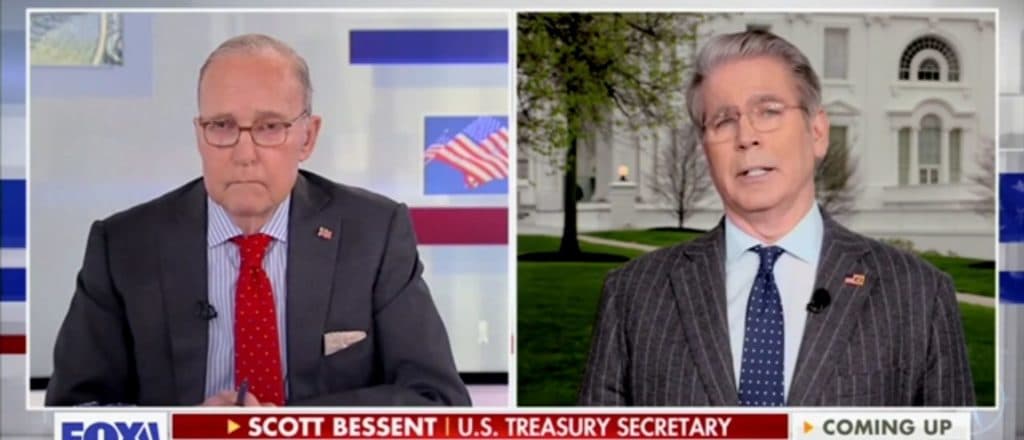
Larry Kudlow pressed U.S. Treasury Secretary Scott Bessent on Fox Business Monday on the rationale behind the tariff rates imposed by President Donald Trump.
Trump on Wednesday declared a national emergency to enforce reciprocal tariffs on nations that impose import charges on the United States, dubbing the move “Liberation Day” and setting a baseline tariff rate of 10%. During the Monday episode of “Kudlow,” the host asked about the consistency of global tariff strategies, citing the European Union’s proposal for zero tariffs.
“Larry, I can tell you that there are 50, 60, maybe almost 70 countries now who have approached US. So it’s going to be a busy April, May, maybe into June. And Japan is a very important military ally,” Bessent told Kudlow. “They’re a very important economic ally. And the U.S. has a lot of history with them. So I would expect that Japan’s going to get priority just because they came forward very quickly. But it is going to be very busy. And if President Trump, again, gave himself maximum negotiating leverage, just when he achieved the maximum leverage, he’s willing to start talking.”
WATCH:
📺 Embedded media — coming soon
Kudlow pointed out the discrepancy between the International Trade Administration’s reported average tariff rate of 4.3% for Japan and the 46% rate shown on Trump’s chart, which calculates tariffs based on trade deficits.
“We looked up the International Trade Administration. It shows Japan with a 4.3% average tariff. But in the chart that President Trump showed last week, the so-called reciprocal charge offs, it has Japan at 46%. Now I know how you get to 46% using deficits as a trade deficit as a share of imports, but that’s an odd way to look at it,” Kudlow told Bessent. “I mean, really, there may be twice as much as US, but they’re not all this much. I mean, 46 is a much higher number than 4.3.”
“One of the reasons President Trump cut the numbers in half was because of what you just said. Academic studies have shown that it’s the non-tariff trade barriers that are the real problem in the U.S. having free and fair access to these markets. If you think about it, I think on most products, the Chinese tariff is 5%. But does anyone think that is a free market?” Bessent asked. “It could be testing in cars. It could be GMO restraints in food. Come on, we buy $3 billion a year of Australian beef, but we can’t export to them. There are a lot of non-tariff trade barriers, and Japan’s are quite high. I am sure that we will have a very productive negotiation with the Japanese.”
The list of Trump’s tariffs on foreign imports includes some of the highest rates for China, which faces a 34% U.S. tariff in response to their 67% levy on American goods. Additional charges will be imposed on countries like Israel, the United Kingdom, Brazil, Singapore, Japan, and Taiwan, with tariffs exceeding the baseline scheduled to take effect on April 9.
The Chinese Ministry of Finance announced Friday that it will impose a 34% tariff on all U.S. imports beginning April 10, retaliating against the Trump administration’s similar levy on Chinese goods. Following Trump’s announcement of “Liberation Day” tariffs, U.S. stock markets saw a significant downturn.
(Featured Image Media Credit: Screenshot/Fox Business)
All content created by the Daily Caller News Foundation, an independent and nonpartisan newswire service, is available without charge to any legitimate news publisher that can provide a large audience. All republished articles must include our logo, our reporter’s byline and their DCNF affiliation. For any questions about our guidelines or partnering with US, please contact [email protected].