
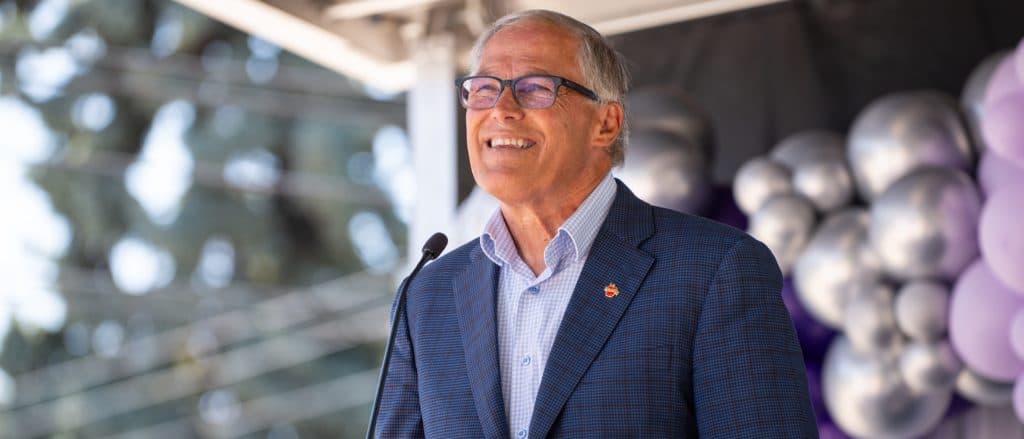

Voters could strike a major blow to outgoing Washington Governor Jay Inslee’s climate legacy if two ballot initiatives that repeal legislation restricting the use of natural gas and taxing companies’ carbon emissions pass on Nov. 5.
Washington state residents are set to vote on two Energy-related ballot initiatives, with one rolling back a law that restricts natural gas usage (I-2066) and the other repealing the state’s carbon trading system (I-2117), which supporters have labeled a “hidden gas tax.” Proponents believe that passage of these initiatives will send a clear message to Washington’s Democratic trifecta that residents are not content to pay higher gas prices than the majority of the nation in the name of climate change.
“Our radical green Energy policies have been put in place by a vocal, pampered minority of activists whose opinions are not widely held and shared,” Jim Walsh, chairman of the Washington GOP and author of the carbon trading system repeal initiative, told the Daily Caller News Foundation. “They are an unsympathetic interest group.”
Inslee has called the referendums “the single most important election other than the White House in the United States.”
Voters appear likely to pass the natural gas ban prohibition initiative, with 44% of registered voters in support and 31% opposed, according to the most recent poll from SurveyUSA conducted between Oct. 9 and 14. State residents appear less eager to back the carbon trading system repeal, with 48% saying they will reject the initiative and 30% in favor. However, 25% remain undecided about the natural gas ban prohibition measure (I-2066) and 22% for the carbon trading system repeal initiative (I-2117).
Walsh told the DCNF that he expects both ballot initiatives to pass while conceding that the natural gas ban prohibition initiative has more support because the measure is ultimately about defending “consumer choice.”
“People like cooking with natural gas, and even if they don’t have it in their home or their apartment, they don’t like the idea of being told that they couldn’t have it,” Walsh told the DCNF.
“We are confident in 2117 and 2066 passing because we have been on the ground talking to voters for the last six months and they say the same thing: prices are too high,” Hallie Balch, spokesperson for Let’s Go Washington, the political committee led by Brian Heywood that financed the push to get these initiatives on voters’ ballots, told the DCNF.
Both petitions collected more signatures than any initiative filed in Washington state during the past two decades. The natural gas ban prohibition measure received more than 514,000 signatures — the second most in state history — and the carbon trading system repeal petition collected more than 466,000, which was the fourth most.
Walsh told the DCNF that nearly 60% of signatures came from independents and registered Democrats, and that he expects voters who cast ballots for Democratic presidential nominee Kamala Harris to also vote in support of these initiatives.
Let’s Go Washington and Walsh attribute cost-of-living concerns as the primary reason these two initiatives have garnered significant support among Washington residents.
Average gas prices in Washington today are the third highest in the nation at around $4.04 a gallon, nearly a dollar more than the $3.13 a gallon national average. The Association of Washington Business (AWB) in January projected that Washington’s carbon market trading program is responsible for a 45 cent increase in gas prices since becoming operational in January 2023.
“I’m willing to make a wager with you,” Heywood said during a debate on the carbon trading system repeal at Seattle University on Oct. 10. “If 2117 passes, the price of gas relative to other states will go down because we’re putting a 25 to 50% tax on it.”
If I-2117 fails, Heywood predicts gas prices will keep rising as the carbon trading system’s carbon price increases. “It’s designed for the price to go up,” Heywood added.
“I-2117 will lower costs by taking 30-50 cents off every gallon of gas, and I-2066 will reduce costs for homeowners and buyers by removing some of the most restrictive building codes in the nation and not requiring people to retrofit their homes to electric for tens of thousands of dollars,” Balch told the DCNF.
The carbon trading system repeal is notably opposed by Amazon, BP America, Microsoft, the Environmental Defense Fund and more than 500 other entities. Microsoft founder Bill Gates and former CEO Steve Ballmer are among the top donors to the No On 2117 Committee, doling out $1 million and $2.5 million, respectively. Let’s Go Washington told the DCNF that more than $40 million in total has been spent against the carbon trading system repeal measure and other initiatives.
Opponents of I-2117 have claimed that repeal of the state’s carbon trading system would lead to substantial cuts to the state’s transportation and infrastructure budget, funded in part through government revenue raised from taxing companies’ carbon emissions.
“It would gut programs that protect communities from wildfires, jeopardize vital protections for our waterways, including rivers, lakes and streams, and eliminate efforts to support salmon recovery and fish habitat,” Kelsey Nyland, a spokesperson for the No On 2117 campaign, told the DCNF. “And by forcing $5.4 billion in cuts to our state’s transportation funding, it would hurt every corner of our state, putting major road and bridge projects addressing congestion, safety and freight mobility at risk of being delayed or even canceled.”
Supporters of the carbon trading system repeal have not offered an alternative source of government revenue that could continue paying for these projects.
“It will be up to the legislature to negotiate a better budget in the upcoming legislative session,” Walsh, also a state Republican lawmaker, told the DCNF. “If we adjust and we negotiate better budgets, then there will be no negative effects. And even the projected effects would be either less or zero if we negotiate a better operating budget in the upcoming budget negotiations, which is entirely possible.”
Heywood has also criticized the state government for implementing no accountability mechanisms that measure the projected climate impacts of projects the government is funding through revenue raised from the carbon trading system.
“They do not have a way to measure the results of any of the money that they’re spending,” Heywood said during the Seattle University debate. “It’s all fake promises with money that they can then go around and pay their political constituents.”
“This is a huge grift,” Heywood added.
Walsh told the DCNF that there could have been even more initiatives on Washington residents’ ballots this election, but that the Washington legislature passed the most popular measures during this year’s legislative session.
“They were afraid if all six appeared on the ballot now, there would be an overwhelming red wave of voters,” Walsh said to the DCNF. “As a turnout mechanism, they’re very powerful.”
Washington Democrats have raised the possibility of taking up a constitutional amendment to curtail or fully eliminate the ballot initiative process that allows voters to have direct say over policies impacting their livelihoods, according to Walsh.
“They’ve lost the people’s support, and what they want to do now is try to get rid of initiatives,” Walsh told the DCNF. “They have no sense of how anti-democratic or arrogant their position is.”
(Featured Image Media Credit: Flickr/Governor Jay Inslee)
All content created by the Daily Caller News Foundation, an independent and nonpartisan newswire service, is available without charge to any legitimate news publisher that can provide a large audience. All republished articles must include our logo, our reporter’s byline and their DCNF affiliation. For any questions about our guidelines or partnering with us, please contact [email protected].