
The people who run the best companies know the pathway to success lies in a focus on core competencies. Do what they are designed to do, keeping the first thing “the first thing” is a form of competitive advantage that no one has found a way to match.
Successful organizations never lose sight of that, even when a fundamental reset is necessary for long-term survival.
That is what David Steiner is looking at as he prepares to become the nation’s next Postmaster General. His predecessor, Louis DeJoy, lost sight of what made the United States Postal Service different from UPS and the firms that made their names getting packages anywhere they needed to be overnight. Unlike its competitors in the private sector, the USPS is required by law to provide six days per week of mail and package delivery to every address in the continental United States.
DeJoy lost sight of this. He, like the others with grand designs for the post office’s future, sees an agency that does everything from selling office products to banking and lending, regardless of cost, capability, or the reality that someone else is already doing it better.
On May 9, at the Postal Service’s Board of Governors meeting, the USPS announced its most recent quarterly financial results. They were horrific. The agency’s net loss for the quarter totaled $3.3 billion, compared to a net loss of $1.5 billion for the same quarter last year. There is little doubt that this year, unless something changes, the USPS will likely lose more than the $9.5 billion it lost in Fiscal Year 2024.
If that continues, it won’t be the price of a stamp that people are talking about. It will be the cost of the bailout.
The USPS has once again failed to meet any of its service standards, despite relaxing them over the last several years. Steiner, the former CEO of Waste Management who currently serves on multiple corporate boards, including FedEx’s, is staring all that right in the face as he prepares to become the nation’s 76th Postmaster General. A person with an interesting set of experiences, he gets what it means to serve American consumers and businesses at their doors.
Given the financial stakes, and the continuing inability to deliver mail and packages on time and efficiently to far too many Americans, Steiner needs to kick things off by hitting the reset button. He needs to put distance quickly between DeJoy’s disastrous Delivering for America, which led to billion-dollar losses and degraded service across the country, especially in Red rural areas, and his plan, whatever it might be.
DeJoy wanted the Postal Service to do everything: collect the mail, process it, transport it, and deliver it even when the private sector could and was doing it more efficiently. He hired 190,000 more career unionized employees at double the compensation rate and committed to spending $40 billion on facilities that would do what those that already existed in the private sector were already doing. This push to insource was at the heart of his plan and the USPS’s most recent troubles. It caused congestion and delays as the Postal Service lacked the experience and systems to do these tasks most efficiently.
These developments, masquerading as innovations and reforms, almost erased the longstanding public-private partnerships the Postal Service has embraced for decades. The private sector, with cutting edge technology and more flexible contracting arrangements, can perform these “middle mile” processing, sorting, and transportation tasks more efficiently.
The new Postmaster General must focus on the core mission: the “final mile” delivery of mail and packages, together, to everyone across the country six days a week. No private entity can afford to fulfill this important mission, which Congress requires to be undertaken and which the Postal Service already does best. FedEx and UPS do not deliver to many rural addresses, and, when they do, they charge more. Rural communities especially need to have affordable and reliable methods of getting and paying bills, picking up and delivering prescriptions, and doing the mundane work of making sure birthday cards arrive on time. The private sector shippers don’t want this business. Only the Postal Service’s focus on household delivery prevents a market failure for these rural areas, which would not receive quality service otherwise.
At the same time, the Postal Service needs to stop spending money it doesn’t have on facilities it doesn’t need and stop hiring new, non-delivery employees when its overall workload is decreasing. Congress should include both these freezes in the ‘budget reconciliation’ bill it is currently considering – this would save tens of billions! Instead, USPS should rely on the private sector to continue doing what they have done well and could do more of – mail and package sortation, handling, processing, logistics and transportation – which would improve service.
The Postal Service has been with us for 250 years. Some people say its time has passed, that its connection to government should be severed. No less a luminary than Benjamin Franklin would probably disagree. Taking it further, he’d probably say it’s important for the new Postmaster General and policymakers to take steps to ensure the USPS can continue serving Americans in the future. That calls for a clean break from the discredited and failed Delivering for America plan.
An experienced journalist and commentator who has contributed to various media outlets and is a highly regarded political analyst, PeterRoffis a former UPI and U.S. News columnist who is now affiliated with several public policy organizations. You can reach him at RoffColumns AT GMAIL.com and follow him on social media @TheRoffDraft.
The views and opinions expressed in this commentary are those of the author and do not reflect the official position of the Daily Caller News Foundation.
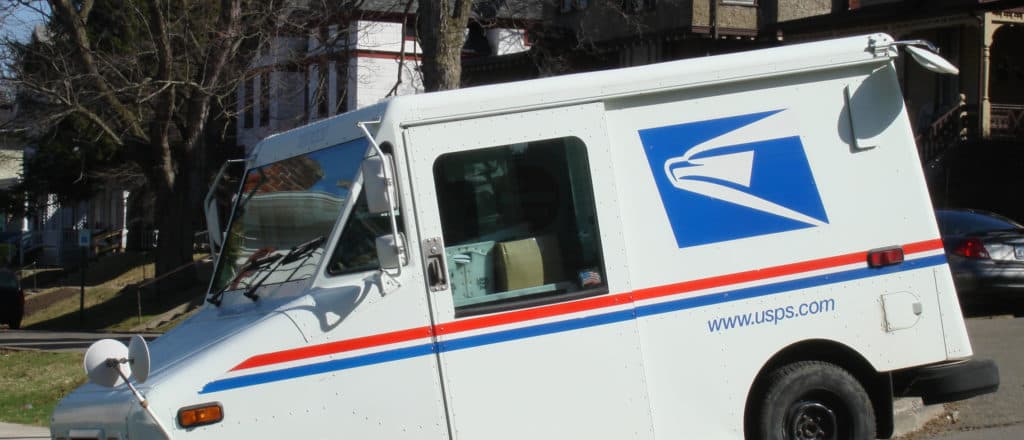
(Featured Image Media Credit: Stilfehrer/Wikimedia Commons)
All content created by the Daily Caller News Foundation, an independent and nonpartisan newswire service, is available without charge to any legitimate news publisher that can provide a large audience. All republished articles must include our logo, our reporter’s byline and their DCNF affiliation. For any questions about our guidelines or partnering with us, please contact [email protected].