
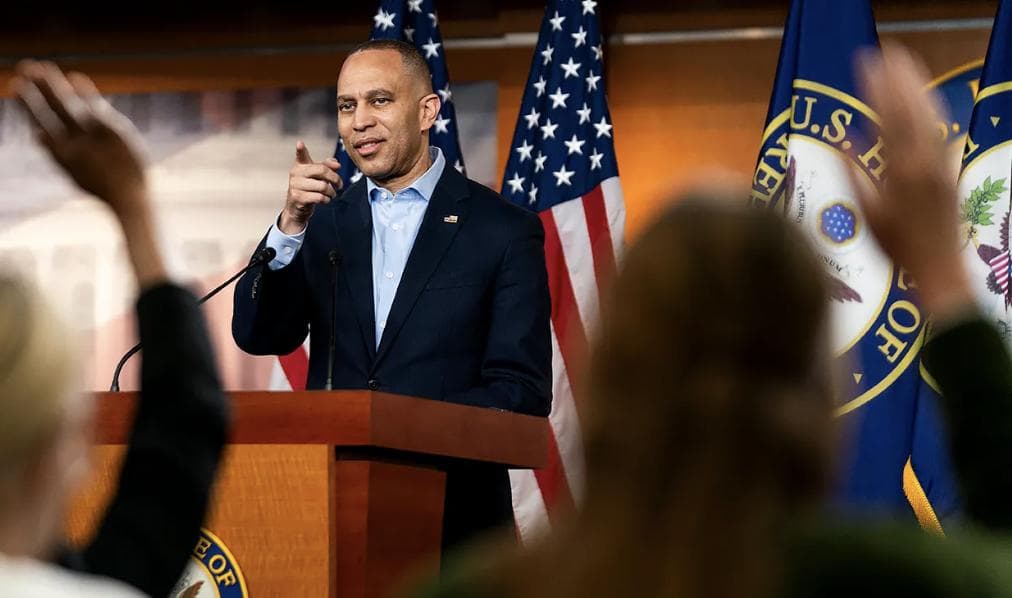
Florida Gov. Ron DeSantis is pushing back against recent comments from House Minority Leader Hakeem Jeffries, as tensions rise over redistricting ahead of the 2026 midterm elections.
Speaking this week, DeSantis mocked Jeffries’ warning to Florida Republicans to “F around and find out” if they move forward with new congressional maps. DeSantis responded with a mix of sarcasm and confidence, saying he would welcome Jeffries to campaign in the state. He even joked about hosting him at the governor’s mansion and taking him fishing, adding that Republicans would benefit from having Jeffries campaign across Florida.
Jeffries’ remarks came earlier in the day, as he criticized what he described as aggressive redistricting efforts led by Republicans. He warned that such moves could backfire, arguing that political momentum in Florida may not be as firmly in the GOP’s favor as it once was. His comments reflect a broader Democratic strategy of challenging Republican-led redistricting plans, often framing their own efforts as a response to GOP actions in other states.
The exchange highlights a growing national fight over congressional maps, with both parties treating redistricting as a key factor in determining control of the House. Republicans currently hold a narrow majority, and both sides are looking for ways to gain an edge before voters head to the polls in 2026.
In recent months, several states have become part of this larger battle. After President Donald Trump encouraged efforts to expand the GOP’s advantage by targeting Democratic-held seats in Texas, similar discussions or actions have emerged in places like North Carolina, Alabama, Louisiana, Georgia, and New York. Each state presents its own legal and political challenges, but the underlying goal is the same: to reshape districts in a way that improves a party’s chances in future elections.
Virginia has also drawn attention after voters approved a redistricting plan backed by Democratic Gov. Abigail Spanberger. That effort aims to strengthen Democrats’ position in the state’s congressional delegation by reshaping district boundaries.
Florida could be the next major flashpoint. With Republicans controlling the state government and several Democratic-held districts potentially in play, DeSantis has already signaled interest in revisiting the state’s congressional map. He announced earlier this year that he would call a special legislative session focused on redistricting, citing population changes and the need to ensure districts reflect current demographics.
At the same time, Florida’s constitution places limits on how districts can be drawn. It prohibits maps that are intentionally designed to favor or disadvantage a political party or incumbent, which could complicate any proposed changes.
Democrats argue that aggressive redistricting could stretch Republican support too thin in certain areas, potentially making once-safe districts more competitive. Jeffries suggested that similar dynamics could play out in Florida, pointing to ongoing battles in Texas as an example.