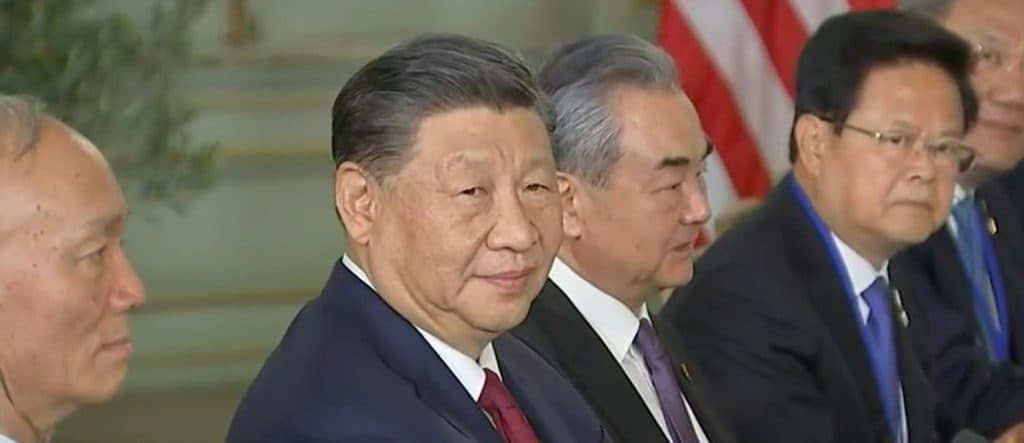

Should the Department of Justice exist to please ideologues and Chinese leader Xi Jinping, or should it exist to defend U.S. national security and economic strength?
That question came into sharp focus this week after the U.S. intelligence community took the rare step on Wednesday of publicly backing the Department of Justice’s agreement to ensure the HPE–Juniper telecommunications merger happens.
In astatement toAxios, a senior intelligence official didn’t mince words, stating that the DOJ blocking the deal would have “hindered American companies and empowered” Chinese competitors by preventing the U.S. from ever catching up to Huawei.
This should have ended the debate. Huawei, backed by Beijing, already controlsnearly one-third of the global telecom equipment market.
Telecom infrastructure forms the backbone of everything from financial systems to military communications. Whoever builds it sets the rules, controls the data flows, and shapes the future.
The DOJ and intelligence community believe that country should be the United States, not China. I agree. For the United States to surrender this ground to China would be an economic and strategic catastrophe.
However, somecritics are attacking the Justice Department for settling the case and letting the merger move forward, accusing the DOJ of being “too soft” on corporate power. That view is wrongheaded, even from a populist point of view, and is completely divorced from reality.HPE-Juniper wouldn’t even be the biggest U.S. company in the market if merged.
The federal government’s antitrust cops are going afterBig Tech. They are going afterTicketmaster andenergy monopolies. This is not an administration afraid of taking on concentrated power. In fact, its keen ability to stop marketplace concentration is precisely why it’s letting the HPE-Juniper merger fly. It knows that a stronger American company is the only way we will be able to stop China and Huawei from writing the global rules on AI and 5G.
The DOJ’s critics would rather see the HPE-Juniper deal blocked in the name of being tough on business, even if it means kneecapping the very American companies that are attempting to prevent Huawei — the biggest company in this field — from continuing to surge ahead. Unilateral disarmament is never in America’s interest, and it’s not here either.
The critics demanding DOJ “get tougher” for its own sake miss this point entirely. They talk as if the goal of antitrust law is to shrink American companies down, even when they are benefiting consumers and not doing anything wrong, until none of them can compete. But ask yourself: who benefits when U.S. companies are kept small, divided, and fighting each other instead of competing with Beijing?
It isn’t American workers, our military, or the intelligence community, which has now explicitly told us this deal is necessary for the U.S. to hold its ground against China. The only people cheering for that kind of self-inflicted wound would be Xi Jinping and the People’s Liberation Army.
The Justice Department gets this. Speaking about the HPE-Juniper settlement, a DOJ spokesmansaid the department “works very closely with our partners in the intelligence community and always considers their views when deciding how best to proceed with a case.”
The DOJ deserves credit for cutting through the noise. By listening to intelligence professionals rather than ivory tower theorists, it secured concrete concessions to protect competition and strengthened America’s position in one of the most strategically critical industries on Earth.
This is the model for how thoughtful policymaking should work — clear and regular communication across departments and agencies to ensure we get things done right.
We can protect competition without sabotaging our ability to compete. We can hold companies accountable without giving China the upper hand, and we can defend the law without sacrificing the national interest.
This isn’t about being “pro-business” or “anti-business.” It’s about being pro-America, and the HPE–Juniper deal is exactly how you keep our nation in the lead.
Steve Diminuco is a former deputy director for Global Intergovernmental Affairs and senior conferences coordinator at the U.S. Department of State.
The views and opinions expressed in this commentary are those of the author and do not reflect the official position of the Daily Caller News Foundation.
(Featured Image Media Credit: Screen Capture/CSPAN)
All content created by the Daily Caller News Foundation, an independent and nonpartisan newswire service, is available without charge to any legitimate news publisher that can provide a large audience. All republished articles must include our logo, our reporter’s byline and their DCNF affiliation. For any questions about our guidelines or partnering with us, please contact [email protected].