
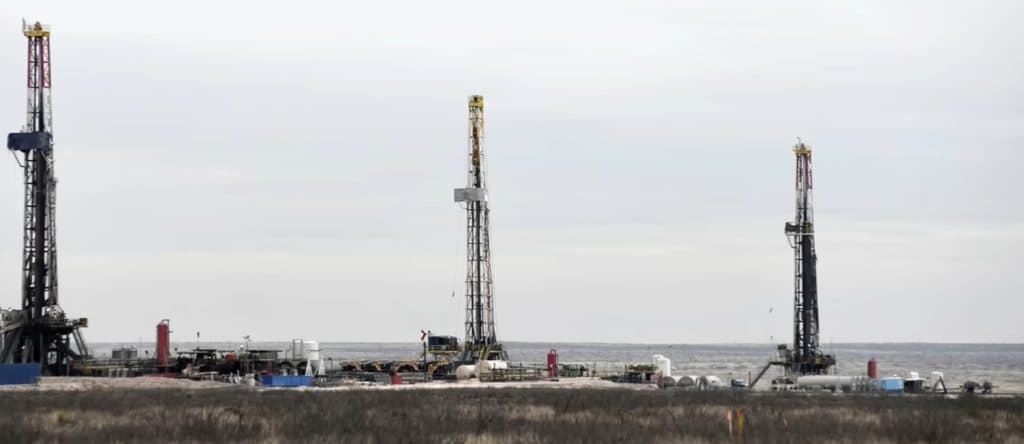
The Supreme Court will hear oral arguments Monday in a case determining whether companies acting under federal orders can shift state lawsuits to federal court — with many concerned parties arguing that American Energy is at stake.
The case addresses whether Chevron and other Energy companies can move a Louisiana state lawsuit to federal court under the federal-officer removal statute, based on actions taken on behalf of the federal government during World War II. Roughly 40 lawsuits have been filed since 2013 over oil and gas companies’ alleged role in Louisiana’s coastal erosion, and the Supreme Court’s upcoming review of Chevron U.S.A. v. Plaquemines Parish decides whether those cases can be moved from state to federal court.
“At the end of the day, this is about federal supremacy… that means that those doing the work of the federal government can’t be hauled into some state or local court to face judgment for the work they’re doing for the federal government,” Mike Fragoso a partner at Torridon Law PLLC, said in a statement.
Several parties filed amicus briefs in September — including the Department of Justice (DOJ), Republican Sen. Ted Cruz of Texas and Republican Alaska Attorney General Stephen Cox — arguing the lawsuits should be heard in federal court because some of the alleged conduct occurred during World War II when companies operated under federal contracts.
Chevron and other Energy companies are urging the Supreme Court to overturn a Fifth Circuitrulingthat found the oil companies failed to establish federal jurisdiction. Former U.S. Attorneys General Bill Barr and Michael Mukasey, along with numerous state attorneys general, support Chevron’s position. They argue the parishes are seeking to impose retroactive liability for conduct that the federal government previously authorized.
“The FDR administration ordered the oil companies to drill as much oil as they can in Louisiana and then refine it into aviation gasoline. … In an emergency situation like wartime, you can’t just go around suing people 80 years later for what the government told them to do,” John Shu, a constitutional law expert and legal commentator who served in the George H.W. Bush and George W. Bush administrations, told the Daily Caller News Foundation. “If you can sue somebody 80 years later for what the government told you to do to win a war, then no one’s going to do it.”
Others like Alliance For Consumers Executive Director O.H. Skinner argue the lawsuits could harm consumers as he links them to “woke lawfare,” or lawsuits pushed by climate activists that seek to wield the courts toenact their agenda.
Skinner told the DCNF previously that “woke lawfare is one of the key fronts being pressed by left-wing activists, where they hope to obtain the policy victories in court that have been rejected at the ballot box and in the halls of Congress. … This Louisiana lawsuit is a chief example of the climate lawfare that is being pushed by these activists and trial lawyers. It would mark a major turning point for the Supreme Court to rule against the plaintiffs and provide its first decision disrupting that campaign.”
Many major climate lawsuits brought by Democrat cities and states against Energy companies have been dismissedrecently, though some analysts argue that if even one surviving case succeeds, it could set a precedent with far-reaching impacts for the Energy sector and consumers.
The Louisiana oil and gas industry is massive, generating over $54 billion for the state in 2021, according to an analysis from the Louisiana Mid-Continent Oil and Gas Association (LMOGA) and the American Petroleum Institute (API). The Gulf Coast accounts for 55% of American refining capacity, with Louisiana’s Gulf Coast alone accounting for a significant portion, according to data from the Energy Information Administration (EIA).
Legal experts, including Carrie Campbell Severino, president of the Judicial Crisis Network, have pointed out alleged close ties and aligned interests between Louisiana’s governor and a trial lawyer leading many of these cases.
Fragoso also argued that “Louisiana is probably the worst place in the country for getting hometowned. Their judges are elected… with the support of plaintiffs’ lawyers… Plaquemines Parish like 23,000 people in it. So do the math of $745 million divided by 23,000 people, and you’re seeing the financial incentive for any individual resident who’s on the jury is tremendous.”
Republican Louisiana Gov. Jeff Landry moved to intervene in the local government lawsuits against the oil and gas companies and said they had “differing and competing interests” that affected Louisiana’s coastal restoration and economy in 2016, according to NOLA.com, a local New Orleans publication. Landry has since voiced support for the lawsuits.
The Baton Rouge law firm Talbot, Carmouche and Marcello, represented the local government’s lawsuit against Chevron for wetlands damages. It also donated $300,000 to the Protect Louisiana’s Children PAC, which supported Landry’s gubernatorial run in 2023, according to the Louisiana Illuminator.
All content created by the Daily Caller News Foundation, an independent and nonpartisan newswire service, is available without charge to any legitimate news publisher that can provide a large audience. All republished articles must include our logo, our reporter’s byline and their DCNF affiliation. For any questions about our guidelines or partnering with us, please contact [email protected].