
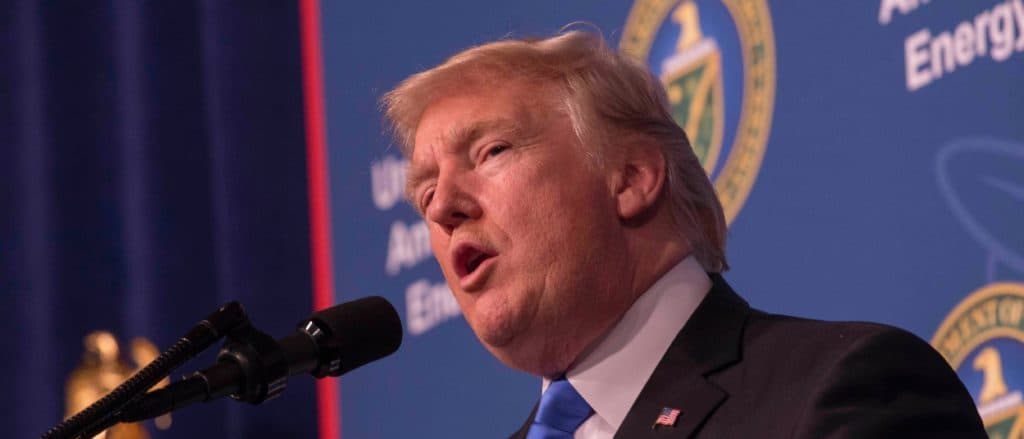

The Supreme Court ruled on former President Donald Trump’s immunity appeal, finding that presidents have immunity from criminal prosecution for “official acts” taken in office.
Trump’s appeal, which seeks to dismiss the case brought by special counsel Jack Smith based on Trump’s claim that he has absolute immunity from criminal prosecution for official acts during his presidency, has long delayed his trial in Washington, D.C., bringing proceedings at the district court to a grinding halt as the Supreme Court sorted out the dispute. Trump was indicted last August on four felony counts relating to alleged efforts to overturn the 2020 election.
“Under our constitutional structure of separated powers, the nature of Presidential power entitles a former President to absolute immunity from criminal prosecution for actions within his conclusive and preclusive constitutional authority,” the court held in a 6-3 ruling. “And he is entitled to at least presumptive immunity from prosecution for all his official acts. There is no immunity for unofficial acts.”
Chief Justice John Roberts wrote in the majority opinion that the ultimate analysis on which of the allegations in Trump’s indictment are considered official acts subject to immunity is “best left to the lower courts.”
“Certain allegations—such as those involving Trump’s discussions with the Acting Attorney General—are readily categorized in light of the nature of the President’s official relationship to the office held by that individual,” Roberts wrote. “Other allegations—such as those involving Trump’s interactions with the Vice President, state officials, and certain private parties, and his comments to the general public present more difficult questions. ”
Roberts wrote that Trump is “absolutely immune from prosecution for the alleged conduct involving his discussions with Justice Department officials.”
District Court Judge Tanya Chutkan canceled the initially scheduled March trial date while the appeal was still pending. The Supreme Court’s ruling now means a trial is almost certain not to be held before the election.
The D.C. Circuit Court of Appeals rejected Trump’s claim in February, finding he is not immune from prosecution. Chutkan previously denied Trump’s bid to dismiss the case in December.
In an effort to speed up the process, Smith asked the Supreme Court in December to take the case before the appeals court could weigh in. The justices declined Smith’s request to accelerate the appeal.
In a dissent, Justice Sonia Sotomayor wrote that the majority’s ruling “reshapes the institution of the Presidency, claiming “the President is now a king above the law.”
“Let the President violate the law, let him exploit the trappings of his office for personal gain, let him use his official power for evil ends,” Sotomayor wrote. “Because if he knew that he may one day face liability for breaking the law, he might not be as bold and fearless as we would like him to be. That is the majority’s message today.”
The Supreme Court ruled Friday in a case brought by Jan. 6 defendant Joseph Fischer that the Department of Justice (DOJ) interpreted an obstruction statute too broadly in charging him and hundreds of others. The ruling could impact Trump’s case as well, since two of the charges brought by Smith are related to the statute.
The indictment alleges Trump “knowingly false claims of election fraud to obstruct the federal government function by which those results are collected, counted, and certified.”
In a separate case involving the former president, the Supreme Court ruled in March that states cannot remove Trump from the 2024 ballot.
Trump’s criminal case in Georgia also is not expected to proceed to trial before the election, as it is now on pause pending the appeal of defendants’ bid to disqualify Fulton County District Attorney Fani Willis from the case. While he did not require her to step down from the case, Judge Scott McAfee found a significant appearance of impropriety in Willis’ relationship with the special prosecutor Nathan Wade, who defendants alleged she financially benefited from appointing when he paid for expenses on vacations.
The Daily Caller News Foundation reported in January that she awarded Wade a higher paying contract than the state’s top racketeering expert.
The trial date for his federal classified documents case in Florida was postponed indefinitely by the judge. Judge Aileen Cannon also held hearings recently considering the constitutionality of Smith’s appointment.
The FBI raided Mar-a-Lago in August 2022 as part of its investigation into Trump’s handling of the documents. Trump’s attorneys argued in a recent motion to dismiss the raid was “unconstitutional” and the search was “executed in an egregious fashion and in bad faith.”
President Joe Biden was not similarly charged for willfully possessing classified information after special counsel Robert Hur concluded a jury would likely not convict him, noting Biden presents himself “as a sympathetic, well-meaning, elderly man with a poor memory.”
Trump was convicted on 34 felony counts for falsifying business records in the case brought by Democratic Manhattan District Attorney Alvin Bragg in May. His sentencing is scheduled for July 11.
(Featured Image Media Credit: Photo Simon Edelman, Energy Department)
All content created by the Daily Caller News Foundation, an independent and nonpartisan newswire service, is available without charge to any legitimate news publisher that can provide a large audience. All republished articles must include our logo, our reporter’s byline and their DCNF affiliation. For any questions about our guidelines or partnering with US, please contact [email protected].