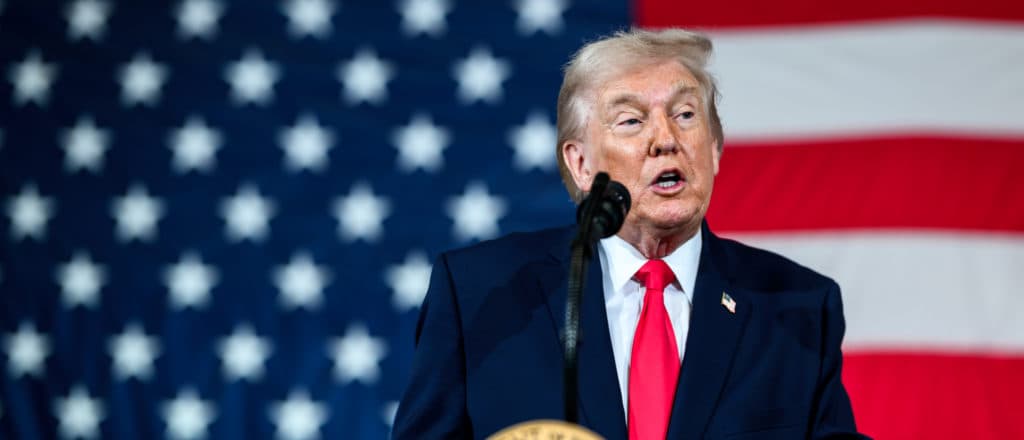
Last week marked one of the most important events on Donald Trump’s foreign policy calendar. The president sat down in Beijing for a much-anticipated meeting with Chinese leader Xi Jinping.
All signs looked positive before the summit, with some commentators comparing it to Richard Nixon’s famous China trip in 1972.
We don’t yet have a full readout of how the meeting went, but the president himself indicated that he and Xi discussed, among other weighty subjects, Iran, Taiwan and the global economy.
This is encouraging. Trump’s main goal in Beijing was to put America first, and that meant insisting China change its behavior on all three of those issues — forcefully if necessary.
Start with the war in Iran. China has made a point of supposedly staying on the sidelines, positioning itself as a peacemaker. The reality is that Beijing has been aiding and abetting the Iranians for months in increasingly bold and dangerous ways.
Just last week, China invoked a “blocking statute” to make known it wouldn’t respect U.S. sanctions on Iranian oil that have been imposed since the start of the war. Despite the Strait of Hormuz being closed, Iranian oil exports continue to transit through and an estimated 90% of them go to China.
When the oil reaches the Chinese mainland, small plants known as “teapot refineries” process the crude, an economic arrangement even CNN has called a “shadowy network.” That network is being used to enrich the same Iranian regime that’s targeting America’s armed forces.
At the summit, he reportedly secured a promise from Xi not to send military equipment to Iran. His administration should watch the situation closely and make sure China is good to his word.
The next point for Trump was to stress that China needs to exercise responsibility in its own corner of the globe.
China is an emerging global force, but militarily it’s still a regional power. Its armed forces are being modernized to win a hypothetical war in the Indo-Pacific, not on shores far from home.
But China is also a deeply irresponsible regional power. Beijing has relentlessly antagonized its powerful neighbor of Japan, cratering Chinese-Japanese relations to their lowest point in more than half a century. Showy military exercises near disputed waters and shadowy influence campaigns have been leveraged against South Korea. Taiwan is under constant threat.
What does this have to do with “America first”? The United States has military alliances with both Japan and South Korea; thousands of U.S. troops are deployed to both countries. Should tensions boil over into a firefight, there is no question the United States would get drawn in.
Last year, Trump reportedly chided the Japanese prime minister for speaking too hawkishly about China. We know refused to take Xi’s bait on Taiwan at the summit; let’s hope he gave Xi a similar warning. Arcane disputes over obscure islands in the Pacific are not worth endangering a single American life.
Then there’s the economic grievances. This is Trump’s bread and butter and he no doubt pressed the case again in Beijing.
Any discussion of China’s economy has to start with tech giant Huawei, which recently announced that for the first time its chips will be used in an AI model also developed by China.
Huawei is expanding China’s domestic tech sector, yet it’s also a national security threat that’s targeted the U.S. with espionage and intellectual property theft. Last year, U.S. intelligence agencies went so far as to push for a shrewd merger between Hewlett Packard Enterprise and Juniper Networks, since the new tech company will have the scale to compete with the dangerous Huawei.
Beijing’s recent demand that Meta unwind its acquisition of the Chinese AI company Manus shows it’s becoming increasingly coercive in what should be a fair competition between tech sectors. This is a problem and something Trump no doubt drove home to the Chinese president.
Whether or not a deal with China is forthcoming, Trump has plenty of leverage to exert America’s interests. China’s economyis weakening and foreign investment has shrunk significantly, meaning Beijing will be eager to avoid more American tariffs.
The Xi summit was a great opportunity for Trump to press his case, not to bully China, but to make sure America comes out stronger than before. As details about the summit begin to dribble out, let’s make sure we judge it by whether Trump put America first.
Stacy Washington is a decorated Air Force veteran, an Emmy-nominated TV personality, and the host of “Stacy on the Right,” which airs nightly 9 p.m. to midnight ET on SiriusXM Patriot Channel 125. She previously served as co-chair of Black Voices for Trump.
The views and opinions expressed in this commentary are those of the author and do not reflect the official position of the Daily Caller News Foundation.
All content created by the Daily Caller News Foundation, an independent and nonpartisan newswire service, is available without charge to any legitimate news publisher that can provide a large audience. All republished articles must include our logo, our reporter’s byline and their DCNF affiliation. For any questions about our guidelines or partnering with us, please contact [email protected].