




Nearly two dozen Democrats broke with House Minority Leader Hakeem Jeffries to pass a sprawling funding package on Tuesday afternoon, ending the four-day partial government shutdown.
Lawmakers voted 217-214 to approve the Senate-passed deal that funds nearly 80% of the federal budget through Sept. 30, including the Departments of War, Treasury and State among other agencies. The House also signed off on a two-week extension of Department of Homeland Security (DHS) funding while Senate Democrats and the White House continue to negotiate reforms to immigration enforcement.
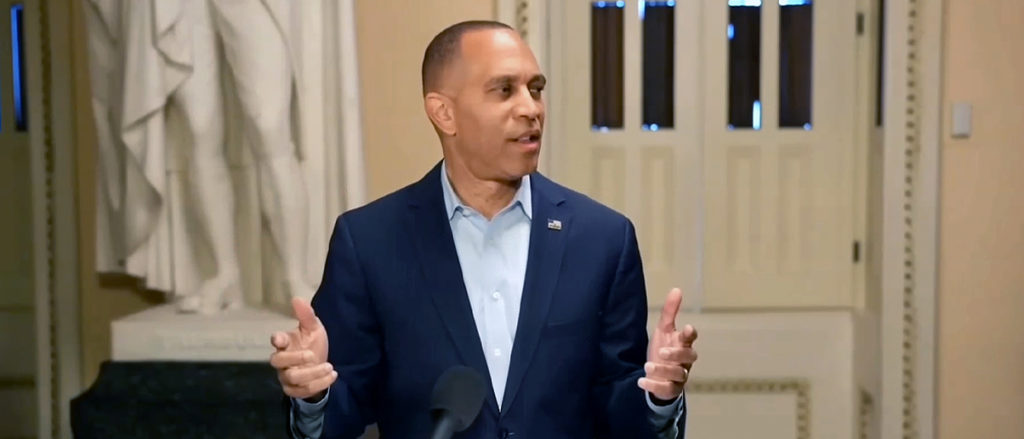
More than 190 Democrats — including House Minority Leader Hakeem Jeffries and his leadership team — voted “no” on the funding deal brokered between Senate Democrats and the White House. Top House Democrats insisted Tuesday that there is no antagonism toward their Democratic colleagues in the upper chamber despite opposing the spending framework negotiated in part by Senate Minority Leader Chuck Schumer.
Among the 21 Democratic lawmakers who voted for the funding deal is Connecticut Rep. Rosa DeLauro, the lead Democrat on the Appropriations Committee, who lauded the “bipartisan” negotiations that crafted the five appropriations bills.
“Did we get everything we wanted, hell no,” DeLauro said Monday. “Did the Republicans get everything they wanted, hell no.”
House Speaker Mike Johnson ripped Democrats for opposing the spending deal to end the partial shutdown.
“What they’ll be shutting down is FEMA operations as we’re cleaning up from the winter storms. They’ll be shutting down TSA, which is obviously necessary to keep the country moving through our airports, Coast Guard operations,” Johnson said Tuesday at a GOP leadership press conference. “So many important functions in the Department of Homeland Security is what will be adversely affected by these partisan games.”
Twenty-one Republicans voted against the funding package, citing concerns about hundreds of earmarks included in the appropriations bills and the failure to fund DHS for the entire fiscal year.
The funding package now heads to the White House for President Donald Trump’s signature. The president urged the House to quickly pass the spending agreement on Monday, arguing that Republicans must avoid “another long, pointless and destructive” shutdown.
Republican Kentucky Rep. Thomas Massie, a fiscal hawk, was the lone GOP lawmaker to oppose a rule teeing up the funding package for a vote on final passage. Given House Speaker Mike Johnson’s razor-thin majority, just two defecting GOP lawmakers could have defeated the procedural vote and prolonged the funding lapse.
Massie’s opposition to the spending agreement comes after Trump attacked Massie’s wife, Carolyn Moffa, in a Truth Social post on Monday, calling her a “Radical Left ‘flamethrower.’” Massie noted that Moffa has voted for Trump every time he has appeared on the ballot since 2016. Trump is backing a GOP primary challenger to Massie ahead of November’s midterm elections.
House GOP leadership also successfully flipped Tennessee Rep. John Rose’s vote to advance the funding package.
Rose, who is mounting a longshot bid against Trump-endorsed Republican Tennessee Sen. Marsha Blackburn in the state’s 2026 gubernatorial primary, initially said he could not vote to advance the funding package without the SAVE Act attached.
The election integrity legislation, which passed the House in April 2025, faces strong headwinds in the Senate due to the 60-vote threshold. Senate Minority Leader Chuck Schumer has vowed that Democrats will use the filibuster to prevent the SAVE Act from clearing the upper chamber.
The updated legislation would require proof of citizenship and voter ID to vote in federal elections.
Republican Reps. Troy Nehls of Texas, Byron Donalds of Florida, Andy Ogles of Tennessee and Victoria Spartz of Indiana also withheld their votes until they flipped to “yes.” The conservative cohort had similar concerns about the SAVE Act’s passage in the Senate.
The funding deal appeared to be on smooth sailing Monday after several GOP holdouts, who had demanded leadership attach an updated version of the SAVE Act, stood down following a meeting with the president at the White House on Monday.
Republican Rep. Anna Paulina Luna of Florida, a leading proponent of the SAVE Act, said she received commitments that the Senate would begin consideration of the legislation outside of the appropriations process.
Senate Majority Leader John Thune clarified Tuesday that he did not commit to put the SAVE Act on the floor and steer around the Senate’s 60-vote threshold by using the rarely-deployed “talking” filibuster.
Thune, who has publicly endorsed the SAVE Act and pledged a floor vote, said he would continue to have conversations with his conference about how to proceed.
All content created by the Daily Caller News Foundation, an independent and nonpartisan newswire service, is available without charge to any legitimate news publisher that can provide a large audience. All republished articles must include our logo, our reporter’s byline and their DCNF affiliation. For any questions about our guidelines or partnering with us, please contact [email protected].