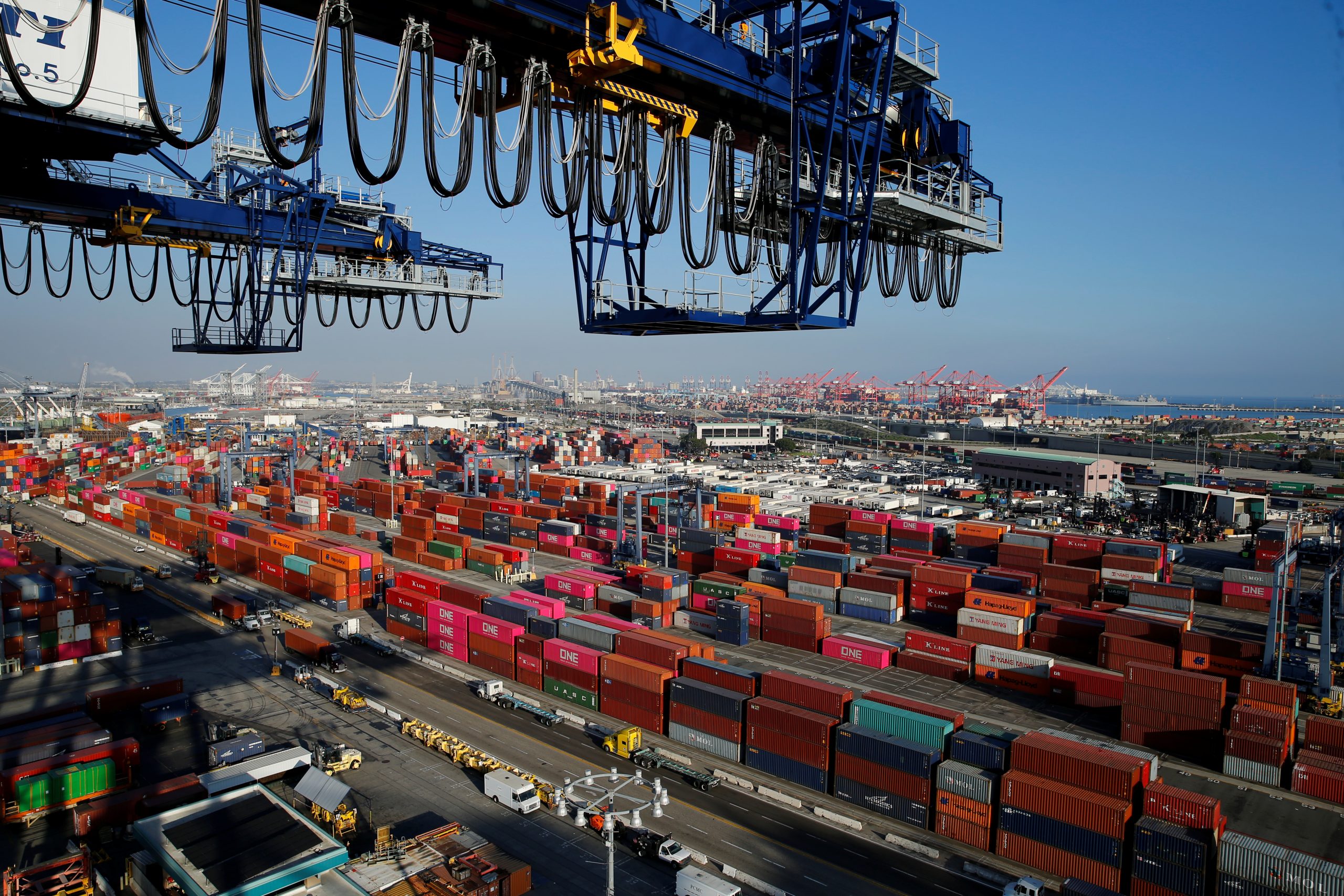




The U.S. economy missed the Trump administration’s 3% growth target for a second straight year, posting its slowest annual growth in three years in 2019 as the slump in business investment deepened amid damaging trade tensions.
The 2.3% expansion last year reported by the Commerce Department on Thursday suggested the White House and Republicans’ massive $1.5 trillion tax cut package, which President Donald Trump had predicted would lift growth above 3%, had provided the economy only a temporary boost.
Moderate growth undercuts the argument by Trump and his fellow Republicans that strong growth would pay for the tax cuts, which are expected to help push the federal budget deficit to $1.02 trillion this year. Growth last year was the slowest since 2016 and followed the 2.9% notched in 2018.
White House economic adviser Larry Kudlow shrugged off the 2019 performance, telling Fox Business Network “it is a fundamentally healthy economy,” and expressed confidence that activity will accelerate this year, a view not widely shared outside the administration.
While Thursday’s snapshot of gross domestic product showed the economy maintaining a moderate pace of growth in the fourth quarter, that was in part because of a smaller import bill, which has since swelled as the year ended. Consumer spending cooled considerably last quarter and scope for a rebound looks limited as wage growth appears to have stalled.
But the longest expansion in history, now in its 11th year, probably remains on track and a recession is unlikely as the Federal Reserve’s three interest rate cuts in 2019 kick in. The Fed kept rates unchanged on Wednesday. Fed Chair Jerome Powell told reporters the U.S. central bank expected “moderate economic growth to continue” but also nodded to some risks, including the recent coronavirus outbreak in China.
The Trump administration’s 18-month-long trade war with China last year fueled fears of a recession. Though the economic outlook has improved with this month’s signing of a Phase 1 deal with Beijing, economists do not see a boost to the economy as U.S. tariffs remained in effect on $360 billion of Chinese imports, about two-thirds of the total.
Gross domestic product increased at a 2.1% annualized rate in the fourth quarter, matching the third-quarter pace, also as lower borrowing costs encouraged purchases of houses. Growth was also supported by increased government spending on defense.
That helped to offset the drag from a slower pace of inventory accumulation. Last quarter’s rise in GDP growth was in line with economist’s expectations.
Economists estimate the speed at which the economy can grow over a long period without igniting inflation at around 1.8%.
Excluding trade, inventories and government spending, the economy grew at a 1.4% rate in the fourth quarter, the slowest in four years. This measure of domestic demand rose at a 2.3% pace in the third quarter.
“The economy had very few engines left at year end to keep flying high in 2020,” said Chris Rupkey, chief economist at MUFG in New York. “The economy is in a good place only because the trade war made imports so expensive that American businesses and consumers cut back their purchases.”
Economists have long disagreed that slashing the corporate tax rate to 21% from 35%, as well as shrinking the trade deficit would boost annual GDP growth to 3.0% on an sustainable basis, because of low productivity and population growth.
They also argue that historically there has not been a very strong relationship between corporate tax rates and business investment. Some companies including Apple used their tax windfall for share buybacks.
The dollar weakened against a basket of currencies, while U.S. Treasury prices rose. Stocks on Wall Street fell as the coronavirus epidemic heightened concerns about China’s economy.
BUSINESS INVESTMENT SLUMPING
Business investment fell at a 1.5% rate in the fourth quarter. It was the third straight quarterly decline and the longest such stretch since 2009. There were decreases last quarter in spending on nonresidential structures such as mining exploration, shafts and wells, and industrial equipment.
Spending on nonresidential structures contracted in 2019 by the most since 2016. Trade tensions have eroded business confidence and weighed on capital expenditure.
With confidence among chief executive officers remaining low in the fourth quarter after dropping to a 10-year low in the prior quarter, a rebound is unlikely soon.
Business investment is also seen pressured by Boeing’s suspension this month of the production of its troubled 737 MAX jetliner, which was grounded last March following two fatal crashes. Boeing on Wednesday reported its first annual loss since 1997.
Economists estimate Boeing’s biggest assembly-line halt in more than 20 years could slice at least half a percentage point from first-quarter GDP growth.
Growth in consumer spending, which accounts for more than two-thirds of U.S. economic activity, slowed to a 1.8% pace after rising at a brisk 3.2% rate in the third quarter. There was a reduction in spending at restaurants and bars.
Though a separate report from the Labor Department on Thursday showed the number of Americans filing claims for state unemployment benefits fell last week, the tight labor market is not generating a faster pace of wage growth.
In the fourth quarter, personal income at the disposal of households after adjusting for inflation rose at a 1.5% rate, stepping down from a 2.9% pace in the third quarter.
The decrease in imports in the fourth quarter, in part because of U.S. tariffs on Chinese goods, compressed the trade deficit. That led to trade adding 1.48 percentage points to fourth-quarter GDP growth, the most since 2009.
“When trade adds more to growth than consumption, you know things are out of whack,” said Joel Naroff, chief economist at Naroff Economic Advisors in Holland, Pennsylvania.
Last quarter’s decline in imports resulted in businesses almost depleting inventories in warehouses. A 40-day strike at General Motors also weighed on motor vehicle inventories.
Inventories rose at a $6.5 billion rate in the fourth quarter, the smallest gain since the second quarter of 2018, after increasing at a $69.4 billion pace in the July-September quarter. Inventory investment chopped 1.09 percentage points from GDP growth last quarter, the most since 2018.
(Reporting by Lucia Mutikani; Editing by Dan Burns and Andrea Ricci)












