



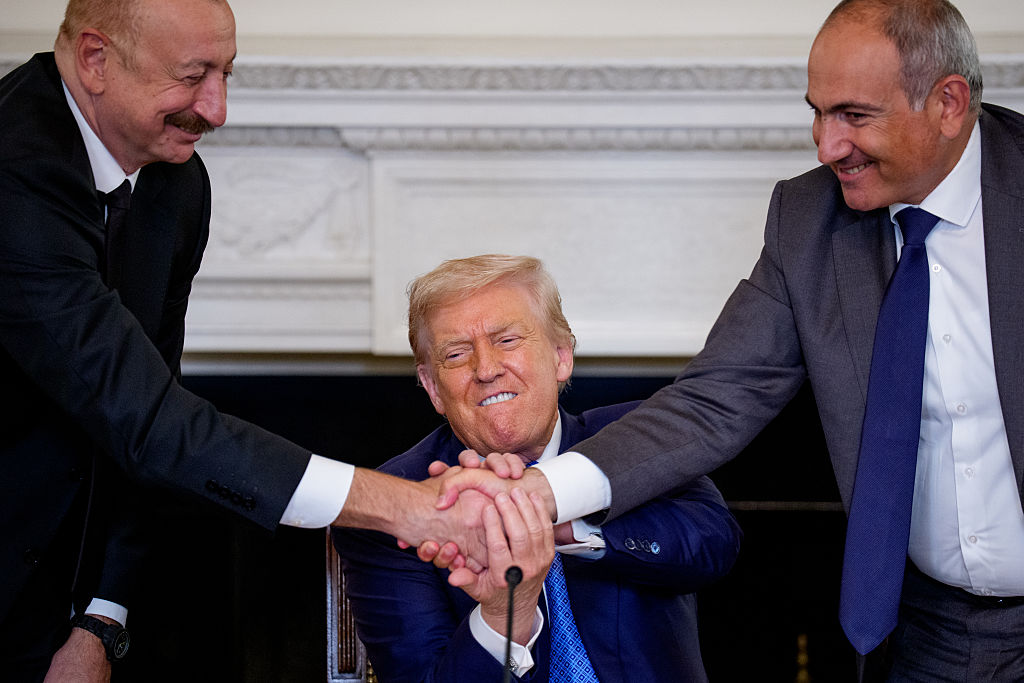
The leaders of Armenia and Azerbaijan shook hands at the White House on Friday as they joined President Donald Trump to sign an agreement aimed at ending decades of conflict, according to the Associated Press.
The deal will reopen key transportation routes and create a major transit corridor — to be named the Trump Route for International Peace and Prosperity — while expanding U.S. influence as Russia’s regional clout declines.
Trump called the naming “a great honor for me” but said, “I didn’t ask for this.” A senior official said Armenia proposed it. Azerbaijani President Ilham Aliyev said the corridor will “create connectivity opportunities for so many countries” and begin “the path toward strategic partnership.”
Armenian Prime Minister Nikol Pashinyan called it a “significant milestone” and thanked Trump, with both leaders joining others in suggesting Trump deserves a Nobel Peace Prize. “President Trump in six months did a miracle,” Aliyev said.
The corridor will connect Azerbaijan to its Nakhchivan exclave through Armenian territory — a demand that had long blocked peace talks. White House spokeswoman Anna Kelly said it will ensure “unimpeded connectivity” while respecting Armenia’s sovereignty. Trump said he was “very confident” in lasting peace and may visit the route.
The signing caps months of U.S.-brokered diplomacy, adding to agreements Trump has mediated this year between Congo and Rwanda, a ceasefire between India and Pakistan, and a threatened trade cutoff to end clashes between Cambodia and Thailand. Gaza and Ukraine peace efforts remain unresolved.
The Armenia-Azerbaijan pact deals a geopolitical blow to Russia, which for decades mediated the conflict to bolster its influence in the South Caucasus. Moscow’s leverage has eroded since its 2022 invasion of Ukraine. Trump’s envoy Steve Witkoff began talks earlier this year with Aliyev to push what officials called a “regional reset.”
Negotiations over the Trump Route’s development — to include rail, oil and gas pipelines, and fiber optics — start next week, with nine developers already interested. Separate bilateral deals with the U.S. will boost cooperation in energy, technology, and the economy.
On Thursday, Trump previewed the agreements on Truth Social, saying they would “fully unlock the potential” of the South Caucasus. “Many Leaders have tried to end the War, with no success, until now, thanks to ‘TRUMP,’” he wrote.
The signing, held in the State Dining Room, marks the first peace declaration between the two since the Cold War. Among the documents was a letter urging the OSCE to dissolve its Minsk Group, long tasked with mediating the conflict but now deemed irrelevant.
Decades of Conflict
The nations fought for nearly 40 years over Nagorno-Karabakh, an ethnically Armenian region inside Azerbaijan. Fighting since the Soviet collapse killed tens of thousands, with repeated failed mediation. In 2023, Azerbaijan retook all of Karabakh and pressed Armenia for the Nakhchivan corridor. Armenia resisted third-party control, citing sovereignty concerns, but U.S. incentives and improved access swayed its position.
Russia’s inaction during Azerbaijan’s 2023 offensive alienated Armenia, which is turning West, while Azerbaijan grows more defiant toward Moscow. U.S. officials say the deal could reshape alliances in the South Caucasus and set the stage for lasting stability.












