



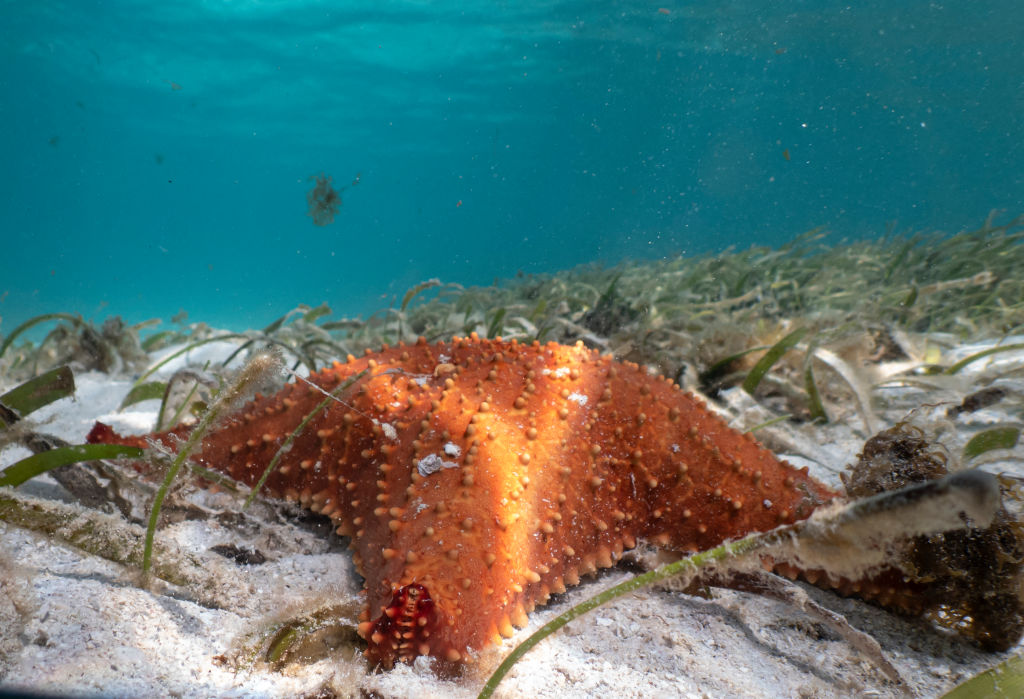
After more than a decade of mystery, scientists say they’ve finally identified what wiped out more than 5 billion sea stars along North America’s Pacific coast — one of the largest marine die-offs ever recorded.
According to The Associated Press, the culprit: a bacterium called Vibrio pectenicida, which has also infected shellfish, according to a new study published Monday in Nature Ecology and Evolution.
Starting in 2013, a mysterious sea star wasting disease devastated populations from Mexico to Alaska, destroying more than 20 species. The sunflower sea star — once one of the most common — lost about 90% of its population in the first five years.
“It’s really quite gruesome,” said Alyssa Gehman, a marine disease ecologist at the Hakai Institute in British Columbia, who helped identify the cause. “Healthy sea stars have puffy arms sticking straight out. But the wasting disease causes them to grow lesions and then their arms actually fall off.”
The discovery ends years of false leads. Early research suggested a virus might be responsible, but scientists later learned the suspected densovirus was actually harmless to healthy sea stars, said Melanie Prentice, co-author of the study.
Researchers ultimately found the answer in coelomic fluid, the liquid surrounding sea stars’ organs, where the bacteria were thriving.
“It’s incredibly difficult to trace the source of so many environmental diseases, especially underwater,” said Blake Ushijima, a microbiologist at the University of North Carolina, Wilmington. He called the team’s work “really smart and significant.”
Now, scientists hope to use this discovery to help the species recover — potentially by breeding resistant sea stars or relocating healthy ones.
Sunflower sea stars are vital to Pacific ecosystems because they keep sea urchin populations in check. Without them, urchins have destroyed nearly 95% of Northern California’s kelp forests, which Rebecca Vega Thurber of UC Santa Barbara called “the rainforests of the ocean.”












