



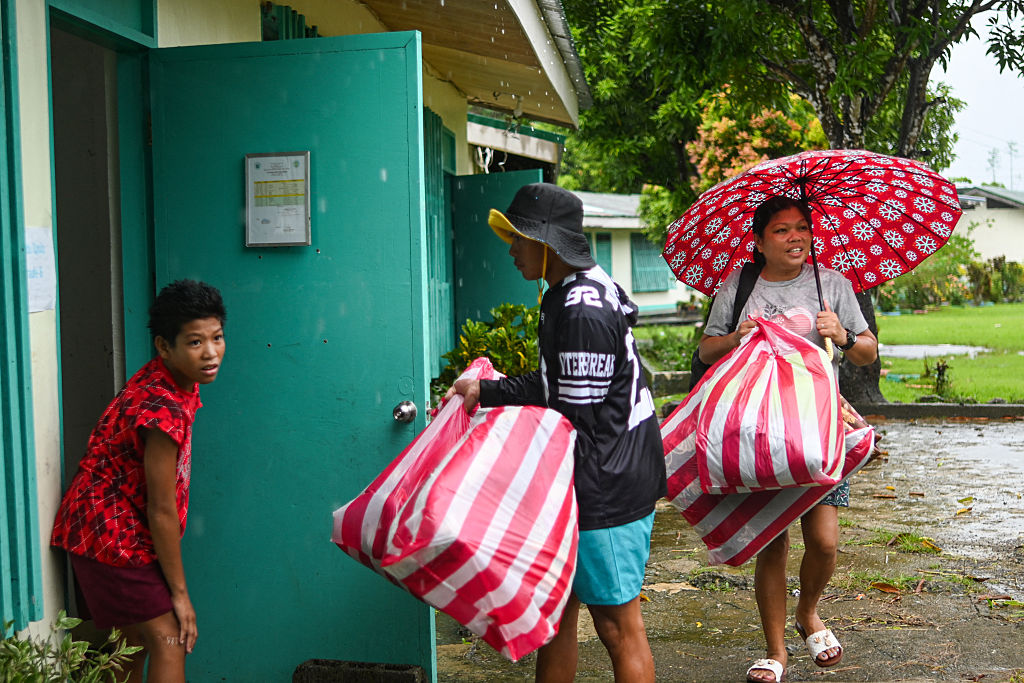
More than 150,000 residents fled their homes in eastern Philippine provinces Monday as Typhoon Kalmaegi roared in from the Pacific Ocean, bringing warnings of torrential rain, destructive winds, and storm surges up to 10 feet high.
According to The Associated Press, the powerful storm — locally named Tino — was expected to make landfall late Monday or early Tuesday, according to forecasters. As of Monday evening, it was located about 59 miles southeast of Guiuan in Eastern Samar province, packing sustained winds of 87 mph and gusts reaching 106 mph.
Authorities warned that Kalmaegi could strengthen further as it moved westward, threatening central island provinces — including Cebu, which is still recovering from a 6.9-magnitude earthquake that struck on Sept. 30, killing at least 79 people and displacing thousands.
Officials said those still living in temporary shelters would be moved to sturdier buildings ahead of the storm.
On Negros Island, residents were cautioned about the risk of volcanic mudflows on Kanlaon Volcano, which has recently emitted plumes of ash and steam, according to the Philippine Institute of Volcanology and Seismology.
Disaster officials said nearly 156,000 people had been evacuated by nightfall in Eastern and Southern provinces, including the Dinagat Islands, while search and rescue units remained on high alert.
“Nobody’s complaining among the residents because of their experience with Yolanda. They know it’s better to be safe than sorry,” Eastern Samar Gov. RV Evardone told the Associated Press, referencing Typhoon Haiyan — known locally as Yolanda — the catastrophic 2013 storm that left more than 7,300 people dead or missing.
To prevent maritime accidents, the coast guard banned inter-island ferries and fishing boats from sailing in rough seas, leaving more than 3,500 passengers and truck drivers stranded across nearly 100 ports. Several domestic flights were also canceled.
The Philippines, hit by an average of 20 typhoons each year, remains one of the world’s most disaster-prone nations due to its frequent earthquakes, volcanic activity, and tropical storms.