



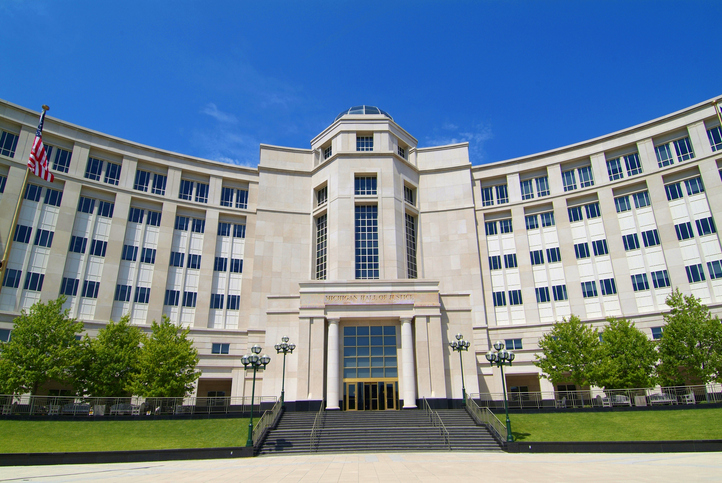
A debate over courthouse safety and immigration enforcement is intensifying in Michigan as the state’s highest court considers a proposal that would bar civil arrests — including immigration detentions — inside state and local courtrooms.
According to The Associated Press, the Michigan Supreme Court announced last month that it is reviewing a rule change that would prohibit civil arrests of anyone “attending a court proceeding or having legal business” in any trial or appellate courthouse.
Criminal arrests and court‑ordered detentions would not be affected.
If approved, Michigan would join states such as New York, Connecticut, and Illinois, which have already moved to limit immigration enforcement in local courts.
Supporters argue the rule is necessary to ensure people aren’t too afraid to appear for hearings or handle legal matters.
“It’s an issue that affects everyone when you have any part of the population that is afraid to come and participate in our court proceedings,” said Susan Reed, executive director of the Michigan Immigrant Rights Center.
Opponents within President Donald Trump’s administration have long criticized similar policies as “sanctuary” measures designed to block lawful arrests.
The administration has challenged such rules in court but has not succeeded in blocking them.
A mathematician’s analysis identified 2,388 likely immigration arrests in federal immigration courts between May and July 2025 — including nine in Detroit — though arrests at local courthouses appear less common for individuals with no criminal history.
Reed and ACLU of Michigan director Loren Khogali urged the court earlier this year to update its rules after a U.S. citizen was mistakenly detained outside Plymouth’s 35th District Court.
In an April letter, they warned that courthouse immigration enforcement could “seriously disrupt the fair and efficient functioning of our state courts.”
They argue that even the possibility of encountering immigration agents can keep people from testifying, reporting abuse, or addressing matters such as child custody and domestic violence.
“A rule would definitely go a long way to address fear,” Reed said. “To simply make the state court a place where state matters are adjudicated and not address these federal civil immigration matters there, it’s really a practical response.”
The Biden‑era limits on courthouse immigration arrests were reversed on day one of Trump’s second term.
Current guidance directs ICE to pursue civil enforcement at or near courthouses when agents have credible information that a targeted individual will be present. ICE officials argue that courthouses offer safer conditions because visitors are screened for weapons.
Michigan is not alone in considering restrictions. Illinois approved its own ban in October, while Connecticut recently passed legislation expanding limits on civil immigration arrests and restricting face coverings by law enforcement in court.
New York’s 2020 law, upheld after a recent court challenge, similarly blocks civil arrests without a criminal warrant or judicial order.
Public feedback in Michigan heavily favors the rule. Nearly 500 comments submitted by Dec. 1 overwhelmingly supported the proposal, emphasizing the need to ensure people can safely access the justice system.
“I have seen firsthand how fear keeps people from showing up for hearings, filing important documents, or even reporting harm,” wrote Michigan attorney Jeremy Orr. “When people are too afraid to enter the courthouse, they lose access to justice, and the entire system suffers.”
Some commenters disagreed, arguing the judiciary should not interfere with federal immigration enforcement. “Come here legally or ICE will see you to the door,” wrote Victoria Muterspaugh.
The Michigan Supreme Court, which has a Democratic-appointed majority, will collect written comments until Dec. 22. A public hearing is expected before the court decides whether to adopt the change, revise it, or reject it entirely.