




President Donald Trump said the Kennedy Center honorees represented “the fabric of America.” Hailing from distinct regional cultures and laboring in wildly different genres, the awards suggested an older form of diversity may actually be America’s strength.
From George Strait’s cowboy coterie to KISS’ vampiric rock and roll, America’s 20th century performing arts offer insight into what we’ve lost since the aughts, and what we ought to regain this millennium. There are common threads that make the honorees uniquely American: perseverance, inventiveness, and an individualist streak.
Though the Kennedy Center board has its own nomination process, this year, Trump said he “was about 98% involved. No, they all went through me.”
I set out for the storied performing arts enter in an attempt to determine art’s future in American national identity and public life. The evening began on the red carpet. Crowded out by film crews, I took my position in the then-empty box awaiting the White House media team. There, I asked KISS’ frontman Paul Stanley what the performing arts meant for patriotism and national identity.
“A very, very complex question. I think the arts at their finest celebrate the individual and your freedom to express yourself. That’s what art is supposed to be, it’s self expression. And in its purest form, people relate to it,” Stanley said. “Not intellectually, but emotionally. If we’re free to create art then we’re living in a free society. The fact that I’m here and other people are here with perhaps diverse opinions about different issues is what makes this America.”
His answer struck me as the same old pablum one hears from the older generation. After reflecting further, I think otherwise. KISS’ generation possessed an individualism and internalized freedom that made America, America. KISS and rock stars writ large were empowered to experiment free from a henpecking nanny-state or repressive corporate structure.
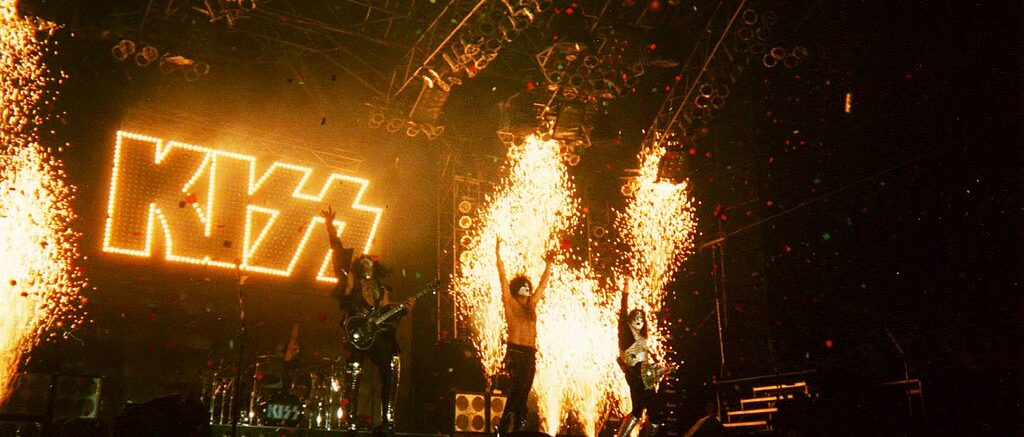
The band epitomized “toxic masculinity”: philandering, partying hard, and in-your-face pyrotechnics. As Gene Simmons said in a 2007 interview with musician Henry Rollins, “we want our rockstars to be unlike ordinary people. And then our rockstars became ordinary people.”
Today’s stars are ordinary. They avoid any transgressive act or remark that may provoke the mob against them and their management. KISS’ era respected freedom of speech and expression as a matter of course. Today, the First Amendment is no longer a cultural force. It exists as a legal artifact rather than a blueprint for popular discourse.
Freedom of expression, at its height, was the cultural powerhouse animating the perseverance, optimism, and individualism that constituted American’s shared cultural language. Garth Brooks, the “Rodeo” star, covered KISS’ “Shout It Out Loud” as part of the ceremony. Today, political polarization has gone hand-in-hand with an aesthetic divergence. As Simmons said in his aforementioned interview, “The record industry is dead because of the fans. They killed it, and what you have now is chaos.” We watch different shows, listen to different music, and read different newspapers.
An Oklahoma country artist and a bedazzled, make-up wearing rock band no longer overlap in the same way that Brooks does with KISS.
Their generation, despite their own disagreements and separate sensibilities, were ultimately contributing to a common consumer market. Though this may be in part due to a monolithic television and radio culture that is now obsolete, it remains the case that our stars are now reduced to the status of influencer. Instead of capturing an audience, they cater to them. The honorees rose to prominence during a time when a shared culture and mass market allowed them to launch unique brands, personas, and cultural production.
The Kennedy Center honorees charted their own courses. As President Trump said, “Sylvester Stallone wasn’t born, he was forged.”
Stallone’s ceremony revolved around “Rocky“, and its display of indomitable will against all odds. Rocky’s grit and determination were emblematic of the evening’s attendees. Gloria Gaynor was treated to a cover of her own break-out single “I Will Survive” that goes hand-in-glove with the fictional Philadelphia boxer’s uphill battle.
Where does perseverance come from? A belief that things can be better. That is optimism. How do you settle a wild continent with barely any men and no way home? A belief in yourself. Gene Simmons, discussing his own career, struck at the heart of what it means to be an American: “I am delusionally in love with myself…because I’m delusional, I’m fearless. It starts with will. The will of a giant.” It takes the will of a giant to survive, to go ten rounds when everyone thinks you will lose, and as Stallone says in the 2006 film “Rocky Balboa”, “It ain’t about how hard you hit. It’s about how hard you can get hit and keep moving forward…that’s how winning is done!”
This is American grandiosity, the drive to succeed independently, or as Trump put it during his remarks at the Kennedy Center Honors, “We want big, we want the biggest, we want bigness.”
America has lost much of what made it great. Free speech and expression are no longer cultural givens, but things to be fought for.
Despite all this, Americans refuse to give up. As Trump joked about some in attendance, ignoring his teleprompter, “Many of you are horrible, miserable people, but you are persistent. You don’t give up, sometimes I wish you’d give up, but you don’t.”
All content created by the Daily Caller News Foundation, an independent and nonpartisan newswire service, is available without charge to any legitimate news publisher that can provide a large audience. All republished articles must include our logo, our reporter’s byline and their DCNF affiliation. For any questions about our guidelines or partnering with us, please contact [email protected].