



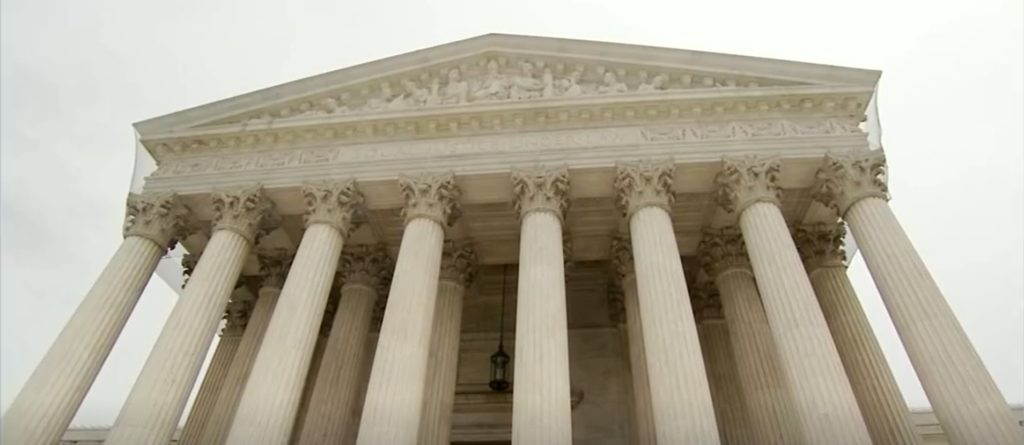

After a year of success at the Supreme Court, the Trump administration faces consequential rulings in the new year on matters where victory may not be as certain, like birthright citizenship and the president’s tariffs.
The administration racked up 20 victories on the Supreme Court’s emergency docket in 2025, with just five losses, according to the Brennan Center for Justice.
High court victories this year have included decisions allowing the administration to stop issuing passports based on gender identity and to enforce its transgender military ban.
The majority let Trump move forward with firing federal workers and Democrat-appointed members of agency boards. It also handed the administration significant wins on immigration, allowing them to resume third-country deportations, revoke Temporary Protected Status (TPS) for Venezuelan nationals and end Biden-era parole grants for more than 500,000 migrants.
One of the administration’s biggest legal wins was the Supreme Court’s opinion in Trump v. CASA, where the majority reined in the power of district court judges by limiting their ability to issue nationwide injunctions.
Meanwhile, two of the administration’s few losses came in the past week.
The majority declined on Tuesday to allow Trump to deploy the National Guard in Chicago. They denied on Friday a request from the administration related to restrictions on immigration judges’ speaking engagements.
In April, the Supreme Court also directed the administration to “facilitate and effectuate” Kilmar Abrego Garcia’s return to the United States after he was deported to El Salvador. Through a 5-4 decision in March — which Justice Samuel Alito strongly objected to — the justices declined to halt a lower court order instructing the administration to pay out $2 billion in foreign aid.
During an interview with the Italian news outlet Corriere Della Sera published Monday, Alito noted there has been “an inclination by presidents to try to do more and more and more, using their own power, or what they believe to be their own power” over the past 10 years.
“And now, under President Trump, it’s just gone on like this, and he’s used his executive power very aggressively,” Alito said.
“And what we have seen since the beginning of his second term, since January, is that so many of these things that he has done are immediately challenged in court,” he continued. “We have 680 district court judges. A district judge says ‘it’s unconstitutional, or it’s unlawful’, and then the case comes to us as an emergency matter.”
The White House did not respond to a request for comment.
Coming In 2026
Significant decisions are pending in 2026, but it’s less clear the administration will prevail in all cases.
On the merits docket, a dispute over Louisiana’s congressional map is still pending. After initially hearing the case last year and putting off a decision, the justices heard arguments again in October, weighing whether race-based redistricting is constitutional. Several justices have signaled an openness to limiting the use of race in creating districts.
Louisiana’s Secretary of State asked for a decision by early January before qualifying dates for state primary elections in April.
The justices already heard arguments in November on Trump’s sweeping tariffs, appearing skeptical of their legality. Treasury Secretary Scott Bessent has said he is confident the tariffs will be upheld because “the Supreme Court does not interfere with a president’s signature policy.”
“I don’t think this ruling is gonna go against us, but if it does, what’s their plan for refunds? How is this going to get to consumers? Are they just going to hand some of these importers big windfalls?” Bessent said in November on Fox News. “What if the exporters had given big discounts already, and then you’re going to give a refund on the tariffs? So, they’d be making it on both sides. So, I don’t think the Supreme Court wants to wade into a mess like that.”
In another major case, Trump v. Slaughter, the Supreme Court will decide whether to overturn a 90-year-old precedent limiting the president’s ability to remove leaders of certain “independent” agencies without cause. Oral arguments in early December seemed to indicate a majority was ready to side with Trump.
The Supreme Court also agreed in early December to consider President Donald Trump’s executive order limiting birthright citizenship. Arguments have not yet been scheduled for the case, but they will take place sometime in the new year.
All content created by the Daily Caller News Foundation, an independent and nonpartisan newswire service, is available without charge to any legitimate news publisher that can provide a large audience. All republished articles must include our logo, our reporter’s byline and their DCNF affiliation. For any questions about our guidelines or partnering with us, please contact [email protected].