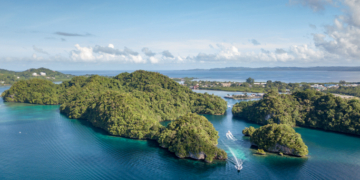




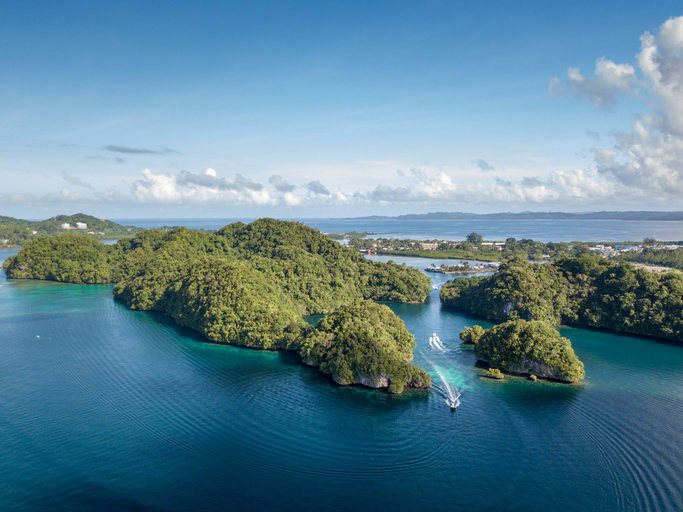
A remote Pacific island nation better known to many Americans as a former backdrop for reality television is stepping into a global immigration spotlight.
According to the New York Post, Palau, a country of roughly 18,000 people east of the Philippines, has agreed to accept up to 75 third-country deportees from the United States who do not have criminal records.
In return, the U.S. government will provide a $7.5 million grant to support public services and infrastructure, officials announced on Christmas Eve.
The agreement was revealed jointly by Palau President Surangel Whipps Jr. and the U.S. Embassy in Koror. Under the deal, deportees whose home countries refuse to take them back — including nations such as China, Cuba, Russia, or Iran — would be allowed to live and work in Palau.
“Palau and the United States signed a Memorandum of Understanding allowing up to 75 third-country nationals, who have never been charged with a crime, to live and work in Palau, helping address local labor shortages in needed occupations,” Whipps said in a statement.
“In connection with this arrangement, the United States granted $7.5 million to help Palau meet related public service and infrastructure needs, while both countries continue close cooperation on immigration and security matters.”
The U.S. Embassy emphasized the immigration enforcement angle of the deal.
“The United States deeply appreciates Palau’s cooperation in enforcing U.S. immigration laws, which remains a top priority for the Trump Administration,” the embassy said.
Beyond the new grant, the Trump administration also agreed to provide $6 million to stabilize Palau’s civil service pension system and another $2 million for new law enforcement initiatives.
The funding adds to a much larger aid package already in place. Under a 20-year agreement brokered by the Biden administration that took effect last year, Palau is set to receive $889 million in U.S. assistance — approximately $44.45 million annually — earmarked for education, healthcare, environmental protection, public safety, and government oversight.
Palau’s ties to the United States run deep. The island chain was captured from Japan during World War II, following the brutal Battle of Peleliu in 1944. In the late 1970s, President Jimmy Carter led the effort to grant Palau independence, a process that culminated in 1994 with the signing of a compact of free association.
Today, Palau uses the U.S. dollar, relies on the U.S. military for defense, and allows its citizens to live and work freely in the United States. English is a co-official language, and the U.S. Postal Service delivers mail.
Heavily dependent on foreign aid — which accounts for about 12% of its GDP — Palau has also received support from Taiwan and Japan. The country gained pop-culture recognition in 2005 as the filming location for the 10th season of “Survivor.”
Palau is not alone in striking such arrangements. Other countries have accepted third-country deportees as part of the Trump administration’s broader push to reduce deportation costs and accelerate removals, with payments varying widely by destination and circumstance.