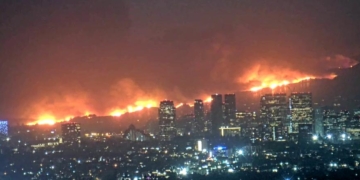





Days before the Palisades Fire in California spiraled out of control, one fire captain refrained from deploying bulldozers due to concerns about “endangered plants” in the region, according to the Los Angeles Times.
The Palisades fires devastated Los Angeles in January, destroying homes and ending a dozen lives. The small Lackman Fire burned through Topanga State Park in California on Jan. 1, and a State Parks employee asked the Los Angeles Fire Department ‘s (LAFD) heavy equipment supervisor Capt. Richard Diede if bulldozers would be dispatched, according to The Times.
“Heck no that area is full of endangered plants,” Diede reportedly replied, five hours after LAFD reported the fire as contained. “I would be a real idiot to ever put a dozer in that area. … I’m so trained.”
The Lachman Fire later rekindled into the massive Palisades blaze on Jan. 7 that burned for 24 days, a multi-agency investigation found.
When reached for comment, the LAFD responded that “At this time, the Los Angeles Fire Department is unable to provide additional substantive comment beyond what has already been made publicly.”
Some locals and policy experts argue California officials paved the way for the ruinous blaze through negligence and stringent environmental regulations. Bulldozing burnable vegetation helps suppress fires, according to the Interior Department, and though California grants exemptions in emergency situations, the state goes to great lengths to shield endangered species and plants.
“Although the LAFD quickly suppressed the Lachman Fire on January 1, unbeknownst to anyone the fire continued to smolder and burn underground, within the root structure of dense
vegetation,” investigators determined, according to the Bureau of Alcohol, Tobacco, Firearms and Explosives (ATF) Special Agent William Schry’s court testimony. “On January 7, heavy winds caused the underground fire to surface and spread above ground in what became the Palisades Fire.”
An arson suspect was arrested in connection with the criminal investigation, Acting U.S. Attorney Bill Essayli announced on Oct. 8.
Several Palisades residents sued the California State Parks in July for allegedly failing to ensure the Lachman Fire was fully extinguished. Attorneys are set to question firefighters in January as to why they did not dispatch bulldozers and halted cleanup the next day, according to The Times.
“State Parks is not a firefighting response agency,” a spokesman for California State Parks told The Times, stating that no one from the agency blocked fire suppression. “When wildfires occur on State Parks property, firefighting response is the responsibility of the appropriate firefighting agency.”
Notably, environmental concerns have stalled wildfire prevention previously, with California Environmental Quality Act (CEQA) reviews reportedly slowing fuel clearing projects ahead of the 2020 Bear Fire that killed 16 people.
After the Los Angeles Department of Water and Power bulldozed some endangered plants in Topanga State Park, the city agreed to pay $1.9 million in fines to cover the damages in 2020. Los Angeles had been updating energy infrastructure to improve resiliency in case of harsh winds or fires, according to The Times.
“We saw this coming, and we have said, ‘I told you so’ every time there’s been a super fire. This time, the super fire happens to be even more catastrophic, because it’s happening in one of the most densely populated areas in the United States,” Edward Ring, director of water and energy policy for the California Policy Center, told the DCNF previously, while the Palisades and Eaton fires ripped through Los Angeles. “It’s the same message, which is that we have neglected our water infrastructure. We have mismanaged our forests and chaparral in the name of environmentalism, and we’re paying the price.”
This story has been updated to include a comment from the LAFD.
All content created by the Daily Caller News Foundation, an independent and nonpartisan newswire service, is available without charge to any legitimate news publisher that can provide a large audience. All republished articles must include our logo, our reporter’s byline and their DCNF affiliation. For any questions about our guidelines or partnering with us, please contact [email protected].