



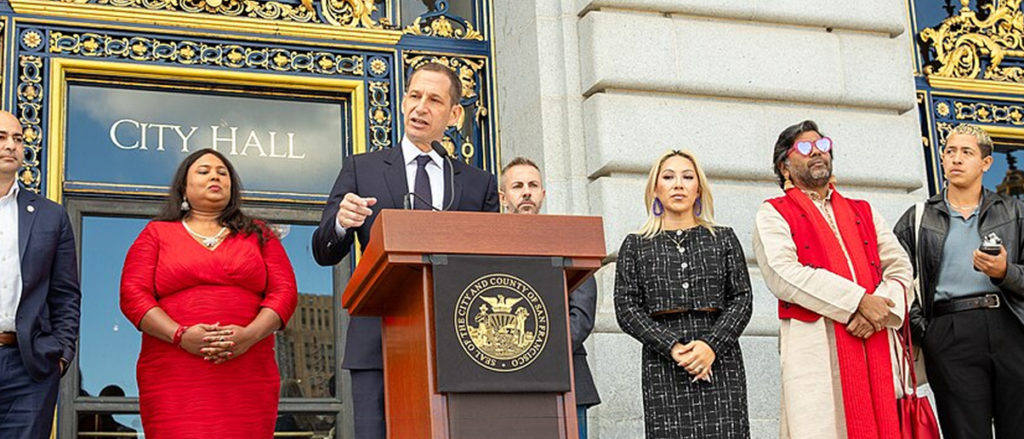

San Francisco Mayor Daniel Lurie quietly signed an ordinance in late December creating a reparations fund that could one day support payouts of up to $5 million per eligible black resident, even as he admitted the city has no money to fund it.
The measure, which passed unanimously through the San Francisco Board of Supervisors in mid-December, establishes a reparations fund tied to the city’s 2023 reparations plan. While the ordinance creates a legal framework to accept private or public contributions, it does not appropriate any funds, guarantee any payments, or identify a funding source.
“As we go through the budget process, we are preparing to close a nearly $1 billion deficit — that means identifying key priorities for funding so we can continue delivering those services well,” Lurie, who signed the bill on Dec. 23, said in a statement, according to ABC 7. “Given these historic fiscal challenges, the city does not have resources to allocate to this fund.”
San Francisco is facing a projected budget deficit of up to $936 million over the next two years as spending continues to outpace revenues in the city of roughly 800,000 residents.
“My administration has regularly supported the use of private funds to support our communities, and if there is private funding that can be legally dedicated to this fund, we stand ready to ensure that funding gets to those who are eligible for it,” Lurie said, according to ABC 7.
The bill was authored by Supervisor Shamann Walton, who described the fund as a step that “moves San Francisco from apology to action.”
“For years, Black San Franciscans have been clear that recognition without resources is not enough. Passing the reparations fund will now allow for individuals, foundations, businesses and communities to donate their own resources towards funding recommendations developed by the African American Reparations Advisory Committee here in San Francisco,” Walton wrote in a statement.
The ordinance is tied to a sweeping reparations plan that outlines more than one hundred recommendations, including income subsidies, debt forgiveness, and up to 250 years of tax abatements for eligible recipients. Such steps would collectively cost the city billions of dollars to implement.
Despite the lack of funding, the new ordinance quickly drew backlash from critics, including Tesla CEO Elon Musk, who called the proposal “deeply morally wrong.”
“California didn’t even have slaves!” Musk wrote on X. “Why is it right for someone who escaped tyranny in other countries and happens to live in SF to pay ‘reparations’ for something they had nothing to do with?”
California didn’t even have slaves!
Why is it right for someone who escaped tyranny in other countries and happens to live in SF to pay “reparations” for something they had nothing to do with?
This is deeply morally wrong. https://t.co/5HYLlTr6PT
— Elon Musk (@elonmusk) January 1, 2026
Others faulted the city for creating a reparations fund in name only.
“Having a fund that remains empty while instituting a ‘long-term’ planning process or continuing to debate the need for reparations is simply more delay and more injustice,” Amos Brown, a former member of the city’s reparations advisory committee, wrote for the San Francisco Chronicle.
Lurie’s office did not respond to the Daily Caller News Foundation’s request for comment.
Other U.S. cities and states have adopted reparations resolutions in recent years, though many have limited their efforts to commissions or studies rather than to direct payments to individuals.
At the state level, Gov. Gavin Newsom signed a bill in October to create the Bureau for Descendants of American Slavery, tasked with implementing reparations policies, and approved funding for the California State University system to research methods for verifying descendants of slaves seeking to access benefits.
All content created by the Daily Caller News Foundation, an independent and nonpartisan newswire service, is available without charge to any legitimate news publisher that can provide a large audience. All republished articles must include our logo, our reporter’s byline and their DCNF affiliation. For any questions about our guidelines or partnering with us, please contact [email protected].