



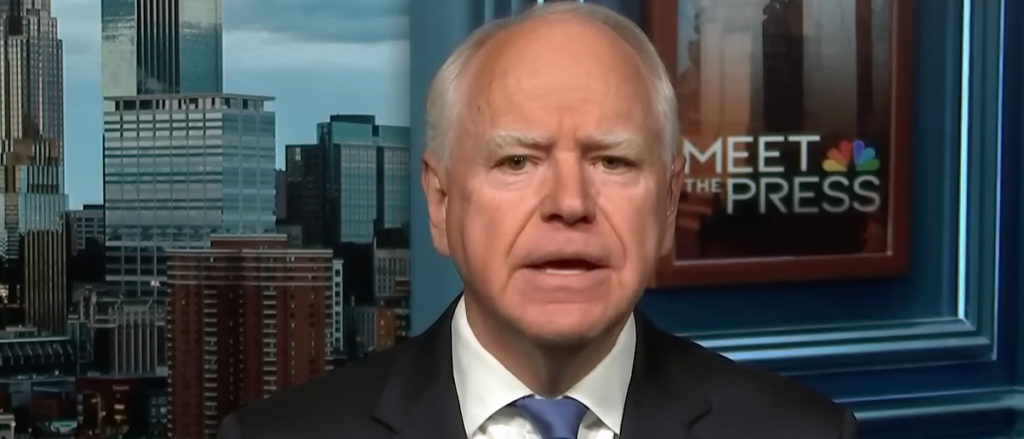

Now that the nation’s attention has turned to Minnesota and its massive welfare fraud – fraud so large (referred to as “industrial-scale” by the assistant U.S. attorney, possibly as much as $9 billion) that Democratic Gov. Tim Walz felt compelled to end his bid for reelection – we should take the opportunity to investigate the possibility of a different kind of fraud, the fraud made possible by Walz’s signature on the so-called “Driver’s Licenses for All” law, which enabled illegal immigrants in Minnesota to receive driver’s licenses from the state.
Let’s be clear about what this policy represents. It’s not compassion. It is not common sense. It is not public safety. It is an open invitation to chaos, fraud, and the further erosion of confidence in our civic institutions.
A driver’s license is not just permission to operate a motor vehicle. In modern America, it is one of the most powerful identity documents a person can possess. It opens doors – literally and figuratively. It allows easier access to banking services, rental agreements, government buildings, employment verification processes, and, yes, in many cases, even voter registration systems. When a state hands out official credentials to individuals who are in the country illegally, it is effectively laundering unlawful status into something that looks legitimate.
Walz and his allies insisted this policy would make roads safe. That claim collapses under even minimal scrutiny. Driving safely depends on focus and awareness, obedience to the rules, and vehicle readiness for the road, not on redefining who is eligible for official identification. Public safety does not require the state to reward illegal behavior with government-issued credentials. On the contrary, it requires the consistent enforcement of the law.
Vehicle crash data from Minnesota strongly support the contention that granting illegal immigrants driver’s licenses, despite Walz’s assertion, does not increase public safety. In 2022, there were 444 traffic fatalities in Minnesota. In 2023, that number fell to 402. But in 2024 – the first full year the new “Driver’s Licenses for All” policy was in effect – the number of traffic fatalities jumped almost 20 percent, to 475.
But the most troubling consequence of this driver’s license policy is not traffic safety. It is the risk it introduces to the integrity of elections and public programs.
Minnesota, like many states, increasingly relies on identity-based systems for voter registration. While supporters of this bill protest that non-citizens are already denied the ability to vote legally, that is not the point. The issue is vulnerability. When you dramatically expand access to state-issued IDs for people whose presence in the country cannot be legally verified, you dramatically expand the opportunity for misuse, error, and fraud.
Confidence in elections depends on safeguards. It depends on citizens believing that only eligible voters are participating and that the system is not being manipulated. Policies like handing out driver’s licenses to illegal immigrants undermine that confidence – not because every recipient will act in bad faith, but because the system is being made more porous by design.
This is not hypothetical. State IDs are routinely used to register to vote. They are used to access absentee ballot processes. Expanding eligibility without corresponding enforcement and verification measures creates risk. Responsible governance requires minimizing risk, not dismissing it – and certainly not enlarging it.
Beyond elections, the policy opens the door to broader identity fraud. A state driver’s license can be used to obtain credit, enter secure buildings, and access public benefits. Once issued, it becomes exceedingly difficult to revoke. When the state blurs the line between lawful residents and those who entered illegally, it creates downstream consequences for taxpayers and communities who are already stretched thin.
This is a pattern we see again and again from progressive leaders: redefine the law to accommodate illegal behavior, then scold anyone who raises concerns as heartless or extreme. But there is nothing heartless about expecting the law to mean what it says, and there is nothing extreme about insisting that citizenship and legal presence still matter.
Americans are a generous people. We welcome legal immigrants who follow the rules, work hard, and contribute to our communities. What we cannot accept is a government that, rather than enforcing the law, finds ways to accommodate those who break it.
Walz’s decision to sign that bill sent exactly the wrong message. It told illegal immigrants that the state government would step in to shield them from the consequences of federal law. It told citizens that their concerns about election integrity and public safety were secondary to ideological virtue-signaling. And it told taxpayers that they would be expected to absorb the costs – financial and civic – of policies they never asked for.
The Tea Party movement was born from a simple conviction: government must be accountable to the people, and the rule of law must apply equally to everyone. Minnesota’s driver’s license policy violates both principles.
If we want a country that works, we must stop pretending that laws are optional and borders are meaningless. Walz may call his driver’s license policy progress. The rest of us know better.
Jenny Beth Martin is Honorary Chairman of Tea Party Patriots Action.
The views and opinions expressed in this commentary are those of the author and do not reflect the official position of the Daily Caller News Foundation.
(Featured Image Media Credit:Screenshot via NBC News/YouTube)
All content created by the Daily Caller News Foundation, an independent and nonpartisan newswire service, is available without charge to any legitimate news publisher that can provide a large audience. All republished articles must include our logo, our reporter’s byline and their DCNF affiliation. For any questions about our guidelines or partnering with us, please contact [email protected].