


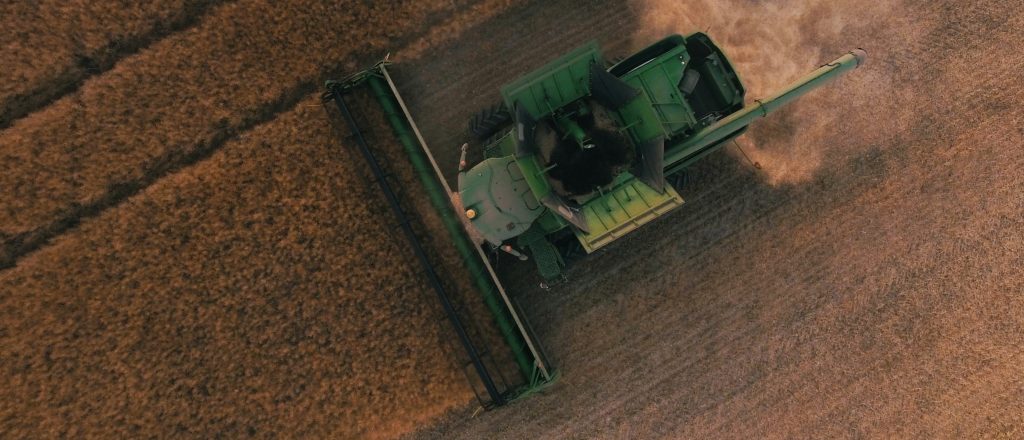
The Environmental Protection Agency (EPA) released guidance Monday for farmers affirming their right to repair their farm and nonroad diesel equipment, aimed at saving them “headaches and costly hassles.”
EPA Administrator Lee Zeldin, Agriculture Secretary Brooke Rollins and Small Business Administrator Kelly Loeffler told reporters Monday that if farmers own their property and nonroad diesel equipment, they have the right to fix it themselves. The guidance clarifies that manufacturers cannot use the Clean Air Act to “justify limiting access to repair tools or software,” the EPA announced Monday.
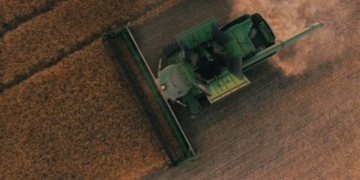
“This clarification applies to all nonroad diesel engines equipped with advanced emission control technologies including selective catalytic reduction and inducement systems as well as Diesel Exhaust Fluid (DEF) system repairs,” the EPA said Monday. Affected equipment includes tractors, excavators, forklifts and other machinery that could be repaired in the field or at a local independent repair shop.
“This might seem like a no brainer, but ask any American farmer, and they will tell you about the headaches and costly hassles that they have been forced to endure at the hands of equipment manufacturers,” Zeldin told reporters on Monday. “Equipment manufacturers have misused the Clean Air Act by falsely claiming that environmental laws prevented them from making essential repair tools or software available to all Americans. … The Clean Air Act was written to ensure clean air for all Americans, not to lock farmers into expensive repairs.”
Loeffler told reporters that “in the aggregate, this is about a $48 billion savings [for American farms.]” Loeffler said the estimate was built farm-by-farm and that the move is estimated to save around $33,000 per repair.
“This should reduce operating costs on the farm by 10 percent annually,” Loeffler said, adding that “this could potentially reach an 80 percent annual reduction in the cost of repairs.”
One North Carolina farmer told a local outlet in December 2023 that restrictions preventing him from repairing his own tractors have had devastating consequences.
Patrick Brown, a fourth-generation farmer, told the outlet that “we have to be able to plant on time, and if we have tractors that are down, that can factor in whether or not we will have a good yield and whether or not we will be able to recover, even if we are able to put the crops in the ground.”
“To have to send it to a retailer to work on it is detrimental to us because we may not even get it back in the time that’s needed,” Brown told the publication. “We don’t even purchase equipment if we can’t fix it, or if it doesn’t offer a warranty where our local dealers can come out to our farm and get it back right.”
Rollins told reporters that “the right to repair isn’t just a slogan — it’s a common-sense extension of the God-given right to private property.”
“Farmers shouldn’t be forced to haul their equipment to specialized and costly repair shops when they could be making those repairs on their own,” Rollins said. “The timely, affordable maintenance of agricultural equipment should not be a luxury. It should be a given.”
The guidance states that “the contents of this document do not have the force and effect of law and are not meant to bind the public in any way. This document is intended only to provide clarity to the public regarding existing requirements under the law or agency policies.”
Zeldin noted that the move is part of the EPA’s mission to power the “Great American Comeback” while safeguarding human health and the environment.
“The Clean Air Act clearly states that farmers and equipment owners are allowed to temporarily override emission systems when it is for the purpose of repair, and as long as the repair returns the equipment to compliance,” Zeldin continued. “Today’s right to repair guidance does not weaken environmental or emission standards. It does not change the law or the Clean Air Act, and it does not reduce compliance obligations.”
All content created by the Daily Caller News Foundation, an independent and nonpartisan newswire service, is available without charge to any legitimate news publisher that can provide a large audience. All republished articles must include our logo, our reporter’s byline and their DCNF affiliation. For any questions about our guidelines or partnering with us, please contact [email protected].