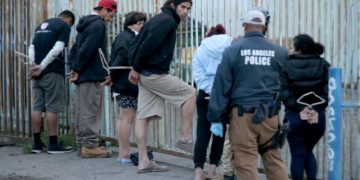




In the shadowy backrooms of vacant commercial buildings and quiet apartments across Los Angeles, a once-unthinkable operational shift is taking place.
According to the New York Post, members of MS-13 and 18th Street—factions that spent decades slaughtering one another in turf wars—are now standing shoulder-to-shoulder, staffing illegal slot machines and counting money.
The driving force behind this truce is the Mexican Mafia, which has effectively ordered a cessation of hostilities to protect the bottom line.
According to police intelligence, these groups have pivoted from tit-for-tat street warfare to a unified “super gang” structure.
The focus is no longer just territory; it is the maximization of profit through narcotics, extortion, and a booming trade in underground casinos known as “casitas.”
Captain Ahmad Zarekani, head of the LAPD Gang and Narcotics Division, notes that the landscape has shifted entirely.
“Gangs that have previous feuds with each other or historically don’t get along are working together,” Zarekani told The Post.
The change is jarring, given the history involved. MS-13 is infamous for the “mountain murders,” where machetes dismembered victims.
Conversely, the 18th Street gang, which evolved into a multinational criminal entity, has a history of executing police officers and torching apartment buildings.
Yet, under the new directive, they function as a corporate entity.
“They’re more organized than at anytime before and now act like business enterprises,” Zarekani said.
This business model is most visible in the casitas. These illegal gambling dens feature a collaborative workforce that defies traditional gang boundaries.
“You’ll have an Avenues gang member doing security, you’ll have an MS-13 guy being the cashier, right, and then you’ll have like a guy, let’s just say 18th Street, picking up the cash,” Detective Hugo Ayon told The Post. “Three different neighborhoods, right? Gangsters, that are all working under this Mexican Mafia.”
Ayon, a veteran with 26 years of experience, said rumors of this “peace treaty” began circulating in 2022, after the pandemic. The message from the top was clear: violence attracts police, and police attention hurts revenue.
“We heard rumors on the street that the Mexican Mafia came out and said, ‘No more street fighting, no more gang banging,’ because it’s impacting the bottom line,” Ayon said. “The practice of going out and hunting down your rivals was outlawed by the Mexican Mafia.”
The alliance now spans 239 miles, stretching from Bakersfield to Chula Vista. With more than 100,000 gang members in Los Angeles alone, law enforcement is struggling to keep pace. The flood of cash has also led to disturbing reports regarding the gangs’ expanding influence.
“We’ve heard more rumors of gangsters now paying off people in government,” Ayon said.
Compounding the issue is a combination of severe staffing shortages and legislative reforms that officers say have removed the consequences for criminal behavior. Former federal prosecutor Neama Rahmani highlighted the disparity created by laws like Proposition 47.
“If you possess cocaine in Las Vegas or even Orange County, they’re going to charge you with a felony,” Rahmani told The Post. “Here, it’s not even charged at all.”
This legal environment has stripped detectives of the leverage needed to flip suspects.
“We’ve had guys in interview rooms tell us, ‘I’m not going to do any time, I’ll be out in a couple days,’” Ayon said.
The reality on the street is grim. During a ride-along near MacArthur Park, open drug use was rampant. For law enforcement, the new alliance between historic enemies, combined with dwindling resources, has created a precarious situation.
“Are we losing the battle? I’d like to think not,” Ayon said. “But we’re barely holding our heads above water, and we’re getting tired.”