



This is the question that has fueled countless essays and debates in recent years as our divides – economic, geographic, and ideological – seem to widen.
To answer that question, America’s leaders would do well to look back 240 years to the 1786 Virginia Statute for Religious Freedom, which we commemorate every Jan. 16 as Religious Freedom Day. Religious freedom is often mischaracterized today as a culture-war flashpoint, but the truth is that the pluralistic religious freedom Jefferson championed still resonates with Americans across the political spectrum today.
Last fall, my team at the Becket Fund for Religious Liberty commissioned its seventh annual Religious Freedom Index, a nationally representative poll of Americans. Year after year, it has revealed broad, bipartisan consensus: support for the right to freely choose and practice one’s religion has consistently hovered over 85% since 2019.
This year’s Index found agreement in surprising places. The questions captured public views on two major Becket victories at the Supreme Court. In Mahmoud v. Taylor, the Supreme Court ruled that a Maryland public school board violated parents’ First Amendment right to direct the religious upbringing of their children when it revoked parental notice and opt-outs for storybooks pushing one-sided gender ideology on pre-kindergartners. Our results show that a majority of Americans, 62%, supported the Court’s decision.
Even stronger consensus emerged around another Supreme Court religious freedom decision this term – Catholic Charities Bureau v. Wisconsin. There, a unanimous Court rejected Wisconsin’s argument that Catholic Charities wasn’t religious. No surprise that argument lost 9-0. The lower court ruled that a Catholic ministry didn’t qualify for a religious tax exemption because it serves all people, regardless of faith, without trying to convert them. Americans supported the Supreme Court’s reversal of this decision by a 30-point margin.
This high support seems, at first glance, to be contrary to the pessimism expressed elsewhere in the survey about society’s acceptance of people of faith. Only 38% of Americans report believing that our society is completely or a good amount accepting of people of faith. Fewer still (31%) report believing that our society is at least a good amount appreciative of the contributions people of faith make to our society.
These numbers may reflect Americans’ belief that the government is treating people of faith unfairly. They have good reasons for thinking so—in Illinois, for example, the federal Department of Health and Human Services (HHS) recently issued a notice against the state for trying to force pro-life doctors and pregnancy centers to refer women for abortions in violation of their religious beliefs. This year’s polling shows that 70% of Americans support freedom for healthcare workers not to participate in abortion procedures, if they have religious objections to them – bad news for Illinois, but very good news for those who want to unite Americans around religious freedom.
The good news in the Index does not stop there. A majority of Americans report that they personally are at least a good amount accepting (73%) and appreciative (53%) of people of faith. And this openness extends beyond people’s own faith groups: strong majorities of non-Catholic Christians and religious non-Christians supported the outcome in Catholic Charities, for example. Clearly, Americans judge society as less accepting than they judge themselves.
Oftentimes news sources and social media algorithms are blamed for dividing Americans into their own social “bubbles,” isolating different groups and feeding them an information diet that furthers their divisions. The good news is that all of us can contribute towards breaking down those barriers.
This year’s Index also found that 42% of Americans (including 46% of Gen Z, the youngest generation) report regularly relying on word of mouth as a source of news. More than podcasting, newspapers, or fancy new AI tools, the stories we tell and share with our friends and family will help heal America’s divisions or widen them.
American leaders can help bridge the gap by both supporting religious freedom and by reminding those they lead that other Americans—by large margins—tend to support religious freedom for Americans of all faiths. Even on supposedly divisive issues such as parental rights, the freedom to believe in traditional marriage, or protecting the confessional seal, Americans rally around the protection of the faithful. Few friendships are won by argument – but by focusing on this area of common agreement, Americans might find that the rifts that divide them are not as insurmountable as they once seemed.
Derringer Dick is a strategic research associate at the Becket Fund for Religious Liberty.
The views and opinions expressed in this commentary are those of the author and do not reflect the official position of the Daily Caller News Foundation.
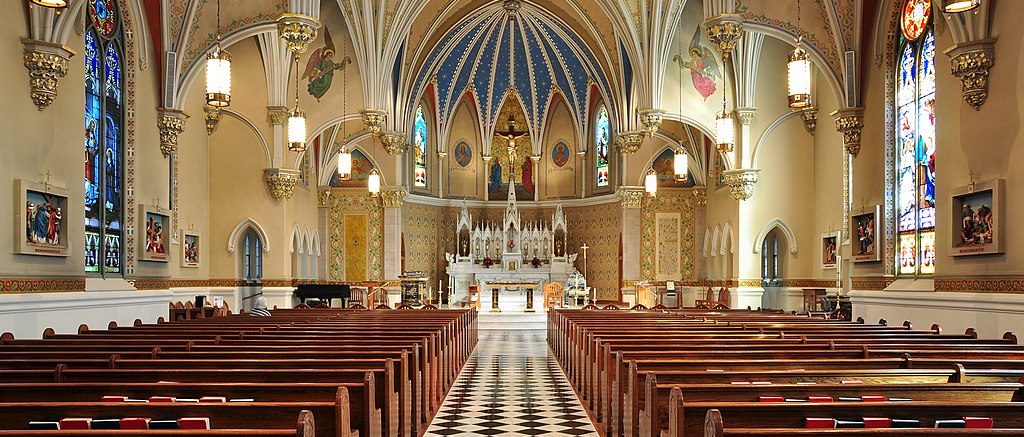
(Featured Image Media Credit: Joe Ravi, CC BY-SA 3.0 <https://creativecommons.org/licenses/by-sa/3.0>, via Wikimedia Commons)
All content created by the Daily Caller News Foundation, an independent and nonpartisan newswire service, is available without charge to any legitimate news publisher that can provide a large audience. All republished articles must include our logo, our reporter’s byline and their DCNF affiliation. For any questions about our guidelines or partnering with us, please contact [email protected].