



Bad Bunny’s Super Bowl halftime show was never going to be just about music. Long before he stepped onto the field, the performance had already become a proxy battle in America’s ongoing culture war — one that increasingly centers on language, national identity, and what it means to be “American” in 2026.
The timing could not have been more pointed. Just days before the game, Florida officially moved to make English the only language permitted for all driver’s license knowledge and skills tests. The Florida Department of Highway Safety and Motor Vehicles framed the change as a matter of safety and clarity, emphasizing that drivers must be able to read road signs, follow instructions, and understand emergency commands. Gov. Ron DeSantis celebrated the move as “common sense,” arguing that a shared language on the roads protects everyone. Lt. Gov. Jay Collins echoed the sentiment, calling it a straightforward step to improve public safety.
That policy shift landed in the middle of a broader national conversation about assimilation versus accommodation — and then came Bad Bunny.
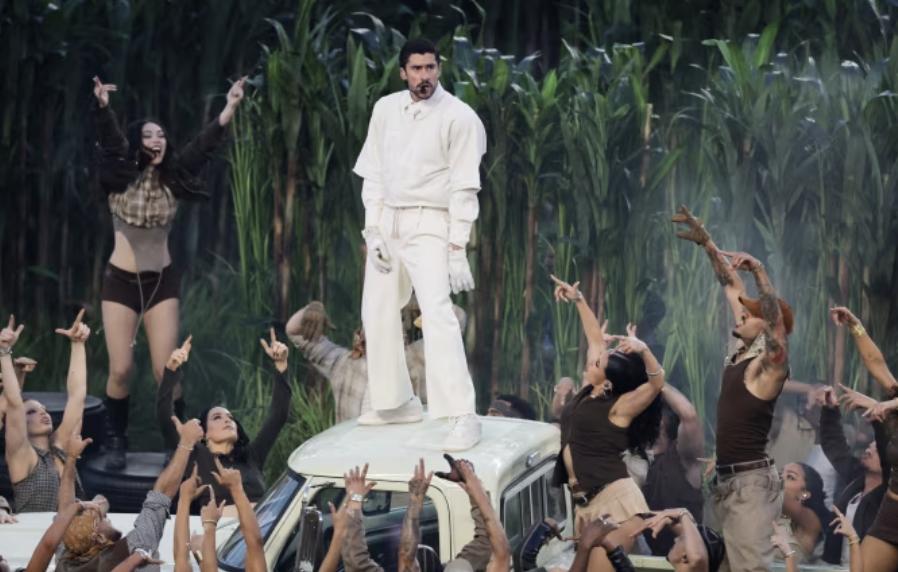
The Puerto Rican superstar delivered the first halftime show in Super Bowl history performed predominantly in Spanish, unapologetically centering Latin culture, history, and grievance. From the sugar cane fields to the bomba drums, from the imagery of laborers fixing power lines to songs warning about Puerto Rico being culturally overwhelmed by outsiders, the message was layered but unmistakable. This was not a neutral celebration. It was a declaration.
Bad Bunny closing out his Super Bowl Halftime performance
“God Bless America: Chile, Argentina, Uruguay, Paraguay, Bolivia, Perú, Ecuador, Brasil, Colombia, […] United States, Canadá, and my motherland, mi barrio, Puerto Rico, seguimo aquí.” pic.twitter.com/cThVRa7u6F
— Modern Notoriety (@ModernNotoriety) February 9, 2026

Bad Bunny’s insistence on Spanish was itself the statement. In an era when states like Florida are asserting that English proficiency is essential for civic participation, Bad Bunny flipped the script on the biggest stage in American sports. He did not translate. He did not apologize. He did not adjust his message for English-speaking comfort. Instead, he made millions of viewers sit with the reality that they were the ones who might not understand.
That tension only sharpened when Bad Bunny briefly switched to English to say “God bless America,” then immediately returned to Spanish, naming countries across the Americas and ending the performance with “We’re still here.” The message was not subtle. America, in his telling, is multilingual, multicultural, and continental — and those who don’t like it can deal with it.
Even the props reinforced the politics. The football he spiked bore the phrase “Together, We Are America,” a slogan that contrasted sharply with policies emphasizing linguistic uniformity. His jersey read “Ocasio,” foregrounding his full Puerto Rican identity, and his song choices referenced power outages, displacement, and cultural erosion. These were not accidental artistic choices. They were political signals embedded in spectacle.
Critics were quick to react. President Trump mocked the performance, saying “Nobody understands a word this guy is saying,” a comment that unintentionally underscored the very divide the show exposed. On the right, Turning Point USA aired an “All-American Halftime Show” featuring Kid Rock and country artists, explicitly marketed as an alternative with “no woke garbage.” Two halftime shows, two visions of the country, airing at the same time.
The NFL having a Super Bowl Halftime Show where their performer sings ENTIRELY in Spanish & waves other nation’s flags, is
% a political statement.
Bad Bunny will go down as the worst halftime show in the history of the league.
America deserved better for its 250th birthday. pic.twitter.com/Glu9BLT5Tp
— Jon Root (@JonnyRoot_) February 9, 2026
 % a political statement.
The Florida language policy and Bad Bunny’s halftime performance are connected by more than coincidence. They represent opposing answers to the same question: should America demand a common language as a prerequisite for participation, or should national identity stretch to accommodate linguistic pluralism even at its most public moments?
Florida’s answer is rooted in function and cohesion — shared language for shared systems. Bad Bunny’s answer is rooted in visibility and resistance — shared space without assimilation. When he performed almost entirely in Spanish at the Super Bowl, it wasn’t just a cultural flex. It was a challenge to the idea that English remains the default price of admission.
That’s why the show felt political even when it was joyful, even when it was celebratory. Language is power. And on Sunday night, Bad Bunny used it to draw a line — not just between cultures, but between competing visions of America itself.
Fox News and The New York Times