




The Trump administration is rapidly approaching a potential military confrontation with Iran that could erupt sooner, and on a larger scale, than many Americans currently expect, sources familiar with the matter told Axios.
U.S. operations would likely involve a multi-week joint campaign with Israel targeting key Iranian nuclear, missile and military infrastructure, Axios reported on Wednesday. With diplomacy stalled and a significant U.S. military presence already in the region, officials warned the coming months could bring the most consequential American military action in the Middle East in more than a decade, according to the outlet.
“The boss is getting fed up. Some people around him warn him against going to war with Iran, but I think there is 90% chance we see kinetic action in the next few weeks,” one Trump adviser told the outlet.
President Donald Trump came close to striking Iran in early January after the regime violently suppressed mass protests. The administration, instead, shifted to a two-track approach of pursuing diplomatic talks while simultaneously building up military forces in the region.
The American military presence in the Middle East has grown dramatically in recent weeks.
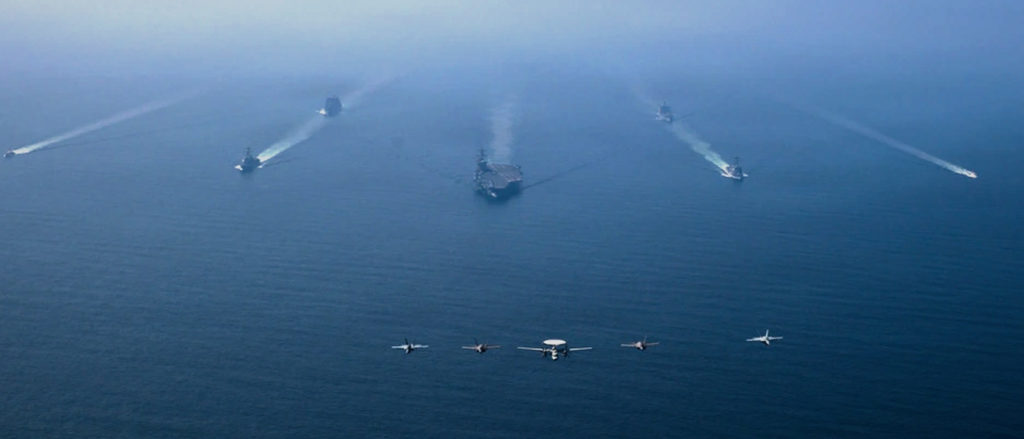
The deployment now includes two aircraft carriers, a dozen major warships, hundreds of fighter jets and multiple air-defense systems, with additional assets still en route. More than 150 cargo flights have delivered weapons and ammunition, and within the past 24 hours, 50 advanced fighters, including F-22s, F-35s and F-16s, were sent to the region, Fox News correspondent Trey Yingst reports.
Some officials expect any conflict to resemble a full-scale war rather than a limited strike, unlike last June’s Israeli-led 12-day campaign, when Trump ordered strikes on key Iranian nuclear sites, the outlet reported. Sources told Axios that the operation could threaten the survival of Iran’s clerical regime.
Despite the escalation, the Trump administration has continued diplomatic efforts, with advisers Jared Kushner and Steve Witkoff meeting in Geneva with Iranian Foreign Minister Abbas Araghchi on Tuesday. While both sides described some progress, U.S. officials acknowledge that the gaps remain wide.
“In some ways it went well, they agreed to meet afterwards, but in other ways it was very clear that the President has set some red lines that the Iranians are not yet willing to actually acknowledge and work through,” Vice President JD Vance told Fox News following negotiations.
Vance said the U.S. would “very much like” to resolve tensions with Iran through “diplomatic negotiation,” but “the president reserves the ability to say when he thinks that diplomacy has reached its natural end.”
“The Iranians said they would come back in the next two weeks with detailed proposals to address some of the open gaps in our positions,” a U.S. official told the Daily Caller News Foundation on Tuesday.
The Israeli government, which is pushing for a broader strike targeting Iran’s nuclear and missile programs, as well as regime change, is preparing for a scenario of war within days, two Israeli officials told the outlet.
Trump on Friday said that “regime change” in Iran “would be the best thing that could happen.” Some of the president’s allies have publicly suggested that strikes on Iran are imminent.
“We’re in the area now where we have got to make some strategic decisions about diplomacy and military action in the coming weeks, not months,” Sen. Lindsey Graham of South Caroline said on Monday, according to the Jerusalem Post.
Tehran, meanwhile, has continued issuing unrestrained threats and provocations against the U.S. and the president.
“The American president claims that their army is the most powerful in the world. Yet it still happens that the world’s most powerful army takes a blow such that it cannot get back up,” Iran’s Supreme Leader Ayatollah Ali Khamenei wrote on X Tuesday, as negotiations were underway.
Le président américain prétend que leur armée est la plus puissante du monde. Il arrive quand-même que l’armée la plus puissante du monde reçoive un coup telle qu’elle ne puisse se relever.
— Ayatollah Khamenei (@fr_Khamenei) February 17, 2026
This week Iran was joined by Russia and China in deploying naval vessels for a joint exercise in the Strait of Hormuz. Tehran also temporarily closed parts of the Strait on Tuesday while the Islamic Revolutionary Guard Corps conducted live-fire drills in the waterway.
At the same time, Iran has taken steps that suggest it is bracing for a confrontation with the U.S.
Satellite imagery shows the country has built a concrete shield over a new facility at a sensitive military site, covered it with soil, and advanced work at locations reportedly bombed by Israel in 2024, according to Reuters. Images also show that Iran has buried tunnel entrances at a nuclear site targeted by U.S. strikes in June, fortified other tunnel entrances, and repaired missile bases hit in the conflict, the outlet reported.
The White House did not immediately respond to the DCNF’s request for comment.
All content created by the Daily Caller News Foundation, an independent and nonpartisan newswire service, is available without charge to any legitimate news publisher that can provide a large audience. All republished articles must include our logo, our reporter’s byline and their DCNF affiliation. For any questions about our guidelines or partnering with us, please contact [email protected].