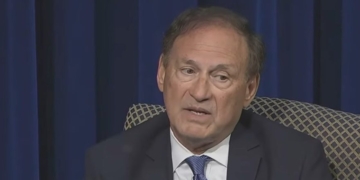






President Donald Trump’s recent mention of Republican Texas Sen. Ted Cruz as a potential Supreme Court nominee as well as current speculation that Justice Samuel Alito may retire this year has renewed focus on when the next Supreme Court vacancy might occur and what it could mean for the Court.
The Supreme Court is often described in terms of its outcomes, but far less attention is paid to the philosophies that produce those outcomes.
Today’s Court operates less like a rigid 6-3 Court with six conservatives and three liberals, and more like a 2-3-1-3 Court. Seen through this structure, the “2” first votes are the most reliably constitutional votes of Justice Clarence Thomas and Justice Alito. Therefore, the replacement of either of these anchor Justices would mark a turning point — one that could reshape the Court and possibly jeopardize the ability of constitutionalists to continue securing major Supreme Court victories on issues central to American justice.
Thomas and Alito consistently exercise a constitutionalist and originalist approach, interpreting the Constitution based on its original public meaning at the time of adoption. The next “3” votes are Justices Brett Kavanaugh, Amy Coney Barrett and Neil Gorsuch. Of course, they are unique, but most often are found between the Thomas/Alito block and the vote of the Chief.
As a group, they have historically not been as reliable as Thomas and Alito when it comes to producing strong constitutionalist rulings. Of note is Gorsuch’s opinion in Bostock v. Clayton County, interpreting discrimination on the basis of sex to include sexual orientation and gender identity, an interpretation not rooted in the text of Title VII. Chief Justice John Roberts often functions as the Court’s sixth vote but at times becomes the fifth “swing vote.” Sometimes he sides with the constitutionalists, and sometimes not. The final “3” votes are Justices Elena Kagan, Sonia Sotomayor and Ketanji Brown Jackson. They form a reliably aligned block focused on an activist approach to the Constitution. They often vote together on major cases with moral, social and/or political impact.
This highlights an issue of vital importance: if one of the two anchor votes of Alito or Thomas were replaced by that of a jurist with a less reliably constitutionalist philosophy (perhaps like that of Roberts), the Court’s entire voting breakdown could shift. That would leave the fifth constitutionalist vote resting on either Justice Roberts or the new justice voting in a way that aligns with constitutionalist reasoning — a serious gamble.
The next Supreme Court justice must have the proper judicial philosophy, courage and conviction to make rigorously constitutionalist rulings rooted in the text. Otherwise, we as constitutionalists will find it much harder to win cases of true principle at the Supreme Court.
Over the last 50 years, the constitutionalist camp has gotten Supreme Court nominations right about 50 percent of the time, or in other words, wrong about 50 percent of the time. That is not an impressive track record. In order to improve that record, we must utilize a different approach than has been applied in the past. With a Republican President and U.S. Senate, the stakes are apparent, and the responsibility is clear. The next Supreme Court nominee must be a person who is proven to be grounded in the strongest constitutionalist principles — one who consciously and carefully rules in accordance with the text, resists the allure of judicial activism, and respects the limits of his or her judicial role.
Viewed through the lens of its 2-3-1-3 structure, it is evident that the Court’s next vacancy is not about putting a “Republican” on the court — but about filling a seat that could redefine the Supreme Court and, thereby, the nation, for a generation to come.
Walker Wildmon serves as the Chief Executive Officer and a Member of the Board of Directors for AFA Action, the 501(c)(4) governmental affairs affiliate of American Family Association (AFA). He is also the Vice President of the American Family Association.
The views and opinions expressed in this commentary are those of the author and do not reflect the official position of the Daily Caller News Foundation.
(Featured Image Media Credit: Screen Capture/CSPAN)
All content created by the Daily Caller News Foundation, an independent and nonpartisan newswire service, is available without charge to any legitimate news publisher that can provide a large audience. All republished articles must include our logo, our reporter’s byline and their DCNF affiliation. For any questions about our guidelines or partnering with us, please contact [email protected].