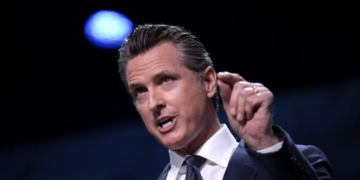




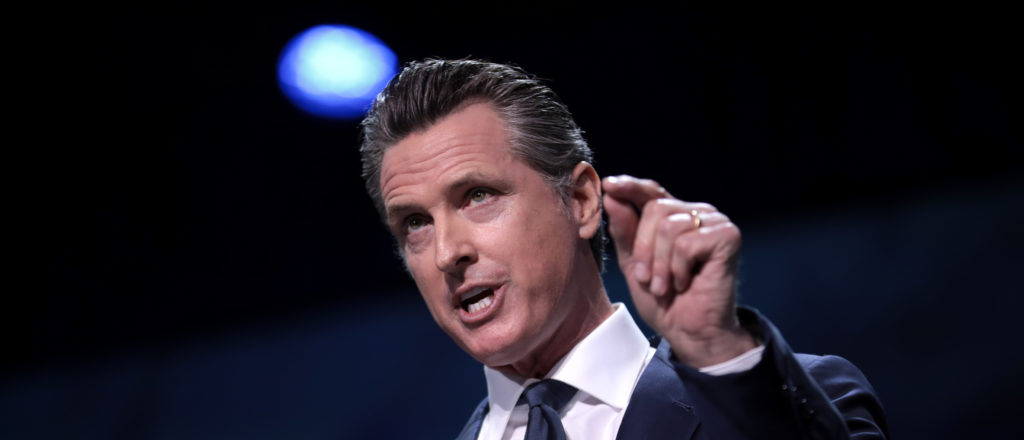
Democratic California Gov. Gavin Newsom appointed former California Public Utilities Commissioner John Reynolds, who appears to have deep industry entanglements from previous roles, as the group’s new president.
The CPUC, originally established in 1911 as the Railroad Commission, is an independent state regulatory agency that oversees investor-owned public utilities and certain transportation services. In a press release from his office, Newsom announced Wednesday that he is appointing Reynolds to the top position, aligning with the governor’s agenda to “deliver 100 percent clean electricity by 2045, combat energy costs, modernize our electricity delivery system, and protect families and businesses from growing impacts of extreme heat and catastrophic wildfires.”
“In his new role, Reynolds will work to lower utility bills and make sure wildfire safety spending makes communities safer—from burying power lines to stronger poles and clearing brush. He will build on the progress already underway: with a new law signed by Governor Newsom last summer, California families will receive up to $60 billion in electricity bill refunds through 2045,” the press release states.
Reynolds was first appointed as a CPUC commissioner by Newsom in December 2021 and later reappointed in December 2022. Prior to his leading role, he had been serving in various roles at the CPUC such as public utilities counsel, advisor to the commissioner and interim chief of staff.
Reynolds also served for nearly three years as managing counsel at Cruise LLC, a General Motors’ autonomous vehicle subsidiary. Cruise is known for developing and deploying self-driving robotaxis.
While working for Cruise, Reynolds dealt with state agencies regarding permits to test and operate autonomous vehicles on public roads. Reynolds was already involved with the CPUC in 2023 when the commission was reviewing permits for Cruise and Waymo.
Despite warnings from San Francisco officials about safety concerns that the autonomous vehicles had reportedly been glitching, blocking traffic and interfering with emergency responders, San Francisco Board of Supervisors President Aaron Peskin urged Reynolds to recuse himself from the CPUC’s vote on Cruise due to his ties.
With the vote delayed twice amid outcry, the CPUC pushed back against the criticisms, stating Reynolds was permitted to vote and had already planned to. By August 2023, the CPUC voted 3-1 to approve the expansions, with Reynolds voting yes as he stated that the AVs had “potential to increase safety.”
Shortly after the approval, a Cruise robotaxi hit a pedestrian in San Francisco who had first been struck by a human-driven car, dragging her 20 feet while attempting to pull over. The viral incident caused CPUC to yank Cruise’s permit statewide, with the company pausing all operations nationwide, executives being dismissed and eventually facing lawsuits.
At the time of the incident, the International Brotherhood of Teamsters, one of the largest labor unions in the United States and Canada, released a scathing press release calling for Reynolds to step down immediately.
“The Cruise fiasco is what happens when you let big business regulate itself,” Teamsters Western Region International Vice President and Secretary-Treasurer of Local 399 Lindsay Dougherty said at the time.
“I doubt Californians would be happy with attorneys from Big Tobacco running the Dept. of Public Health or attorneys from Big Oil running CalEPA,” Dougherty added. “Big Tech shouldn’t be an exception. John Reynolds never should have been at the CPUC to begin with, and the Teamsters demand he step down immediately.”
Despite the backlash, there was no formal probe into the incident nor did Reynolds step down.
In addition to his Cruise connection, Reynolds worked as an associate for de la Peña & Holiday LLP between March 2012 and December 2012, according to his LinkedIn profile. The firm represents clients in the energy industry.
The alleged revolving door between the energy industry and the CPUC has drawn criticism, with nonprofit watchdog Food & Water Watch releasing a report in November 2024 highlighting the commission’s ties to energy giants in the state.
Former CPUC Commissioner Carla Peterman, who served from 2015 to 2018 and notably retained Reynolds as an advisor during that time, later joined PG&E. According to the Food & Water Watch report, Peterman received a $290,000 cash bonus, a $270,000 stock bonus, and a $560,000 base salary.
In 2023, PG&E reported spending $3.1 million lobbying the state government, including the Legislature and agencies such as the CPUC. By 2024, the company spent about $3 million total. As of 2025’s report, PG&E’s lobbying activity jumped to an estimated $4.7 million in general spending, disbursing a little over $2 million alone within their third quarter.
Among its primary advocacy efforts, PG&E lobbied on issues like wildfire mitigation. For example, the company successfully lobbied against Senate Bill 1003 — which would have required utilities to prove wildfire safety spending was prudent and cost-effective before passing costs to customers.
Between 2019 and 2024, PG&E customers have seen rates grow an estimated 48%, outpacing inflation, but reportedly decreasing 16% between 2024 and 2026, according to Ava Energy.
The spike was seen as the CPUC authorized the three major investor-owned utilities, including PG&E, to collect about $27 billion from ratepayers for wildfire prevention and insurance. The commission has also allowed PG&E to recover billions more for wildfire mitigation and catastrophic events, as well as multi-billions in general rate requests.
Notably, PG&E pleaded guilty for the disastrous 2018 Camp Fire, in which 85 people died.
Sempra, parent of San Diego Gas & Electric (SDG&E) and SoCalGas, has also been called out for its ties to the CPUC.
In 2023, Sempra spent an estimated $1.5 million on lobbying in California, including CPUC efforts, rising slightly to $1.6 million in 2024 amid $891 million in SDG&E profits.
The company lobbied the CPUC and Legislature on rate increases and wildfire issues, including pushing for $475 million more from customers and fighting rules that would prohibit charging customers for the company’s own ads or lobbying costs.
Reports from SDG&E about system-average spikes in electric delivery rates show an increase of about 7.4%, while total bundled rates additionally increased by 10.2% in relation to current rates. In January, the CPUC approved that there will be an additional $5 uptick per month for the next three years to write off past wildfire risk reduction spending from 2019 to 2022.
Reynolds did not respond to the Daily Caller News Foundation’s request for comment.
All content created by the Daily Caller News Foundation, an independent and nonpartisan newswire service, is available without charge to any legitimate news publisher that can provide a large audience. All republished articles must include our logo, our reporter’s byline and their DCNF affiliation. For any questions about our guidelines or partnering with us, please contact [email protected].