



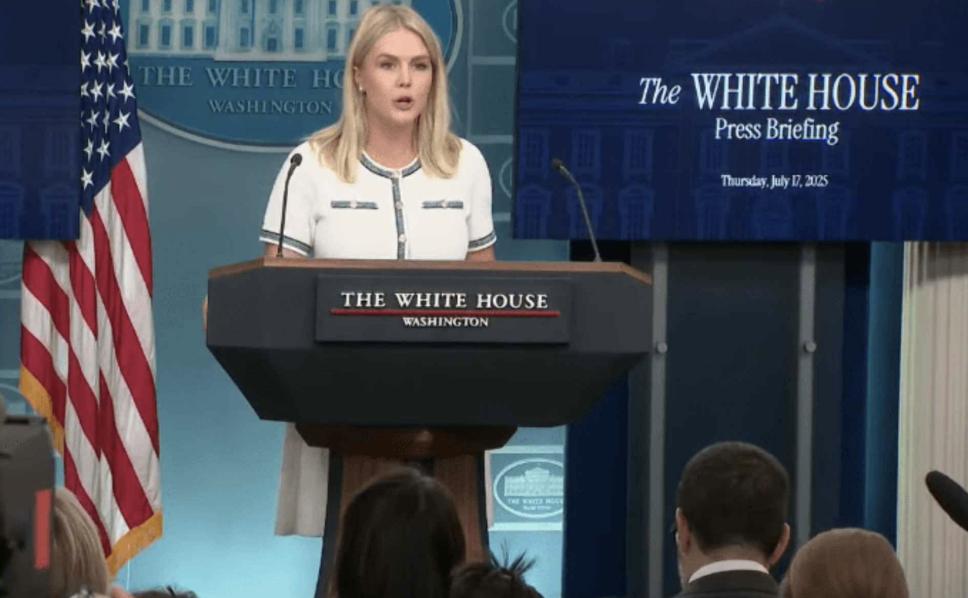
White House press secretary Karoline Leavitt did not hide her disbelief Wednesday when CBS News correspondent Ed O’Keefe pressed her for examples of when President Donald Trump had been “falsely” accused of racism.
The exchange came after Trump released a statement marking the death of civil rights activist Jesse Jackson. In that statement, the president said he had been “falsely and consistently called a racist by the scoundrels and lunatics on the radical left, Democrats all,” while noting it had “always [been his] pleasure to help Jesse along the way.”
O’Keefe zeroed in on that line during the briefing.
“Where or when does the president believe he’s been falsely called racist?” he asked.
Leavitt appeared taken aback.
“You’re kidding, right?” she responded. “I will pull you a plethora of examples. I’m going to get my team in that room to start going through the internet of radical Democrats throughout the years and who have accused this president falsely of being a racist. And I’m sure there’s many people in this room and on network television across the country who have accused him of the same. In fact, I know that because I’ve seen it with my own eyes.”
Her response set the tone for what has been a recurring political battle dating back to Trump’s first presidential campaign.
CBS just got EMBARRASSED in the White House briefing room.
Karoline Leavitt laughs in his face: “You’re kidding, right?”
Then promises to drop a PLETHORA of examples—including his OWN old tweet calling Trump’s posts racist.
This is peak fake news hypocrisy.
RT if you’re sick… pic.twitter.com/yLjrtPZFYUShould there be examples provided of Trump being wrongly accused of racism?— Shira Wiggles (@ImperfectEngel) February 20, 2026

When Trump launched his 2015 bid for the White House, critics accused him of targeting Mexicans with racist rhetoric after he said some illegal immigrants were rapists. During the 2016 race, then-Democratic nominee Hillary Clinton accused Trump of “peddling bigotry and prejudice and paranoia.”
The accusations continued following the 2017 riot in Charlottesville, Virginia. Democrats argued that Trump encouraged white supremacy through his remarks after the rally. Trump stated at the time that while there were “very fine people” present, neo-Nazis and white nationalists should be “condemned totally.”
During the 2020 Democratic presidential primary, several candidates escalated their rhetoric. Sen. Elizabeth Warren, Sen. Bernie Sanders, and former Rep. Beto O’Rourke each labeled Trump a “white supremacist” during the campaign.
Media criticism also intensified over the years. In 2018, Trump faced backlash after reportedly referring to African nations as “shithole countries.” More recently, controversy erupted over an artificial intelligence-generated video posted on Truth Social depicting former President Barack Obama and former first lady Michelle Obama as apes, along with other Democrats portrayed as jungle animals, while Trump was represented as a lion.
In August 2024, MSNBC host Lawrence O’Donnell described Trump as the “most racist” occupant of the White House who did not own slaves.
The comparisons extended beyond rhetoric. During the 2024 election cycle, former Vice President Kamala Harris’ campaign and several media figures compared Trump’s Madison Square Garden rally to the infamous 1939 Nazi rally held at the same venue.
Leavitt’s sharp pushback highlights the ongoing clash between the Trump administration and members of the press over how the president’s words and actions are characterized. As the 2026 political landscape continues to take shape, the debate over Trump’s record — and the language used to describe it — shows no signs of cooling down.












