



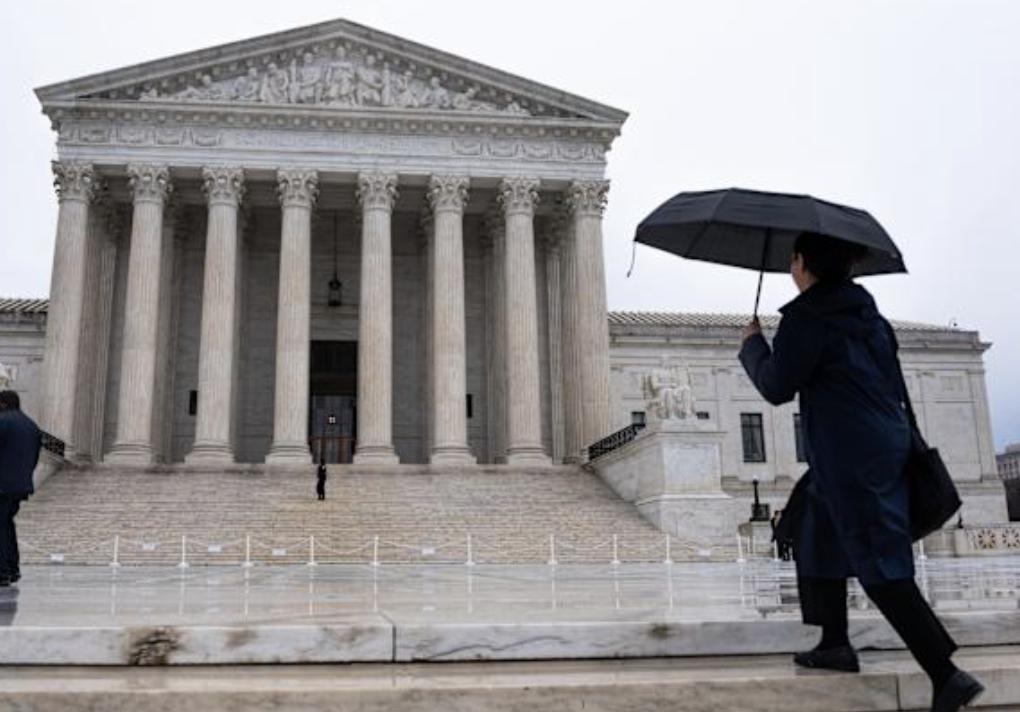
The Supreme Court delivered a major blow to President Donald Trump’s sweeping tariff strategy Friday morning, ruling 6–3 that he overstepped his authority under a decades-old emergency law. But Justice Clarence Thomas was not having it.
In a forceful dissent that cut straight to the constitutional core, Thomas accused the majority of fundamentally misreading both the governing statute and the separation of powers.
“As (Kavanaugh) explains, the Court’s decision … cannot be justified as a matter of statutory interpretation. Congress authorized the President to ‘regulate … importation,’” Thomas wrote. “Throughout American history, the authority to ‘regulate importation’ has been understood to include the authority to impose duties on imports.”
The case centered on Trump’s use of the International Emergency Economic Powers Act (IEEPA), a 1977 law that allows a president, after declaring a national emergency tied to foreign threats, to regulate or block economic transactions. Trump invoked the statute to impose sweeping tariffs on trading partners as part of his broader effort to revive American manufacturing, boost jobs, and rebalance trade.
The Court’s majority disagreed. Chief Justice John Roberts, writing for the Court, said the president was asserting “extraordinary power to unilaterally impose tariffs of unlimited amount, duration, and scope.” In light of that sweeping claim, Roberts wrote, the president needed “clear congressional authorization” — something the majority concluded Congress did not provide in IEEPA.
The ruling declared that even after a national emergency is declared, IEEPA does not authorize the president to impose tariffs. According to the majority, Congress did not clearly transfer its core tariff-and-tax authority to the executive branch.
Thomas, joined by Justices Samuel Alito and Brett Kavanaugh in dissent, saw it very differently.
He argued that the nondelegation doctrine — which limits Congress from handing off its core legislative powers — is far narrower than the majority implied. In his view, Congress crosses a constitutional line only when it delegates “core” powers that trigger deprivations of “life, liberty, or property.” Delegating authority over foreign trade, including tariffs, does not meet that threshold.
“As I suggested over a decade ago, the nondelegation doctrine does not apply to ‘a delegation of power to make rules governing private conduct in the area of foreign trade,’ including rules imposing duties on imports,” Thomas wrote. He added bluntly that the Court’s reliance on separation of powers principles was “mistaken.”
Thomas also reached back into history, pointing to President Richard Nixon’s 1971 across-the-board 10 percent import surcharge. That move was upheld in United States v. Yoshida International under the Trading with the Enemy Act — IEEPA’s predecessor — using nearly identical “regulate … importation” language.
“The meaning of that phrase was beyond doubt by the time that Congress enacted this statute,” Thomas wrote, noting that Nixon’s tariff authority had already been upheld when lawmakers passed IEEPA.
For Thomas, the conclusion was clear: the statute authorized Trump’s tariffs. The Court, he said, simply got it wrong.
Trump responded swiftly. Speaking after the ruling, he emphasized that the Court did not eliminate tariffs altogether, but only rejected this particular use of IEEPA. He announced a new 10 percent global tariff and maintained that without tariffs, “this country would be in such trouble right now.”
The decision marks a pivotal test of executive power — and a sharp constitutional divide within the Court itself. With three justices warning that the majority misread both statute and history, the fight over presidential trade authority is far from over.
The post Clarence Thomas Comments On Recent Supreme Court Ruling appeared first on Red Right Patriot.