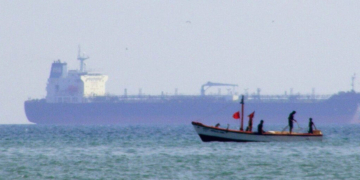




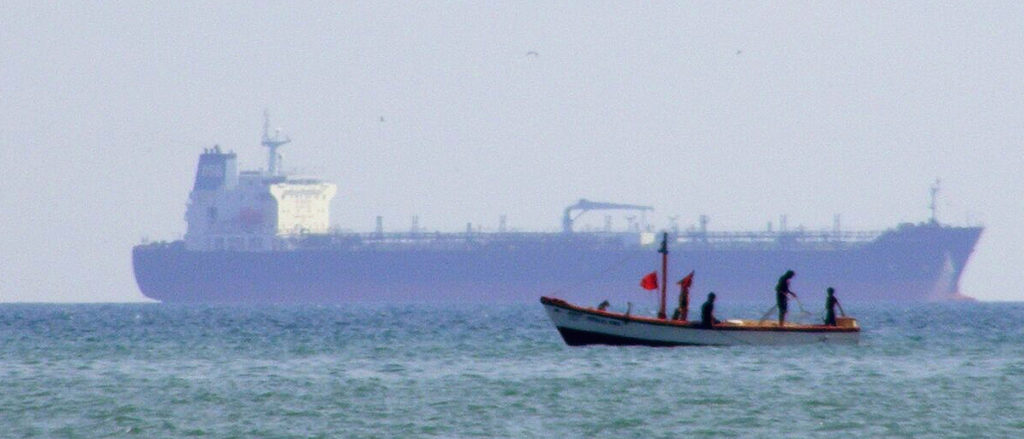
Two Chinese oil tankers appeared to traverse the Strait of Hormuz on Tuesday, though one of them stopped and turned around after crossing the strait.
Tankers have already crossed the strait, including two Chinese-owned vessels: Rich Starry and Murlikishan, according to marinetraffic.com. The tankers weren’t violating the rules of the U.S. blockade, as they did not come from an Iranian port, according to a statement made by U.S. Central Command on X, but the post didn’t say whether sanctioned ships would be stopped.
The Rich Starry dropped anchor after clearing the strait and turned to head back toward the strait, as of this writing, according to data from marinetraffic.com. It is unclear whether the U.S. Navy would allow the Rich Starry, which is owned by a Chinese company that is sanctioned by the U.S. Treasury Department, to proceed.
Rich Starry is ownedby Shanghai Xuanrun Shipping Co Ltd, which is both a debarred entity and a sanctioned entity, according to information from MagicPort. Specifically, the company is subject to the Iran-focused sanctions imposed by the U.S. Treasury Department’s Office of Foreign Assets Control under Executive Order 13949.
The Murlikishan successfully crossed the strait and is now moving inside the Persian Gulf at the time of this publication, according to marinetraffic.com.
Another vessel, the Elpis, visited the Iranian port of Bushehr, and is beholden to the U.S. blockade. The Elpis, sailing under the flag of Comoros, dropped anchor in the Gulf of Oman, according to data from marinetraffic.com.
“No ships made it past the U.S. blockade,” according to a X post that U.S. CENTCOM referred the Daily Caller News Foundation to when asked about the Chinese vessels crossing the strait. However, the post later concedes that “U.S. forces are supporting freedom of navigation for vessels transiting the Strait of Hormuz to and from non-Iranian ports.”
“The Strait of Hormuz is an important international trade route for goods and energy. Keeping the area safe and stable and ensuring unimpeded passage serves the common interest of the international community,” Chinese Foreign Ministry Spokesperson Guo Jiakun said during a press conference on Monday. “The root cause of the disruption at the Strait of Hormuz is the military conflict. To solve the issue, the conflict must stop as soon as possible.”
More than 10,000 U.S. Sailors, Marines, and Airmen along with over a dozen warships and dozens of aircraft are executing the mission to blockade ships entering and departing Iranian ports. During the first 24 hours, no ships made it past the U.S. blockade and 6 merchant vessels… pic.twitter.com/dpWAAknzQp
Should the U.S. take action against Chinese ships near the Hormuz Strait?— U.S. Central Command (@CENTCOM) April 14, 2026
Rich Starry and Murlikishan are both chemical-oil product tankers, according to information available at vesselfinder. These vessels frequently visit China to unload their cargo, according to open source information found on Magicport.ai.
The U.S. blockade requires that all vessels not go to or from Iranian ports, while the Iranian blockade requires that vessels obtain approval from the Iranian regime before crossing the strait.
Although the vessels are Chinese-owned, they are operated under the flags of foreign nations. Rich Starry is currently sailing under the flag of Malawi, and Murlikishan is currently sailing under the flag of Madagascar, according to vesselfinder.com. Registering shipping vessels under the flags of other nations is not uncommon for the shipping industry.
To bypass the United States blockade, vessels must not have a port of call in an Iranian port, according to a US CENTCOM press release. To bypass the Iranian blockade, vessels must pay a toll in Chinese Yuan and receive approval from the Iranian regime, according to reporting by Bloomberg.
China was reportedly preparing to send air defense systems to Iran, according to information that anonymous sources provided to CNN.
All content created by the Daily Caller News Foundation, an independent and nonpartisan newswire service, is available without charge to any legitimate news publisher that can provide a large audience. All republished articles must include our logo, our reporter’s byline and their DCNF affiliation. For any questions about our guidelines or partnering with us, please contact [email protected].