



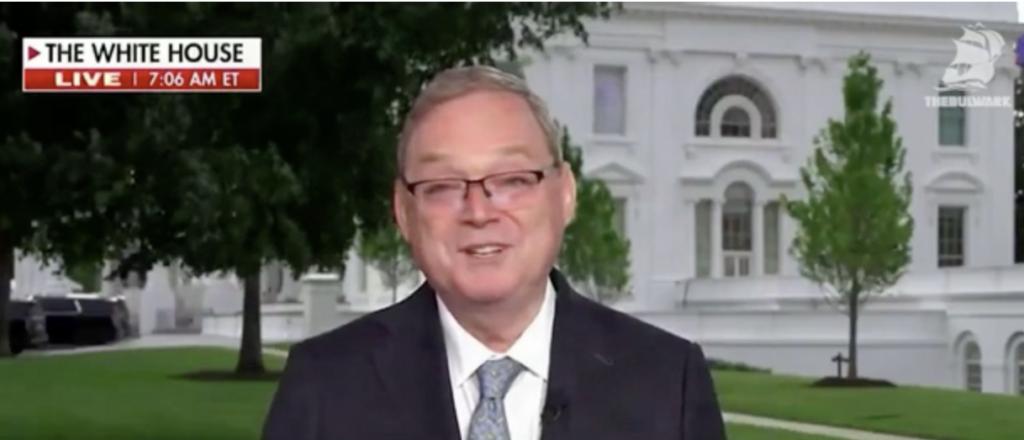
National Economic Council Director Kevin Hassett on Wednesday touted that Americans were relying more heavily on credit cards while the Iran war makes everyday goods more expensive.
Hassett said on Fox Business’ “Mornings with Maria” that Americans were spending more on goods with credit cards despite prices soaring since the beginning of the Iran war. The consumer price index (CPI) spiked 0.9% in March, pushing the annual inflation rate to 3.3%, largely due to the increase in energy prices as a result of the blockade on the Strait of Hormuz.
“The consumer is really, really firing in all cylinders just like the corporate sector you’re seeing in the earnings reports and they’re doing that because they have so much more money in their pockets. In fact, I had the head of one of the big five banks in my office yesterday going through the credit card data and Secretary Bessent said credit card spending is through the roof. They’re spending more on gasoline, but they’re spending more on everything else too.”
WATCH:
The total credit card debt in the U.S. stood at over $1.2 trillion in the fourth quarter of 2025, according to data from the New York Federal Reserve Bank. In that same timeframe, 7.13% of cardholders were overdue by 90 days or more. Total household debt increased 1% to $18.8 trillion in the fourth quarter of 2025, according to the New York Fed.
The average credit card rate was 25.29% as of Monday, according to Forbes. President Donald Trump previously floated capping credit card interest rates at 10% for one year, though he received pushback from banks and credit card companies.
As of Wednesday, gasoline prices in the U.S. surged roughly 50% to 52% since the conflict began on Feb. 28. The average price of regular gas rose from $3.15 to $4.53 in just one year, while the price of diesel surged from $3.54 to $5.67, according to AAA.
The naval blockade of the strait caused consumers to pay more for products such as fertilizer, steel, oil, sulfur and more. The rising costs of fertilizer forced Americans to spend their disposable income on food, while experts previously told the Daily Caller News Foundation that the rise in oil prices could be permanent.
Business leaders and market analysts found that consumers were growing concerned with the economy, rising costs and rising mortgage rates. Global business sentiment turned bleak since the conflict began, as higher energy prices and lower stock prices were “weighing on [their] confidence.”
Trump said on April 23 that Americans should expect gas prices to be higher “for a little while” while the U.S. remained involved in the conflict. During the 2024 election, voters largely entrusted Trump over former Vice President Kamala Harris to handle the economy by lowering the price of gas and other essentials.
Several polls showed Trump’s approval ratings on the economy are at second-term lows. A Washington Post-ABC News-Ipsos poll found Trump’s disapproval rating was a record-high 62% Monday, and 66% of Americans disapproved of Trump’s actions on the Iran war.
All content created by the Daily Caller News Foundation, an independent and nonpartisan newswire service, is available without charge to any legitimate news publisher that can provide a large audience. All republished articles must include our logo, our reporter’s byline and their DCNF affiliation. For any questions about our guidelines or partnering with us, please contact [email protected].